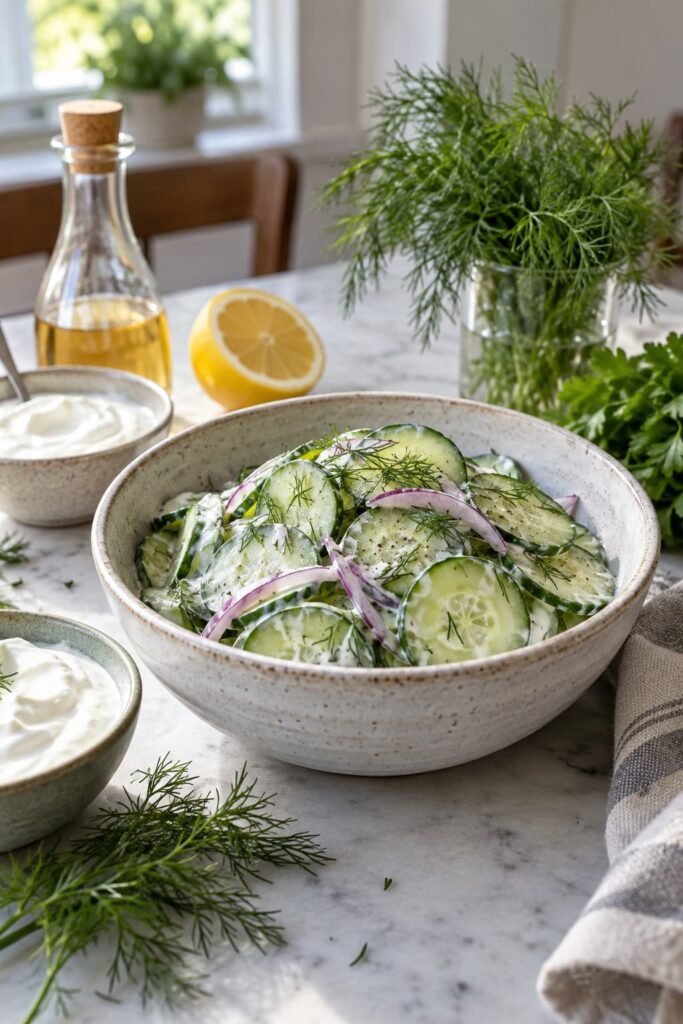
Keto cucumber salad generally refers to a cucumber-based salad prepared with carbohydrate intake in mind. It may use a creamy dressing made with sour cream, mayonnaise, or plain Greek yogurt, or a lighter dressing based on vinegar, lemon juice, oil, herbs, and seasonings.
There is no single formula that defines every version. The carbohydrate content depends on the ingredients, their amounts, and the serving size. A salad containing added sugar, sweetened yogurt, or a prepared dressing may have a different carbohydrate profile from one made with unsweetened alternatives.
What Is Keto Cucumber Salad?
Keto cucumber salad is a broad style of cucumber salad rather than one standardized recipe.
Cucumber forms the base, while the dressing and additions determine the particular style. Creamy versions commonly use sour cream, mayonnaise, or plain Greek yogurt. Other versions rely more on vinegar, lemon juice, oil, herbs, and seasonings.
The word “keto” alone does not establish the carbohydrate content of a finished salad. The complete ingredient list, quantities, and serving size need to be considered when carbohydrate intake is being tracked.
What Ingredients Are Commonly Used?
The ingredients depend mainly on the type of dressing and the flavor profile being created.
Cucumbers
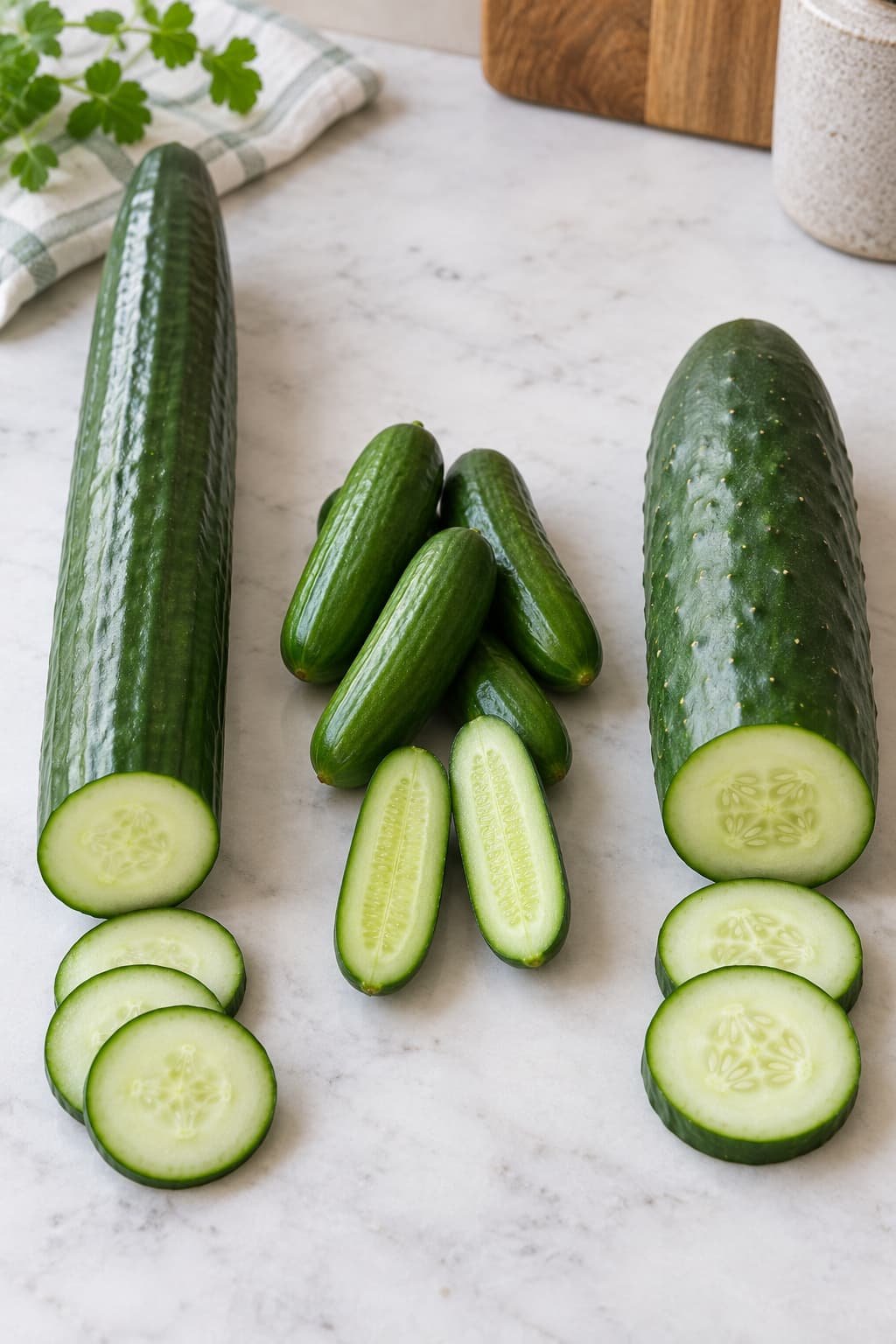
English, Persian, and standard slicing cucumbers can all be used.
English cucumbers are generally long and have relatively thin skin and soft seeds. Persian cucumbers are smaller and also have relatively thin skin. Standard slicing cucumbers commonly have larger seeds and may be sold with waxed skin.
These differences can affect preparation and eating texture, but no single cucumber variety is required.
Peeling and seed removal are preparation choices. They may be more useful with cucumbers that have thicker skin or larger seeds.
Creamy Dressing Ingredients
Sour cream, mayonnaise, and plain Greek yogurt are common creamy bases.
Sour cream provides a different flavor and consistency from mayonnaise, while Greek yogurt has its own texture and nutrition profile. These ingredients should not be treated as nutritionally identical.
Packaged products can also vary from one brand or formulation to another. When carbohydrate or added-sugar content matters, the specific Nutrition Facts label is more useful than relying on the ingredient name alone.
Vinegar, Lemon Juice, and Oil
A cucumber salad does not need a creamy dressing.
Vinegar can provide the main acidity in a lighter version. White vinegar, apple cider vinegar, and wine vinegars have different flavor profiles.
Lemon juice may also provide acidity, while oil can be combined with vinegar or lemon juice as part of the dressing. There is no universal oil-to-acid ratio that applies to every cucumber salad.
Some dressings contain added sugar and others do not. For packaged foods, FDA Nutrition Facts information identifies serving size, total carbohydrate, and applicable added-sugar information.
Herbs, Onion, and Seasonings
Dill is commonly paired with cucumber, while chives and parsley are other possible herb additions.
Red onion, green onion, or shallot may also be included for additional flavor and texture. Onion contributes carbohydrate, so the amount used becomes part of the nutrition of the finished salad.
Salt and black pepper are common seasonings. Salt can also encourage moisture to leave cucumber tissue, which is relevant when considering a watery dressing. Oregon State University Extension describes concentrated salt brine as drawing liquid from cucumbers in food-preservation guidance.
That evidence supports the general moisture explanation; it does not establish a specific salting time or salt quantity for fresh cucumber salad.
Creamy vs Vinegar-Style Cucumber Salad
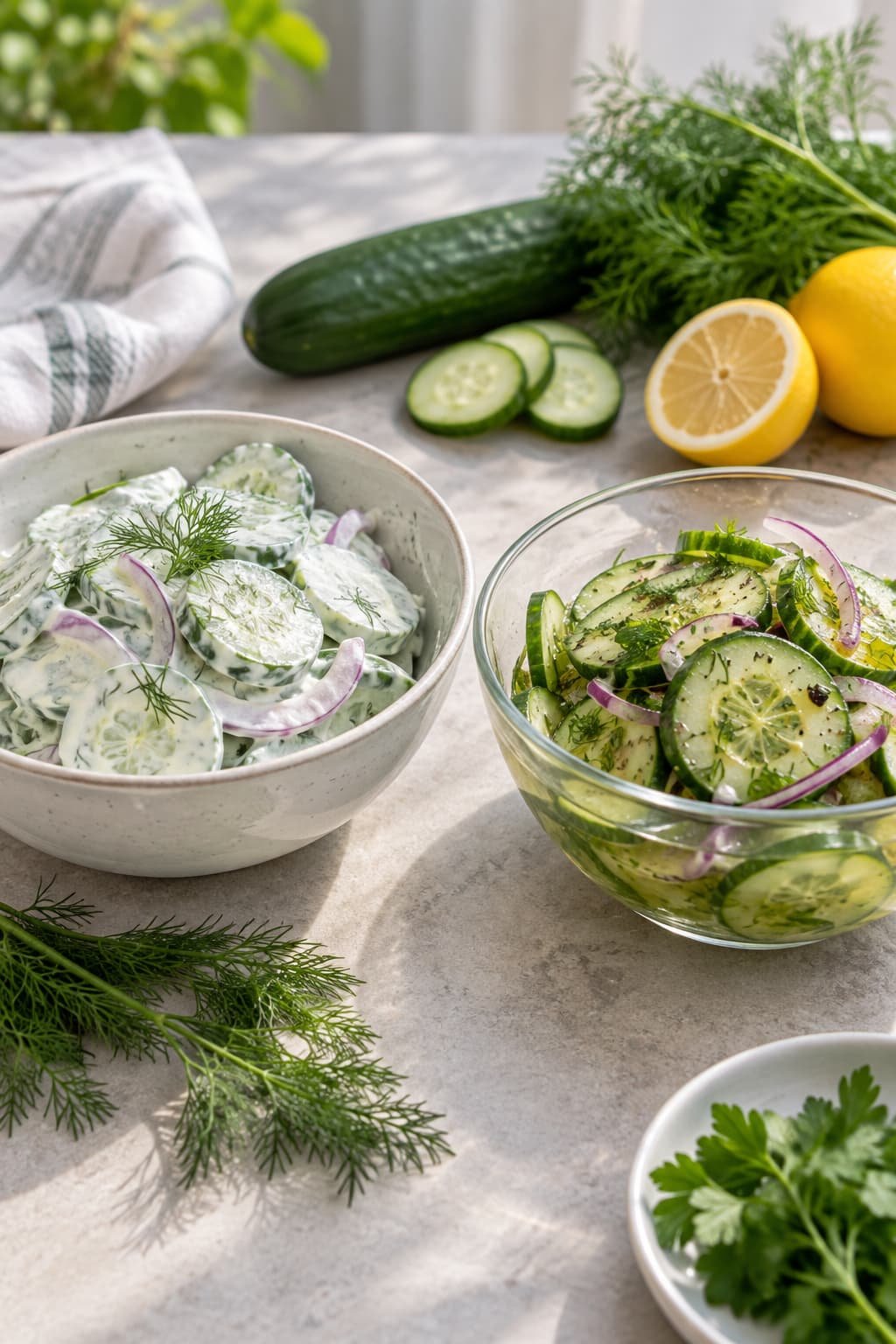
The main difference between the two styles is the dressing.
Creamy Cucumber Salad
Creamy versions generally use sour cream, mayonnaise, plain Greek yogurt, or a combination of creamy ingredients.
The choice affects flavor, thickness, and nutritional composition. Greek yogurt, sour cream, and mayonnaise should not be assumed to produce identical results or have identical nutrition profiles.
Dill, onion, lemon juice, vinegar, pepper, or other seasonings may also be included.
Vinegar-Based Cucumber Salad
Vinegar-based versions rely more heavily on acidity rather than a creamy base.
Vinegar may be combined with oil, herbs, onion, lemon juice, pepper, or other seasonings.
A vinegar-based salad is not automatically lower in carbohydrate. Added sugar, sweetened sauces, or prepared dressings can change the total, so the complete ingredient list still matters.
How Is Keto Cucumber Salad Commonly Prepared?
There is no single required preparation method.
In general, the cucumbers are washed and sliced, the dressing is prepared, and the ingredients are then combined.
Cucumbers may be cut into rounds, half-moons, chunks, or another shape suited to the salad. Peeling or removing larger seeds is optional.
A creamy dressing may use sour cream, mayonnaise, or yogurt. A non-creamy dressing may use vinegar, lemon juice, oil, herbs, and seasonings.
Exact ingredient quantities, dressing ratios, preparation times, yields, and serving sizes depend on the specific recipe. Without a tested formulation, one set of measurements should not be presented as universally correct.
Why Can Cucumber Salad Become Watery?
Cucumber salad can become watery because cucumber naturally contains a high proportion of water. Purdue Extension describes cucumber as about 90% water.
After cucumber is sliced and combined with a dressing, liquid may collect in the bowl. This can make a creamy dressing thinner or dilute a vinegar-based dressing.
How noticeable the change becomes can vary with the cucumber, preparation method, use of salt, and how long the ingredients remain combined.
Should Cucumbers Be Salted and Drained?
Salting and draining are optional preparation techniques.
Salt can encourage liquid to leave cucumber tissue. Some preparation methods therefore salt sliced cucumber before dressing it and then drain or gently dry the pieces.
This may reduce the amount of cucumber liquid entering the dressing, but there is no universal salt quantity or resting period for fresh cucumber salad. Those details depend on a specific recipe.
The salad can also be prepared without pre-salting. Some moisture may still accumulate because cucumber itself contains substantial water.
How Do Ingredients Affect the Carbohydrate Content?
The carbohydrate content of the finished salad depends on the complete ingredients, their quantities, total yield, and serving size.
Cucumber contributes carbohydrate naturally. Onion also contributes carbohydrate, so the amount added matters.
Sweetened yogurt, bottled dressings, sauces, and other packaged ingredients can have different carbohydrate profiles from unsweetened alternatives. Added sugars also contribute to the carbohydrate total.
For packaged foods, the nutrient amounts on a U.S. Nutrition Facts label apply to the stated serving size. The amount actually used therefore matters when estimating the nutrition of a finished salad.
There is no reliable single carbohydrate figure for every cucumber salad. An exact value requires a defined formulation and calculation.
Total Carbs vs Net Carbs
On U.S. Nutrition Facts labels, Total Carbohydrate includes components such as dietary fiber and sugars.
Net carbs is different. The term does not have a legal definition and is not used by the FDA as an official Nutrition Facts measure. The American Diabetes Association notes that net-carb calculations commonly subtract fiber and sometimes sugar alcohols from total carbohydrate, but that calculation is not fully standardized.
For that reason, a net-carb number should be identified as a calculated estimate rather than an official FDA value.
Common Variations
The salad can be adapted by changing the creamy base, acidic ingredients, herbs, or additions.
A sour cream or mayonnaise-based version creates a creamy dressing. Some preparations use one ingredient, while others combine them.
A plain Greek yogurt-based version provides another creamy option. Its flavor, consistency, and nutrition can differ from sour cream or mayonnaise, so an exact 1:1 replacement should not be assumed without a tested recipe.
A vinegar-and-herb version uses acidity rather than relying on a creamy base. Vinegar may be combined with oil, dill, parsley, onion, pepper, lemon juice, or other seasonings.
Dill, onion, chives, parsley, and similar additions can be used with more than one dressing style. They are variations rather than required components.
What Should You Consider Before Changing the Ingredients?
A substitution may affect several parts of the salad at once, including flavor, dressing thickness, acidity, carbohydrate content, and how noticeable cucumber moisture becomes.
Packaged alternatives should be checked individually. Labels such as “plain,” “light,” or “plant-based” do not by themselves establish carbohydrate or added-sugar content.
Dairy and non-dairy products should also be treated as separate formulations rather than automatic equivalents.
Without a tested recipe, substitutions are better presented as possible options rather than exact replacements. An identical flavor, consistency, or result should not be promised.
Make-Ahead and Storage Considerations
Cucumber salad may become more watery as it sits because moisture can continue to collect from the cucumber.
If maintaining the initial dressing consistency is important, keeping the prepared cucumber and dressing separate until closer to serving is one possible approach. This reduces the time they remain combined, although it does not prevent moisture release.
Food safety is separate from texture. FDA guidance recommends keeping refrigerators at 40°F (4°C) or below. Foods that require refrigeration generally should not remain at room temperature for more than two hours, or more than one hour when the air temperature is above 90°F (32°C).
Those are general food-safety limits, not a specific shelf-life recommendation for cucumber salad. An exact refrigerated storage duration is not given here because ingredients and handling can vary.
Frequently Asked Questions About Keto Cucumber Salad
Are cucumbers suitable for a keto eating pattern?
Cucumbers contain carbohydrate, so whether a particular amount fits a ketogenic or other carbohydrate-restricted eating pattern depends on the portion and the person’s carbohydrate target.
The finished salad also needs to be considered as a whole because dressings, yogurt, onion, sauces, and sweeteners can change its carbohydrate content.
Can cucumber salad be made without added sugar?
Yes. Added sugar is not required to prepare cucumber salad.
Creamy and vinegar-based dressings can both be made without deliberately adding sugar. Packaged yogurt, sauces, and dressings should still be checked individually because some products may contain added sugars.