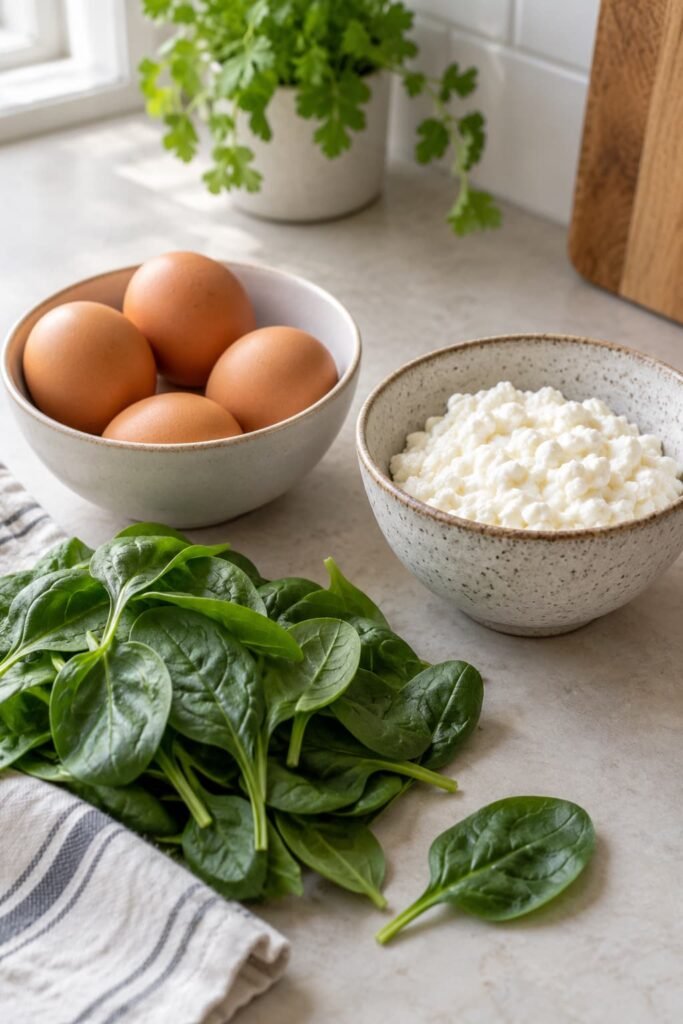
A spinach egg bake with cottage cheese is a baked egg dish built around eggs, cottage cheese, and spinach. Eggs provide much of the structure, cottage cheese contributes protein and dairy solids, and spinach adds a leafy vegetable component.
The phrase high-protein spinach egg bake with cottage cheese is often used for this type of dish because eggs and cottage cheese both provide protein. However, the name alone does not establish a specific amount of protein. The actual amount depends on the ingredients, quantities, specific products, and serving size.
What Is a Spinach Egg Bake with Cottage Cheese?
A spinach egg bake combines eggs, cottage cheese, and spinach before baking. Seasonings, additional vegetables, or other cheeses may also be included depending on the formulation.
The main ingredients serve different purposes. Eggs help the mixture set during cooking. Cottage cheese adds protein, dairy solids, moisture, and curds. Spinach adds a vegetable component and can contribute additional moisture.
Because these ingredients affect the mixture in different ways, changing their proportions may change more than flavor. For example, increasing a moisture-rich ingredient may also change how much liquid is present during cooking.
How Is an Egg Bake Different From a Frittata or Egg Casserole?
These terms can overlap.
An egg bake is a broad term for an egg-based mixture cooked in a baking dish.
A frittata is also centered on eggs and may contain vegetables, cheese, herbs, or other ingredients.
An egg casserole is another broad category. Depending on the recipe, it may contain eggs along with vegetables, cheese, bread, potatoes, meat, or other additions.
A dish made with spinach, eggs, and cottage cheese may therefore be described as an egg bake or egg casserole depending on how it is prepared and presented.
What Role Do Eggs, Cottage Cheese, and Spinach Play?
Eggs, cottage cheese, and spinach contribute different structural, nutritional, and moisture-related properties to the dish.
Understanding those roles helps explain why changing one ingredient can affect several parts of the mixture.
Eggs Provide Structure and Protein
Eggs usually form the main structural base.
When egg proteins are heated, they denature and coagulate. This allows a liquid egg mixture to become firmer as it cooks.
Eggs also contribute protein. How much they contribute to each portion depends on the number of eggs used and how the finished dish is divided.
What Does Cottage Cheese Do in an Egg Bake?
Cottage cheese contributes protein, dairy solids, moisture, and curds.
Products can vary in milkfat level, sodium, curd size, moisture, serving size, and nutrition values. For nutrient calculations, the Nutrition Facts label on the specific cottage cheese product is more useful than assuming all products have the same composition.
Cottage cheese may be stirred directly into the eggs or blended first.
Leaving it unblended keeps the curds more distinct in the uncooked mixture. Blending breaks the curds into smaller particles and distributes the cottage cheese more evenly before baking.
Neither approach guarantees a particular finished texture. The result can also depend on ingredient proportions, vegetables, and cooking conditions.
What Does Spinach Add?
Spinach adds a leafy vegetable component, along with color and its characteristic flavor.
Moisture is especially relevant in an egg bake. Fresh spinach contains water and loses volume as it cooks. Frozen spinach may contain noticeable free liquid after thawing.
That water becomes part of the overall egg mixture, so the way spinach is prepared may affect how much moisture enters the dish.
Spinach contains some protein, but eggs and cottage cheese are generally the more important protein contributors in this type of bake.
Where Does the Protein Come From?
Eggs and cottage cheese are the main sources of protein in this dish.
Other ingredients may contribute protein as well, but the total should be based on the complete ingredient list rather than estimated from the name of the dish.
Why Does Protein Per Serving Vary?
There is no universal protein-per-serving value for a spinach and cottage cheese egg bake.
The amount depends on:
- how many eggs are used;
- how much cottage cheese is included;
- the nutrition profile of the specific cottage cheese product;
- any other protein-containing ingredients;
- how many portions the finished dish is divided into.
For a specific formulation, protein can be estimated by adding the protein supplied by all ingredients and dividing that total by the number of portions.
Without a verified formulation and serving size, assigning a fixed protein number would be misleading.
What Does “High-Protein” Mean?
The term high protein should not automatically be treated as a verified nutrition claim simply because a dish contains eggs and cottage cheese.
For U.S. food-labeling purposes, FDA guidance states that terms such as “high,” “rich in,” and “excellent source of” generally require at least 20% of the Daily Value per reference amount for the nutrient.
That does not establish that every homemade spinach and cottage cheese egg bake meets this standard. A specific formulation and appropriate serving basis would need to be evaluated first.
For this article, the accurate conclusion is that eggs and cottage cheese contribute protein, while the amount per portion depends on the actual formulation.
Fresh or Frozen Spinach: What Changes?
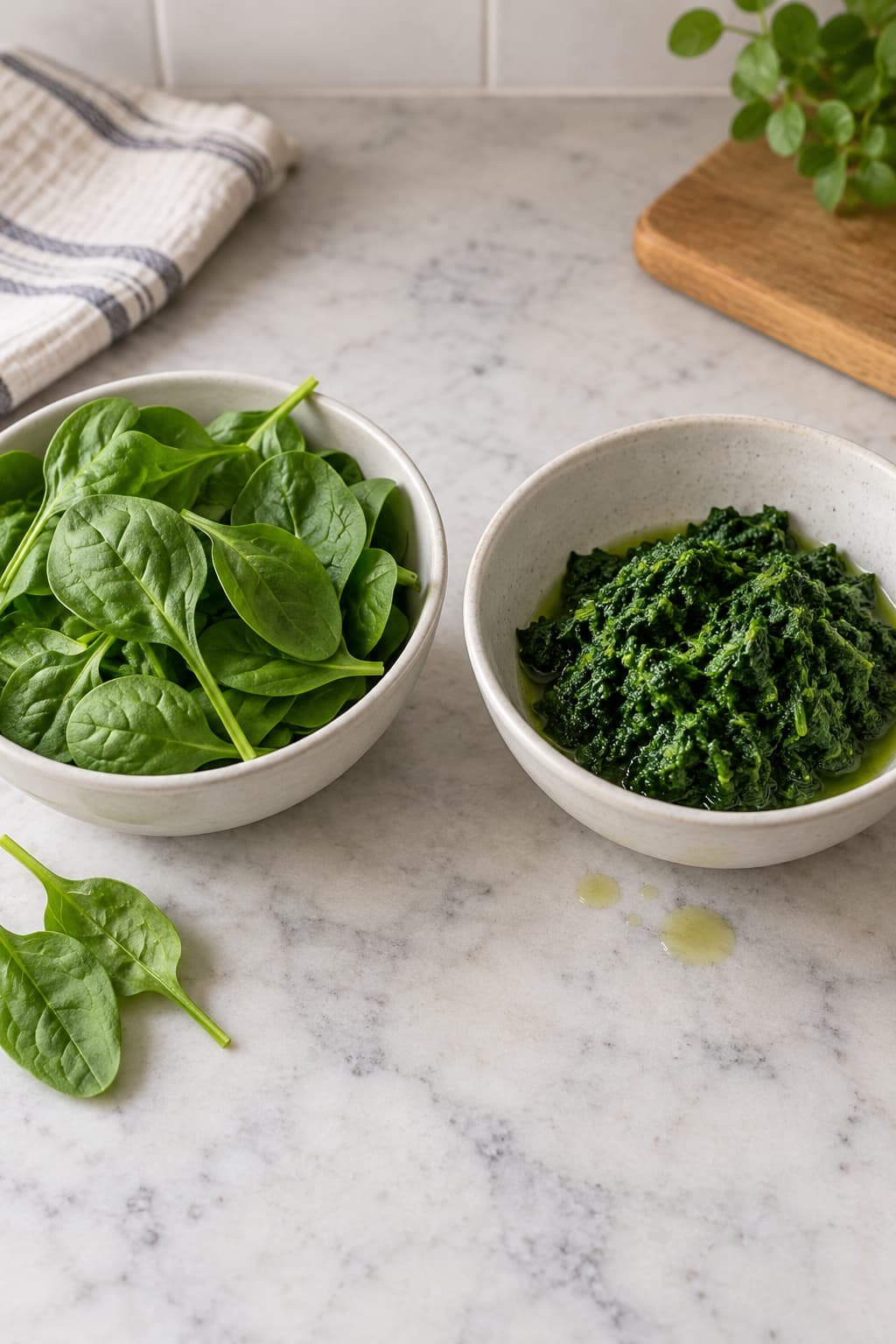
Both fresh and frozen spinach can be used in cooked egg dishes, but they may require different preparation.
The main practical difference is moisture. Fresh spinach releases water and loses volume during cooking, while thawed frozen spinach may already contain free liquid.
Can Frozen Spinach Be Used in an Egg Bake?
Yes. Frozen spinach can be used in egg-based baked dishes.
Thawing and draining frozen spinach is a commonly used approach because it can limit excess liquid entering the mixture.
This does not establish a universal substitution ratio between fresh and frozen spinach. The amount should come from the specific formulation being followed.
Why Does Excess Spinach Moisture Matter?
Water from spinach becomes part of the total liquid in the egg mixture.
If thawed spinach carries substantial free liquid into the baking dish, it may contribute to a wetter consistency. Cottage cheese and other vegetables can add moisture too.
Draining thawed spinach can reduce unnecessary added water, but it does not guarantee a particular finished texture. Ingredient proportions and cooking conditions also matter.
Fresh spinach may be handled differently depending on the preparation. Some formulations use it directly, while others wilt or cook it first. Without a tested formulation, neither method should be described as universally better.
How Is a Cottage Cheese Egg Bake Generally Prepared?
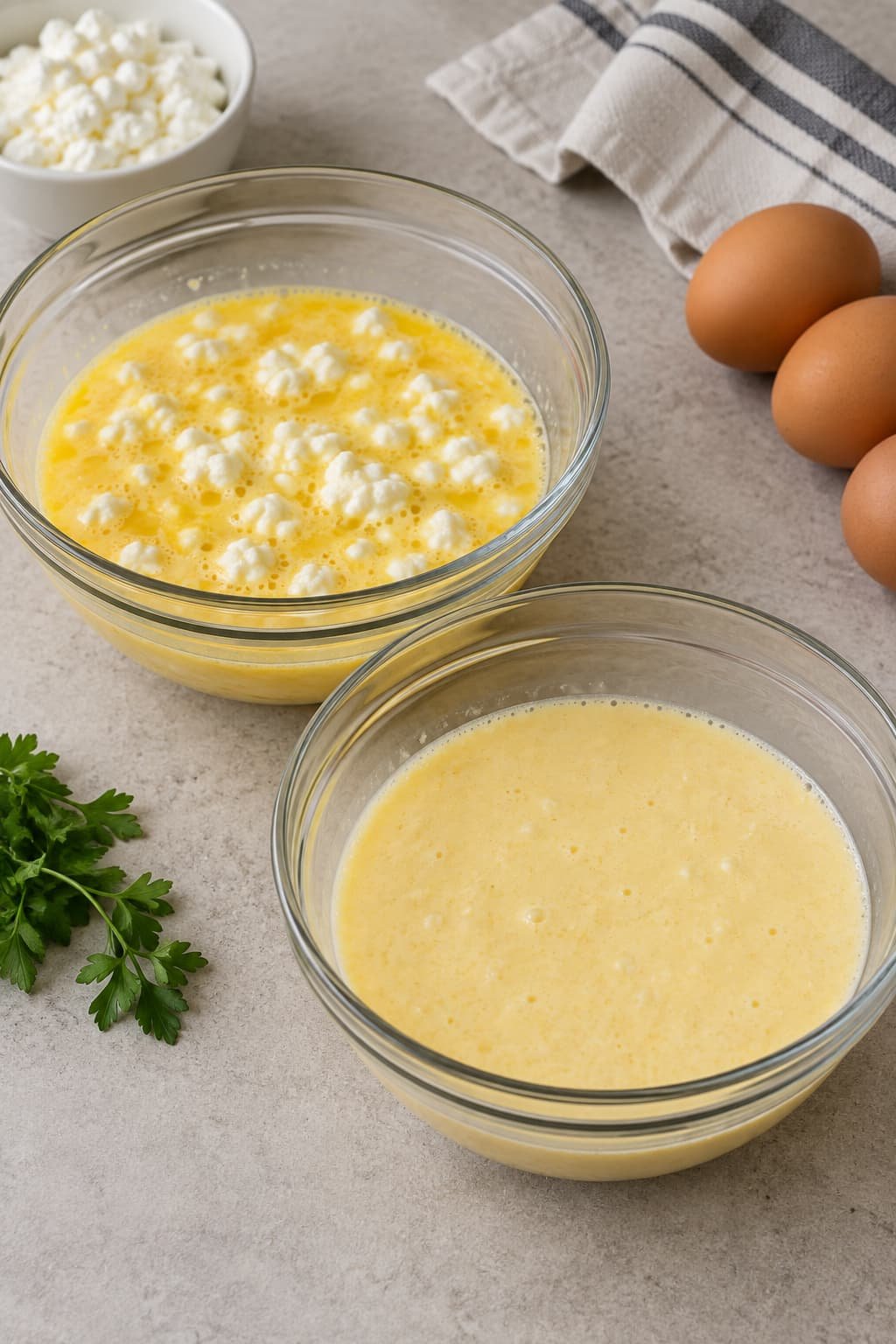
The general process is to prepare the spinach, combine the eggs and cottage cheese, add seasonings or other ingredients, transfer the mixture to a baking dish, and cook it until the eggs are safely cooked.
Because this article is informational rather than a personally tested recipe, it does not assign universal ingredient quantities, pan dimensions, oven temperatures, baking times, or serving counts.
A general preparation sequence is:
- Prepare the spinach. Frozen spinach may be thawed and excess liquid removed. Fresh spinach can be prepared according to the chosen formulation.
- Combine the eggs and cottage cheese. Cottage cheese may be stirred in directly or blended first.
- Add the spinach and seasonings. Other ingredients may be included if the formulation calls for them.
- Transfer the mixture to a suitable baking dish.
- Cook until the egg mixture reaches a safe internal temperature.
USDA recommends cooking casseroles and other dishes containing eggs to an internal temperature of 160°F (71.1°C). A food thermometer should be used to check the temperature.
That temperature is a food-safety requirement, not a universal oven setting or baking time.
Does Cottage Cheese Need to Be Blended?
No. Blending cottage cheese is optional.
Blending breaks the curds into smaller particles and makes the uncooked mixture more uniform. Leaving cottage cheese unblended keeps the curds more distinct before baking.
The choice may change how the ingredients are distributed, but it does not guarantee a particular finished texture.
Why Can a Spinach Egg Bake Become Watery?
A watery egg bake can have several possible causes. Moisture from spinach, cottage cheese, other vegetables, and the overall balance of ingredients may all contribute.
Frozen spinach can carry free liquid after thawing, while fresh spinach can release water during cooking.
Cottage cheese also contributes moisture along with protein, curds, and dairy solids. That does not mean cottage cheese alone causes a watery result.
A center that has not fully set may also appear loose, although this is different from visible liquid released by vegetables.
Because several factors may be involved, no single preparation step can be guaranteed to prevent excess moisture.
Can Other Vegetables Add More Moisture?
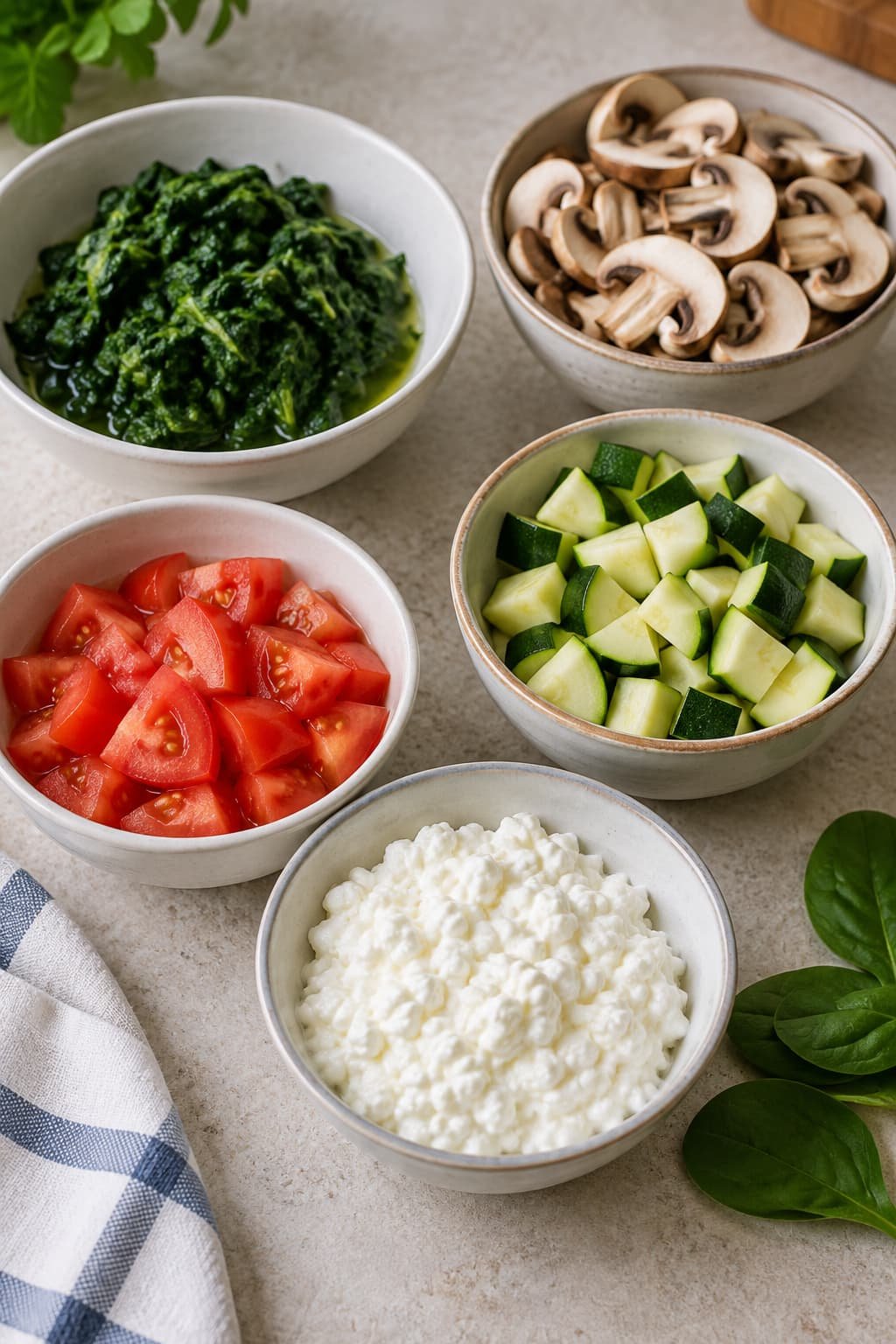
Yes. Vegetables such as tomatoes, mushrooms, and zucchini contain water and may release some of it during cooking.
Adding several moisture-rich vegetables can change the liquid balance of an egg bake. The effect depends on the amount used, how the vegetables are prepared, and the rest of the formulation.
This does not mean these vegetables cannot be included. It means their moisture should be considered along with the other ingredients.
What Should You Consider Before Changing the Ingredients?
Changing ingredients can affect moisture, nutrition, flavor, and how the egg mixture behaves during cooking.
Without a tested formulation, it is more useful to explain those possible changes than to provide exact substitution ratios.
Does the Type of Cottage Cheese Matter?
It can.
Cottage cheese products may differ in milkfat percentage, protein, sodium, serving size, moisture, and curd size.
If protein, calories, fat, or sodium are being calculated, use the Nutrition Facts label from the specific product.
Differences in moisture may also affect the mixture, but there is no verified basis here for describing one milkfat level or curd size as the best choice.
Can Whole Eggs and Egg Whites Be Combined?
Yes. Some egg dishes combine whole eggs with additional egg whites.
Changing the balance changes the nutritional composition because whole eggs and egg whites do not contain the same amounts of fat, calories, and other nutrients.
No universal replacement ratio should be assumed for this dish because a specific formulation has not been independently tested.
What Happens When Extra Cheese or Vegetables Are Added?
Additional ingredients can change both nutrition and moisture.
Extra cheese may change protein, fat, sodium, dairy solids, and moisture depending on the product and amount.
Vegetables may add volume, flavor, and water. Tomatoes, mushrooms, zucchini, and additional spinach, for example, can release moisture during cooking.
Adding ingredients should therefore not be treated as a neutral change that will always produce the same result.
What Should You Know About Food Safety and Leftovers?
Egg dishes are perishable, so safe cooking, cooling, refrigeration, and reheating matter.
USDA recommends cooking dishes containing eggs to an internal temperature of 160°F (71.1°C). Cooked egg dishes should be cooled promptly in shallow containers when they are being saved for later and generally used within 3 to 4 days under refrigeration.
Perishable leftovers should be refrigerated within 2 hours, or within 1 hour when the surrounding temperature is above 90°F (32.2°C). When reheating leftovers, USDA recommends reaching 165°F (73.9°C).
These figures are food-safety guidance. They do not predict how the texture of a specific egg bake will change during storage or reheating.
Can a Spinach Egg Bake Be Made Ahead?
A raw egg mixture can be prepared ahead only when it is handled and refrigerated safely.
USDA advises cooking dishes containing raw eggs immediately or refrigerating them and cooking them within 24 hours.
This is a food-safety guideline. It does not guarantee that an assembled egg bake will have the same texture after refrigeration as one cooked immediately.
Can a Cottage Cheese Egg Bake Be Frozen?
A cooked egg casserole can be frozen.
USDA specifically lists baked casseroles made with eggs for 2 to 3 months of freezer storage. Its broader freezing guidance explains that recommended freezer times relate mainly to quality when food remains continuously frozen at 0°F (-17.8°C).
This does not guarantee that texture or moisture will remain unchanged after freezing and reheating.
How Long Does Cooked Egg Bake Keep in the Refrigerator?
USDA lists cooked egg casseroles at 3 to 4 days under refrigeration.
Leftovers should also be refrigerated promptly rather than left at room temperature for extended periods.