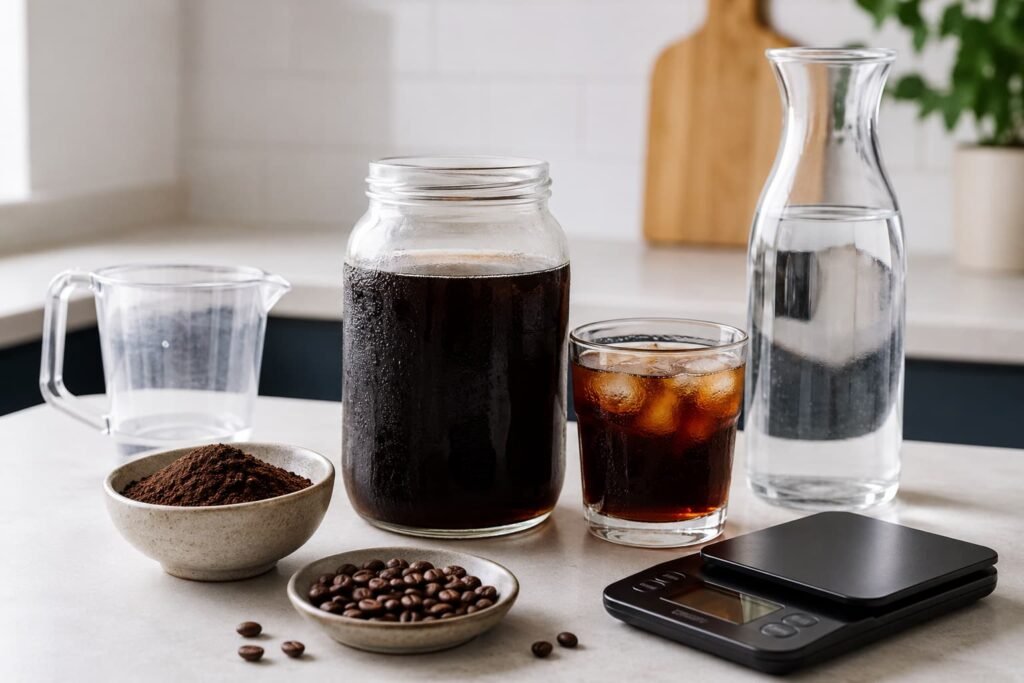
cold brew ratio chart

Cold Brew Ratio Chart in Grams, Cups and Ounces

Facebook
LinkedIn
Pinterest
WhatsApp

Table of Contents

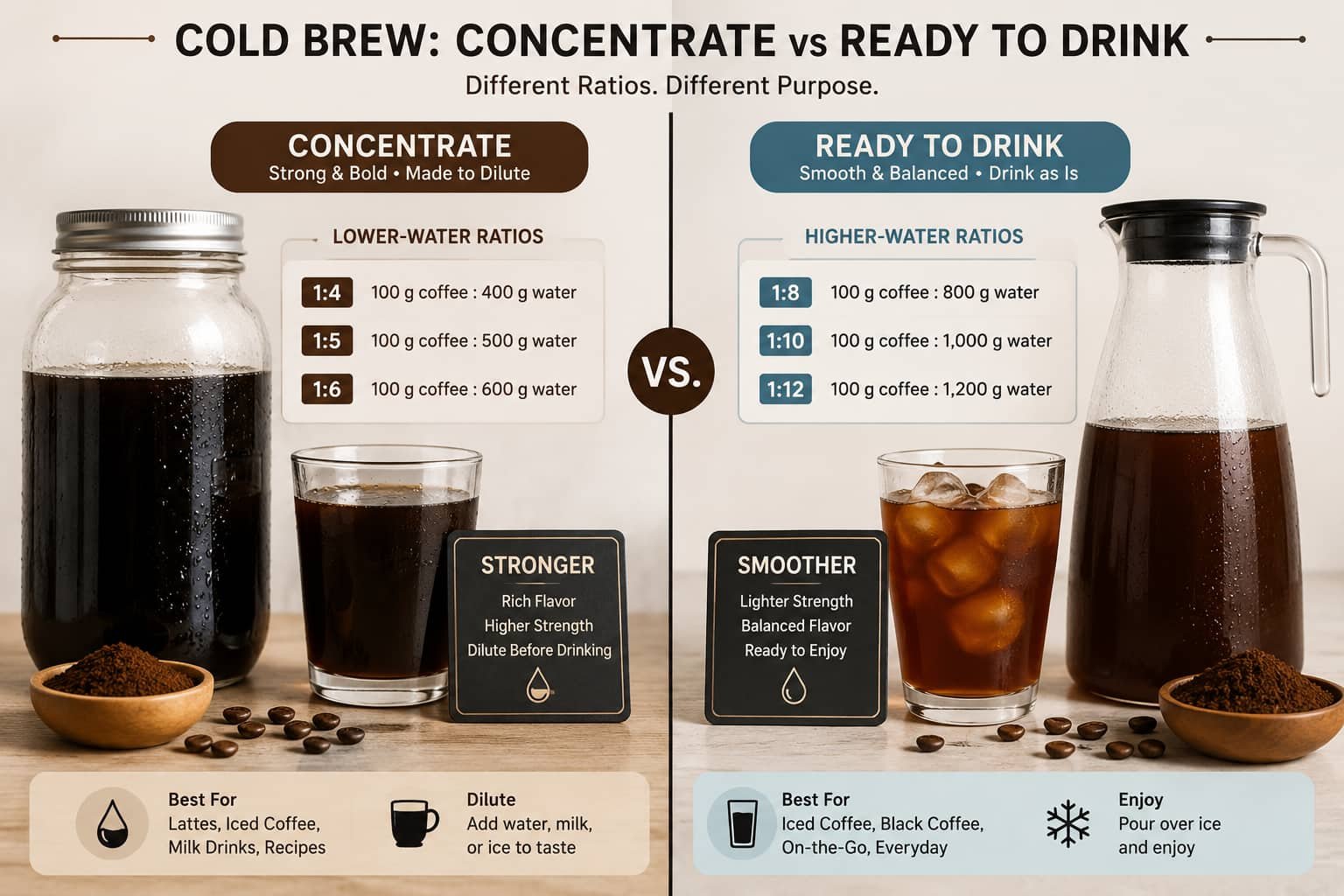
The right coffee-to-water ratio for cold brew depends on whether you are making a concentrated base or a finished drink. Cold brew concentrate uses a higher proportion of ground coffee and normally needs water or milk before serving. Ready-to-drink cold brew contains more brewing water, so it can usually be served directly over ice.

This cold brew ratio chart explains common ratios and provides measurements in grams, cups and ounces for different strengths and batch sizes. Measuring coffee and water by weight gives the most consistent results because the volume of ground coffee changes with the roast, grind size and how firmly it is packed. Use the ratios as practical starting points, then adjust the next batch according to your coffee and preferred strength.

Cold Brew Ratio

Quick Answer: What Is the Best Cold Brew Ratio?

A ratio from 1:4 to 1:6 is a practical starting range for cold brew concentrate. Ratios from 1:8 to 1:12 work better for strong, balanced or lighter ready-to-drink cold brew.

A 1:5 cold brew ratio means using one part ground coffee for every five parts water, measured by weight. For example, 100 grams of coffee requires 500 grams of water. Choose the ratio based on whether the finished brew will be diluted with water or milk.

Cold brew type Starting ratio Example by weight Expected result Dilution needed
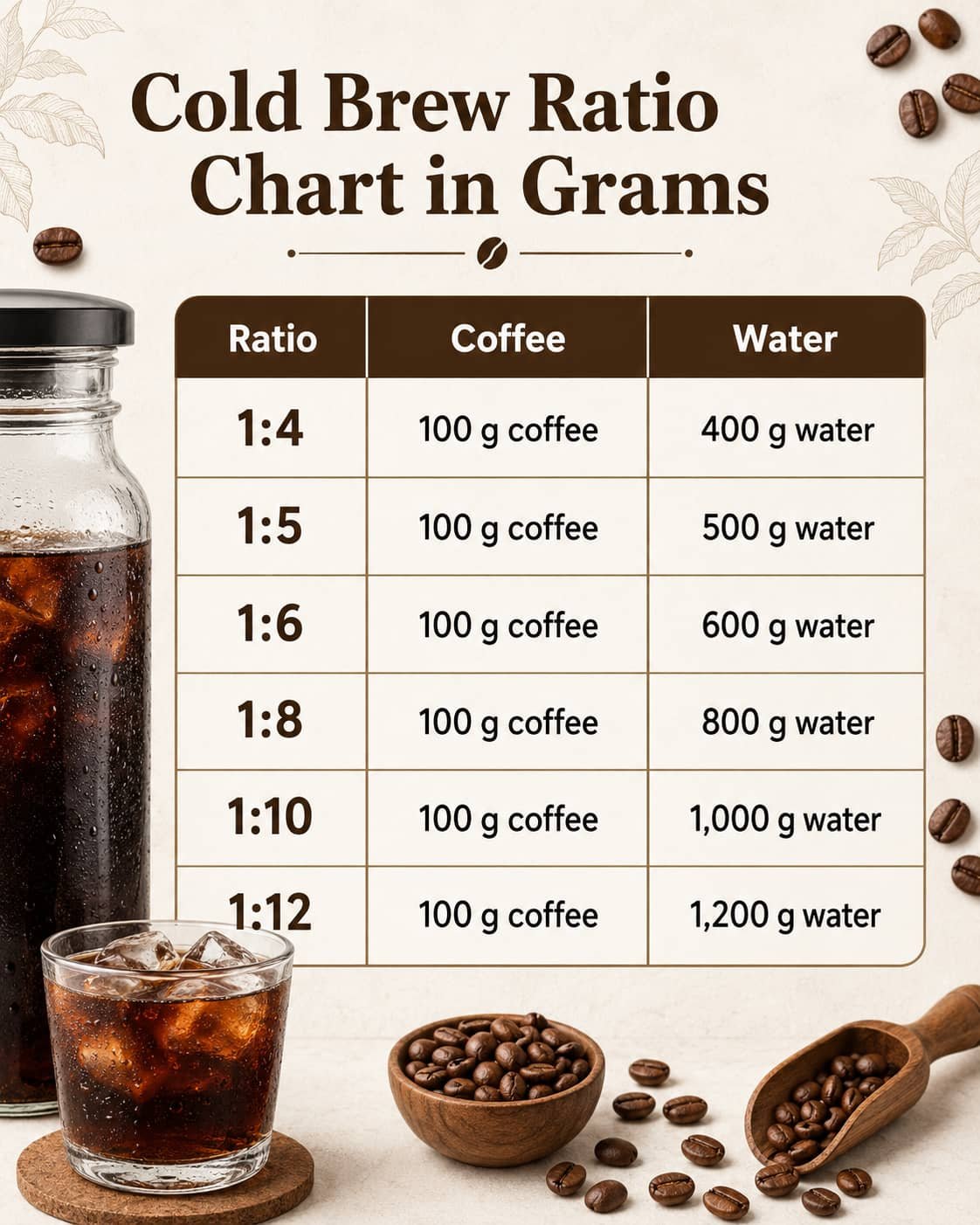
Strong concentrate 1:4 100 g coffee + 400 g water Very concentrated Yes
Standard concentrate 1:5 100 g coffee + 500 g water Strong concentrate Yes
Light concentrate 1:6 100 g coffee + 600 g water Lighter concentrate Usually
Strong ready-to-drink 1:8 100 g coffee + 800 g water Bold cold brew Optional
Balanced ready-to-drink 1:10 100 g coffee + 1,000 g water Balanced cold brew No
Light ready-to-drink 1:12 100 g coffee + 1,200 g water Mild cold brew No

These strength descriptions are starting estimates rather than fixed results. The final taste can change with the coffee variety, roast level, grind size, steeping time and filtration method. Ice also dilutes the drink as it melts, so a stronger ready-to-drink ratio may taste more balanced when served over a full glass of ice.

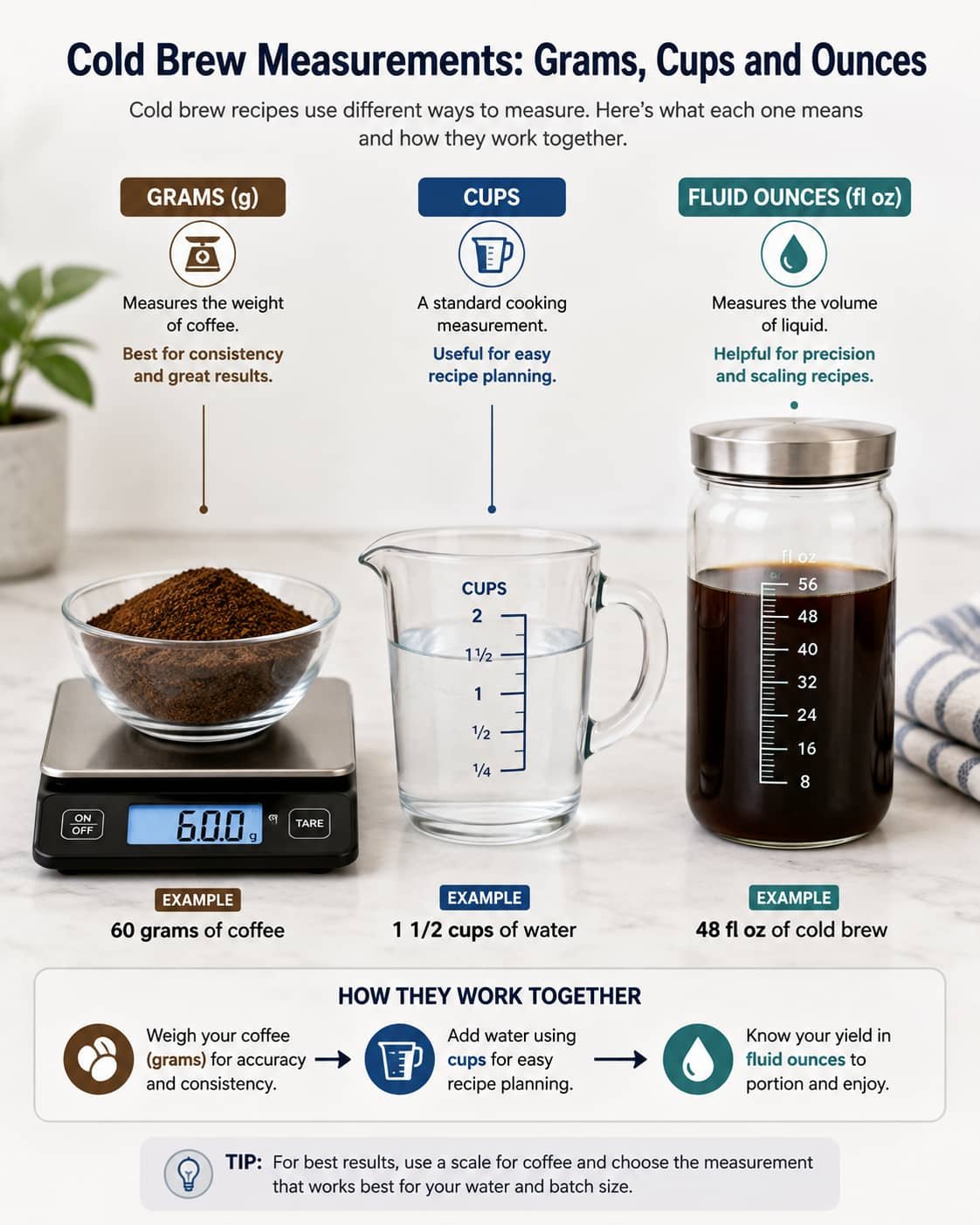
For accurate measurements, use grams whenever possible. Coffee listed in ounces should be measured by weight, while jar and pitcher sizes are normally shown in fluid ounces. Cup measurements are convenient but less precise because ground coffee does not always fill a measuring cup at the same weight.

Cold Brew Coffee

How to Read a Cold Brew Coffee Ratio

A cold brew coffee ratio compares the weight of ground coffee with the weight of brewing water. Coffee is written first and water is written second. A 1:5 ratio, for example, means using one equal part coffee for every five parts water.

All ratios in this guide are based on coffee by weight to water by weight. Measuring with a digital kitchen scale gives more dependable results than using cups because ground coffee can occupy different amounts of space depending on the roast, grind size and how tightly it settles.

What Does a 1:5 Cold Brew Ratio Mean?

A 1:5 cold brew ratio means using one gram of ground coffee for every five grams of water. A batch made with 100 grams of coffee would therefore require 500 grams of water.

The same formula works for any batch size. If you have 50 grams of coffee, multiply it by five to get 250 grams of water. If you want to use 1,000 grams of water, divide it by five to get 200 grams of coffee.

For most people, 1:5 produces a cold brew concentrate rather than a finished drink. After straining, it can be mixed with water or milk and served over ice. The exact serving strength depends on the coffee and personal preference.

Why a Lower Second Number Makes Stronger Coffee

A lower second number means there is more coffee relative to the water. A 1:4 ratio uses one part coffee for every four parts water, while a 1:10 ratio spreads the same amount of coffee across ten parts water. The 1:4 batch will therefore be more concentrated.

A stronger ratio does not automatically create better flavor. It only increases the amount of coffee relative to water. Bean variety, roast level, grind consistency, water quality, steeping time and filtration also affect the finished brew.

Using more coffee cannot correct poor extraction. A strong batch can still taste flat, harsh or muddy when the grind or brewing conditions are unsuitable.

Brewing Ratio vs Dilution Ratio

The brewing ratio and dilution ratio apply at different stages. The brewing ratio controls how much coffee and water are combined before steeping. The dilution ratio explains how the strained concentrate is mixed before drinking.

Ratio type What it compares When it applies Example
Brewing ratio Ground coffee to brewing water Before steeping 100 g coffee with 500 g water at 1:5
Dilution ratio Strained concentrate to water or milk After straining 1 cup concentrate with 1 cup water at 1:1

A strong brewing ratio does not determine one required serving method. The strained concentrate can still be adjusted with water, milk or ice according to taste.

best cold brew

Cold Brew Ratio Chart by Strength

The best cold brew ratio depends on whether you want a concentrate or a drink that can usually be served without additional water. Ratios from 1:4 to 1:6 are useful concentrate starting points, while ratios from 1:8 to 1:12 cover bold through mild ready-to-drink options.

Ratio Common use Likely strength Typical dilution guidance
1:4 Strong concentrate Very concentrated Normally diluted
1:5 Standard concentrate Strong Usually diluted
1:6 Lighter concentrate Moderately strong Often diluted
1:8 Bold ready-to-drink cold brew Strong Optional
1:10 Balanced ready-to-drink cold brew Medium Usually not needed
1:12 Light ready-to-drink cold brew Mild Usually not needed

These are practical starting points rather than fixed industry definitions. The same cold brew coffee ratio can taste different depending on the beans, roast, grind, steeping conditions, filtration and the amount of melting ice used when serving.

Ratios for Cold Brew Concentrate

A 1:4 cold brew concentrate ratio creates the strongest option in this chart. It suits small batches, milk-based drinks and situations where a powerful coffee base will be diluted before serving. Most people will find it too concentrated to drink on its own.

A 1:5 ratio provides a strong but more flexible concentrate. It uses less coffee than 1:4 while leaving enough strength for dilution with water or milk. Complete ingredients and brewing instructions are available in this 1:5 cold brew concentrate recipe.

A 1:6 ratio creates a softer concentrate. It may suit someone who wants a strong cup without adding an equal amount of water or milk. Dilution may still be useful, especially when the brew is served without much ice.

Ratios for Ready-to-Drink Cold Brew

A 1:8 ready-to-drink cold brew ratio produces a bold cup. It can usually be served without dilution, although it works especially well over ice because melting ice gradually reduces the strength.

A 1:10 ratio is a practical starting point for balanced cold brew. It uses less coffee than a concentrate but still provides enough body and flavor for serving black or with a small amount of milk.

A 1:12 ratio creates a milder drink. It works well for readers who prefer a lighter cup and do not plan to add extra water. It may become too weak when poured over a large quantity of ice, so the serving method should be considered before choosing this ratio.

cold brew ratio grams

Cold Brew Ratio Chart in Grams

Measuring a cold brew ratio in grams is the most accurate way to scale a batch. Select the amount of water you want to use, then divide it by the second number in the ratio.

For example, 1,000 grams of water divided by five requires 200 grams of coffee for a 1:5 batch.

For ordinary kitchen scaling, one gram of water can be treated as approximately one milliliter. This means 1,000 grams of water is close to one liter. This conversion applies to water, not ground coffee.

Choose a brewing container larger than the listed water volume. Coffee grounds also take up space and need enough room to become fully wet and stirred without overflowing.

Cold Brew Concentrate Measurements in Grams

Brewing water Approximate volume Coffee at 1:4 Coffee at 1:5 Coffee at 1:6
500 g 500 ml 125 g 100 g 83 g
750 g 750 ml 188 g 150 g 125 g
1,000 g 1 liter 250 g 200 g 167 g
1,500 g 1.5 liters 375 g 300 g 250 g
2,000 g 2 liters 500 g 400 g 333 g

Values that do not divide into whole numbers have been rounded to the nearest gram. These stronger ratios normally produce concentrate that is diluted after straining.

Ready-to-Drink Cold Brew Measurements in Grams

Brewing water Approximate volume Coffee at 1:8 Coffee at 1:10 Coffee at 1:12
500 g 500 ml 63 g 50 g 42 g
750 g 750 ml 94 g 75 g 63 g
1,000 g 1 liter 125 g 100 g 83 g
1,500 g 1.5 liters 188 g 150 g 125 g
2,000 g 2 liters 250 g 200 g 167 g

The water shown in these tables is the amount added before steeping. It is not the guaranteed volume of finished cold brew. Ground coffee absorbs and retains part of the water, while straining leaves additional liquid behind, so the final yield will be lower than the starting amount.

cold brew

Cold Brew Ratio Chart in Ounces

A cold brew ratio in ounces can be confusing because ground coffee and water are often measured with different types of ounces. Ground coffee should be measured in ounces by weight, while water volume and container capacity are usually listed in US fluid ounces.

These units are not interchangeable. For example, 16 US fluid ounces of water weighs approximately 16.7 ounces. A 1:5 cold brew ratio therefore does not mean combining 1 ounce of coffee with 5 fluid ounces of water. The coffee and water must be compared by weight for the ratio to remain accurate.

All ounce and cup measurements in this guide use US units.

Weight Ounces vs Fluid Ounces

An ounce by weight measures mass. It is shown as oz wt and should be used when weighing ground coffee.

A fluid ounce measures volume. It is shown as fl oz and is commonly used for water quantities, jars and pitchers.

Unit What it measures Use in cold brew
oz wt Weight Measures ground coffee and water by weight
fl oz Volume Describes water volume and container capacity

For the most consistent results, place the brewing container on a digital kitchen scale and weigh both the coffee and water. Fluid ounces are useful for choosing a batch size, but the water volume must be converted to weight before calculating the coffee amount.

Coffee Measurements for 16, 32 and 64 Fluid Ounces

The charts below assume that 16, 32 or 64 fl oz refers to the water added before steeping, not the total capacity of the brewing container.

Choose a container larger than the listed water volume. Ground coffee also takes up space, and extra room is needed to wet and stir the grounds without overflowing. A 32 fl oz jar, for example, cannot comfortably hold 32 fl oz of water plus enough coffee for a concentrated batch.

Cold Brew Concentrate Measurements in Ounces

Brewing water Approximate water weight Coffee at 1:4 Coffee at 1:5 Coffee at 1:6
16 fl oz 16.7 oz wt 4.2 oz wt 3.3 oz wt 2.8 oz wt
32 fl oz 33.4 oz wt 8.3 oz wt 6.7 oz wt 5.6 oz wt
64 fl oz 66.8 oz wt 16.7 oz wt 13.4 oz wt 11.1 oz wt

These ratios are intended primarily for cold brew concentrate. A 1:4 batch contains the highest proportion of coffee and is commonly diluted before serving. A 1:6 batch creates a softer concentrate but may still need water or milk, depending on personal taste.

Ready-to-Drink Cold Brew Measurements in Ounces

Brewing water Approximate water weight Coffee at 1:8 Coffee at 1:10 Coffee at 1:12
16 fl oz 16.7 oz wt 2.1 oz wt 1.7 oz wt 1.4 oz wt
32 fl oz 33.4 oz wt 4.2 oz wt 3.3 oz wt 2.8 oz wt
64 fl oz 66.8 oz wt 8.3 oz wt 6.7 oz wt 5.6 oz wt

The values are rounded to the nearest tenth of an ounce, which is practical for most home kitchen scales. Use grams when preparing a small batch or when greater precision is needed.

The final strained yield will be lower than the starting water volume. Ground coffee absorbs some of the water, while additional liquid remains trapped in the grounds and filter.

Cold Brew Ratio Chart in Cups

Cup measurements are less accurate than weight measurements because the volume of ground coffee changes with bean density, roast level, grind size and packing. Two level cups of coffee can weigh differently even when they are measured with the same US cup.

A kitchen scale is the better choice whenever one is available. When you must use volume, the coffee grounds-to-water ratio in cups can provide a practical starting estimate, but the finished strength may vary between different coffees.

The charts below use a working estimate of 80 grams of medium-coarse ground coffee per level US cup. This is not a universal conversion. Fill the measuring cup gently, do not compress the grounds and level the top without packing.

For greater accuracy, weigh one level cup of your own ground coffee. Then use this calculation:

Required coffee weight ÷ weight of one level cup = cups of ground coffee

Approximate Concentrate Measurements Using US Cups

Brewing water Coffee at 1:4 Coffee at 1:5 Coffee at 1:6
2 cups or 16 fl oz About 1½ cups About 1¼ cups About 1 cup
4 cups or 32 fl oz About 3 cups About 2⅜ cups About 2 cups
8 cups or 64 fl oz About 6 cups About 4¾ cups About 4 cups

Concentrate ratios require a large amount of ground coffee. For batches this size, weighing the coffee is easier and more dependable than filling several measuring cups.

Approximate Ready-to-Drink Measurements Using US Cups

Brewing water Coffee at 1:8 Coffee at 1:10 Coffee at 1:12
2 cups or 16 fl oz About ¾ cup About ⅝ cup About ½ cup
4 cups or 32 fl oz About 1½ cups About 1¼ cups About 1 cup
8 cups or 64 fl oz About 3 cups About 2⅜ cups About 2 cups

Treat these cup measurements as estimates rather than exact conversions. If the finished cold brew tastes clean but is stronger or weaker than expected, adjust the coffee-to-water ratio in the next batch.

If the drink tastes harsh, sour or muddy, changing the ratio alone may not solve the problem. Review the grind size, steeping time and filtration method before increasing or reducing the amount of coffee.

How the Cup Estimates Were Calculated

Cup measurements are less precise than gram measurements because ground coffee does not have a fixed volume-to-weight conversion. For calculation purposes, this guide uses a working estimate of 80 grams of loosely filled, medium-coarse ground coffee per level US measuring cup. The actual weight may vary considerably between different coffees.

A US measuring cup holds 8 fluid ounces by volume, but that does not mean one cup of ground coffee weighs 8 ounces. Coffee weight changes with the bean variety, roast level, grind size and the amount of air between the particles.

These estimates assume that the coffee is ground to a medium-coarse consistency, placed loosely into the cup, left unpacked and leveled gently across the top. Shaking, pressing or compacting the grounds can increase the amount of coffee inside the same measuring cup.

Darker-roasted coffee often weighs less by volume than lighter-roasted coffee, although the exact difference depends on the beans and grind. A finer grind may also settle more tightly and produce a heavier cup than a medium-coarse grind.

For the most accurate conversion, place an empty bowl on a digital kitchen scale and press the tare button to return the display to zero. Add one loosely filled, level cup of your ground coffee and record its weight. Use that result instead of the 80-gram estimate when converting the gram measurements in this guide.

Approximate Cup Conversion Chart

First, find the coffee amount required in the cold brew ratio chart in grams. Use the table below only when you need to convert that weight into US cups.

The values are rounded estimates based on 80 grams of coffee per level cup. They should not be treated as exact measurements.

Ground coffee by weight Approximate US cups
40 g About ½ cup
50 g About ⅝ cup
60 g About ¾ cup
80 g About 1 cup
100 g About 1¼ cups
120 g About 1½ cups
150 g About 1⅞ cups
160 g About 2 cups
200 g About 2½ cups
240 g About 3 cups
300 g About 3¾ cups
400 g About 5 cups

To estimate another amount, divide the required coffee weight by 80:

Coffee weight in grams ÷ 80 = approximate cups of ground coffee

For example, 100 grams of coffee equals approximately 1¼ level cups using this estimate. A batch requiring 200 grams would need approximately 2½ level cups.

These conversions are useful when a kitchen scale is unavailable, but they are not as dependable as weighing the coffee. For consistent cold brew strength from one batch to the next, measure the ground coffee in grams whenever possible.

cold brew coffee maker

How Much Coffee Do You Need for Common Container Sizes?

The coffee amount should be calculated from the weight of the brewing water, not only from the capacity printed on the jar. A 32 fl oz jar, for example, cannot hold 32 fl oz of water plus a large amount of ground coffee without overflowing.

All measurements below compare coffee by weight with water by weight. Coffee amounts are rounded to the nearest gram and tenth of an ounce. Use the separate cup-conversion chart only when a kitchen scale is unavailable because volume measurements are less consistent.

When the listed amount refers to water, use the exact chart measurement. When it refers to the container’s total capacity, leave visible headspace for the dry grounds, wetting and stirring. The final strained yield will also be lower than the starting water amount because the coffee and filter retain some liquid.

Cold Brew Ratio for a 16 oz Jar

A 16 oz jar and 16 fl oz of brewing water are not the same thing. If the jar itself has a 16 fl oz capacity, adding a full 16 fl oz of water leaves no room for the coffee grounds.

For a small jar, place the empty jar on a digital scale and press the tare button. Add less than the jar’s full capacity of water, leaving enough space for the coffee and careful stirring. Record the water weight, then divide it by the ratio number to calculate the coffee.

For example:

Water weight ÷ 5 = coffee needed for a 1:5 concentrate

Water weight ÷ 10 = coffee needed for a 1:10 ready-to-drink batch

If you want to use a full 16 fl oz of water, prepare the batch in a larger container. Sixteen US fluid ounces of water weighs approximately 473 grams.

Ratio Common use Coffee for 16 fl oz water Coffee by weight
1:4 Strong concentrate 118 g 4.2 oz wt
1:5 Standard concentrate 95 g 3.3 oz wt
1:8 Bold ready-to-drink 59 g 2.1 oz wt
1:10 Balanced ready-to-drink 47 g 1.7 oz wt
1:12 Light ready-to-drink 39 g 1.4 oz wt

These values apply to 16 fl oz of water, not a completely filled 16 oz jar.

How Much Coffee for 32 oz Cold Brew?

For 32 fl oz of brewing water, use approximately 189 grams of coffee for a 1:5 concentrate or 95 grams for a balanced 1:10 ready-to-drink cold brew.

Thirty-two US fluid ounces of water weighs approximately 946 grams.

Ratio Common use Coffee in grams Coffee in ounces
1:4 Strong concentrate 237 g 8.3 oz wt
1:5 Standard concentrate 189 g 6.7 oz wt
1:6 Lighter concentrate 158 g 5.6 oz wt
1:8 Bold ready-to-drink 118 g 4.2 oz wt
1:10 Balanced ready-to-drink 95 g 3.3 oz wt
1:12 Light ready-to-drink 79 g 2.8 oz wt

These measurements apply when 32 fl oz is the amount of water added. A jar with a total capacity of 32 fl oz requires less water because the grounds also occupy space.

There is no single safe fill level for every 32 oz jar. Jar shape, filter type, grind and stirring method can all change the available space. Leave visible headroom rather than filling the container to the rim.

How Much Coffee for a 64 oz Mason Jar?

A 64 oz mason jar cannot hold a full 64 fl oz of water plus the coffee required for cold brew. The dry grounds already occupy considerable space, and once wet, they retain water and become difficult to stir inside an overfilled jar.

If 64 fl oz refers to the water amount, use a brewing vessel larger than 64 fl oz. Sixty-four US fluid ounces of water weighs approximately 1,893 grams.

Ratio Common use Coffee in grams Coffee in ounces
1:4 Strong concentrate 473 g 16.7 oz wt
1:5 Standard concentrate 379 g 13.4 oz wt
1:6 Lighter concentrate 315 g 11.1 oz wt
1:8 Bold ready-to-drink 237 g 8.3 oz wt
1:10 Balanced ready-to-drink 189 g 6.7 oz wt
1:12 Light ready-to-drink 158 g 5.6 oz wt

If 64 oz describes the jar’s total capacity, add a smaller amount of water and record its weight. Divide the water weight by the selected ratio instead of relying on an untested universal fill line.

For example, if the water in the jar weighs 1,500 grams, a 1:5 batch requires 300 grams of coffee, while a 1:10 batch requires 150 grams.

Stir carefully to wet all the grounds. Do not shake a heavily filled glass jar unless the lid is secure and there is enough headspace to prevent leakage.

Cold Brew Ratio for 1 Liter

One liter of water weighs approximately 1,000 grams, making the coffee calculation straightforward.

For a 1:5 cold brew concentrate, use 200 grams of ground coffee per liter of water. For a balanced 1:10 ready-to-drink batch, use 100 grams.

Ratio Common use Coffee for 1 liter water Coffee in ounces
1:4 Strong concentrate 250 g 8.8 oz wt
1:5 Standard concentrate 200 g 7.1 oz wt
1:6 Lighter concentrate 167 g 5.9 oz wt
1:8 Bold ready-to-drink 125 g 4.4 oz wt
1:10 Balanced ready-to-drink 100 g 3.5 oz wt
1:12 Light ready-to-drink 83 g 2.9 oz wt

A one-liter bottle or jar is not large enough for one full liter of water plus the coffee grounds. Use a larger brewing vessel when one liter refers to the water amount.

Cold Brew Ratio for One Gallon

One US gallon contains 128 fl oz and weighs approximately 3,785 grams. The amount of coffee required depends heavily on whether the batch is intended as concentrate or ready-to-drink cold brew.

For one gallon of brewing water, use approximately 757 grams of coffee at 1:5 or 379 grams at 1:10.

Ratio Common use Coffee required Coffee in ounces
1:4 Strong concentrate 946 g 33.4 oz wt
1:5 Standard concentrate 757 g 26.7 oz wt
1:6 Lighter concentrate 631 g 22.3 oz wt
1:8 Bold ready-to-drink 473 g 16.7 oz wt
1:10 Balanced ready-to-drink 379 g 13.4 oz wt
1:12 Light ready-to-drink 315 g 11.1 oz wt

These measurements treat one gallon as the amount of water added, not the total capacity of the brewing container. A one-gallon jug cannot hold a gallon of water plus several hundred grams of coffee. Use a substantially larger food-safe vessel with enough room for mixing.

A gallon of water at concentrate strength creates an unusually large home batch. It can be expensive, difficult to stir and awkward to filter. Making two smaller batches is often easier and produces more consistent filtration.

Do not expect one full gallon of strained cold brew. Ground coffee absorbs part of the water, and additional liquid remains in the filter. Measure the strained coffee before calculating servings or dilution.

Large batches can also clog small paper filters. A spacious reusable filter bag may make the grounds easier to remove, but fine sediment may still require a second filtration. Avoid aggressively squeezing the grounds because this can push fine particles into the drink and create a cloudy or muddy texture.

cold brew ratio calculator

How to Calculate Cold Brew Ratio for Any Batch Size

You can calculate a cold brew ratio for any batch size with two simple formulas. The calculations work when the ratio is written with coffee as one part, such as 1:5, 1:8 or 1:10, and both coffee and water are compared by weight.

When the amount of water is already known, divide its weight by the second number in the ratio.

Coffee weight = water weight ÷ ratio number

For a 1:5 ratio with 1,000 grams of water:

1,000 ÷ 5 = 200 grams of coffee

For a 1:10 ratio with the same amount of water:

1,000 ÷ 10 = 100 grams of coffee

A lower second number uses more coffee relative to the water, creating a more concentrated batch. A higher second number uses less coffee and generally produces a lighter brew.

Calculating from the Amount of Water

When you know how much water you want to use, weigh it in grams and divide that number by the selected ratio.

For example, the following calculations use 750 grams of water:

Desired ratio Calculation Coffee required
1:5 concentrate 750 ÷ 5 150 g
1:8 bold ready-to-drink 750 ÷ 8 About 94 g
1:10 balanced ready-to-drink 750 ÷ 10 75 g
1:12 light ready-to-drink 750 ÷ 12 About 63 g

When the result includes a decimal, round it to the nearest gram. Small differences below one gram are unlikely to noticeably change an ordinary home batch.

If the water is measured in US fluid ounces, convert it to grams before using the cold brew ratio formula. One US fluid ounce of water weighs approximately 29.6 grams.

For example, 20 US fluid ounces of water weighs approximately 591 grams:

591 ÷ 5 = about 118 grams of coffee at 1:5

591 ÷ 10 = about 59 grams of coffee at 1:10

The water entered in the formula is the amount added before steeping. It is not the expected strained yield because the coffee grounds and filter retain some of the liquid.

Calculating from the Amount of Coffee

When you already know how much ground coffee is available, multiply its weight by the second number in the desired ratio.

Water weight = coffee weight × ratio number

For example, if you have 80 grams of coffee:

Desired ratio Calculation Water required
1:5 concentrate 80 × 5 400 g
1:8 bold ready-to-drink 80 × 8 640 g
1:10 balanced ready-to-drink 80 × 10 800 g
1:12 light ready-to-drink 80 × 12 960 g

For ordinary kitchen scaling, one gram of water can be treated as approximately one milliliter. Therefore, 800 grams of water is close to 800 milliliters. This conversion applies to water, not ground coffee.

Calculating from the coffee amount is useful when only part of a bag remains. Instead of guessing how much water to add, weigh the available coffee and build the cold brew batch size around it.

Use a brewing container larger than the calculated water volume. The ground coffee also takes up space, and visible headroom is needed for wetting and stirring without overflow.

Use the Formula as a Manual Cold Brew Ratio Calculator

The two formulas can function as a simple manual cold brew ratio calculator:

What you know Formula to use
Water amount Coffee = water weight ÷ ratio number
Coffee amount Water = coffee weight × ratio number

For example, suppose you want to use 1,200 grams of water at a 1:8 ratio:

1,200 ÷ 8 = 150 grams of coffee

If you instead have 150 grams of coffee and want a 1:10 batch:

150 × 10 = 1,500 grams of water

These calculations provide starting ingredient amounts. They do not predict the exact flavor or final yield. Roast level, grind size, steeping conditions and filtration can still affect the finished cold brew.

An interactive calculator should only be added to this page when it is fully functional. It should clearly separate water in fluid ounces from coffee in ounces by weight and return results in grams for the most dependable measurement.

Cold Brew Concentrate

Cold Brew Concentrate Dilution Chart

A cold brew dilution ratio explains how fully strained concentrate is mixed with water or milk before serving. Unlike the brewing ratio, which compares ground coffee with brewing water by weight, a serving dilution ratio is measured by volume after straining.

The correct cold brew concentrate dilution ratio depends on the original brewing strength. A 1:4 concentrate usually needs more dilution than a lighter 1:6 concentrate. Prepare one serving first, taste it and adjust before adding water or milk to the entire stored batch.

The chart below provides practical starting points for concentrate brewed between approximately 1:4 and 1:6.

Serving style Concentrate Water or milk Likely serving strength
Strong black cold brew 2 parts 1 part water Bold and concentrated
Balanced black cold brew 1 part 1 part water Smooth everyday strength
Mild black cold brew 1 part 1½ parts water Lighter coffee flavor
Cold brew with milk 1 part 1 part milk Creamy and full-bodied
Cold brew over substantial ice 2 parts ½ part water or none Strong before the ice melts

For a strong black serving, mix 4 fluid ounces of concentrate with 2 fluid ounces of cold water. For a balanced concentrate-to-water ratio, combine 4 fluid ounces of concentrate with 4 fluid ounces of water.

These amounts work best as starting points for a strong concentrate. A 1:4 batch may need additional water, while a 1:6 batch may taste balanced with less dilution. Add the diluting liquid gradually rather than assuming every concentrate needs the same serving ratio.

Milk can replace some or all of the water. Whole milk and creamier alternatives usually make the coffee taste softer and fuller, while lighter milk allows more of the coffee flavor to remain noticeable. Start with less milk when using a mild concentrate.

When serving over a large amount of ice, add little or no water at first. Melting ice will provide additional dilution, especially when the drink is consumed slowly. Chilling the concentrate, serving liquid and glass beforehand can reduce rapid melting.

If the flavor is clean but too strong, add a small amount of water or milk. If it becomes weak, reduce the dilution in the next serving rather than trying to correct the entire stored batch.

how to make cold brew at home

Why the Final Yield Is Lower Than the Water Added

The starting water amount is not the same as the amount of cold brew collected after filtration. Ground coffee absorbs and holds part of the brewing water, while additional liquid remains inside the wet grounds and filter.

Stronger brewing ratios contain more coffee for the same amount of water. This creates more material capable of retaining liquid, but the exact loss varies too much to predict with one universal absorption percentage.

The filtration method also affects the strained yield. A reusable filter bag, fine-mesh strainer and paper filter may each retain a different amount of coffee. Allowing the liquid to drain naturally can produce a cleaner result, although some usable coffee may remain behind.

Pressing or squeezing the grounds may increase the yield, but it can also introduce fine sediment, particularly when the grind is too fine or a loose cloth filter is used. This may leave the finished cold brew cloudy or muddy.

Large batches require extra container capacity because the brewing vessel must hold the starting water, dry coffee grounds and enough open space for thorough wetting and stirring. Container capacity should therefore not be treated as the same thing as usable water capacity.

A cold brew ratio chart or formula provides the starting brewing amount, not a guaranteed strained yield. A calculation based on 1,000 grams of water tells you how much water to add before steeping. It does not mean that one liter of cold brew will remain after filtration.

For reliable planning, measure the liquid after each tested batch. Place an empty container on a scale, press the tare button and add the strained cold brew. Alternatively, measure the final volume in a clearly marked container.

Use the same measurement method each time so different batches can be compared accurately. Record the following details together:

  • Starting water amount
  • Coffee weight and brewing ratio
  • Grind size
  • Filtration method
  • Final strained weight or volume

Use the measured strained yield when planning dilution, servings and storage. Do not publish or rely on a fixed absorption percentage unless it comes from controlled testing with the same coffee, grind, ratio and filtration method.

Grams vs Cups

Grams vs Cups vs Ounces: Which Measurement Is Most Accurate?

Grams are the most practical and accurate unit for measuring a cold brew coffee ratio. A digital kitchen scale allows both the ground coffee and water to be measured by weight, making the same ratio easier to repeat across different batches.

A cold brew ratio by weight remains consistent even when the coffee changes. At 1:5, for example, 100 grams of coffee always requires 500 grams of water. The amount of space occupied by those grounds may vary with the roast and grind, but the weight-based ratio remains unchanged.

Ounces by weight can also produce accurate results when the scale has suitable precision. They should be written as oz wt and must not be confused with fluid ounces. Grams are usually easier for smaller batches because most kitchen scales display them in more practical increments.

Fluid ounces measure volume. They are useful for measuring water and describing jar or pitcher capacity, but they cannot be treated as equal to ounces of ground coffee.

US cups are convenient when a scale is unavailable, but they provide only an estimate. Coffee density, roast level, grind size and packing can all change the weight held by the same measuring cup. Cup conversions should therefore be based on the working estimate explained earlier in this guide.

Measurement method Reliability Best use Main limitation
Grams Most dependable Calculating and repeating any cold brew ratio Requires a digital scale
Ounces by weight Dependable with a precise scale Weighing coffee when grams are unavailable Can be confused with fluid ounces
Fluid ounces Suitable for volume Measuring water and container capacity Cannot represent coffee weight directly
US cups Approximate Measuring grounds without a scale Results change with density and packing

For consistent cold brew, measure the coffee and water in grams whenever possible. Ounces by weight are a suitable alternative, while cups should be treated as convenient approximations.

Cold brew tables should always distinguish oz wt from fl oz. Mixing weight ounces with fluid ounces can produce a batch that is significantly stronger or weaker than intended.

cold brew

How to Adjust the Ratio When Cold Brew Is Too Strong or Weak

Change the coffee-to-water ratio when the finished brew tastes clean but its concentration is too strong or too weak. If it tastes harsh, sour, hollow or muddy, the brewing method may be the real problem.

Problem Recommended adjustment
Concentrate tastes too strong Add water or milk gradually to one serving
Ready-to-drink cold brew tastes clean but weak Use more coffee or choose a lower ratio number next time
Cold brew becomes watery over ice Add less serving water or use coffee ice cubes
Results change between batches Weigh both ingredients instead of measuring coffee in cups
Brew tastes harsh, sour, hollow or muddy Check the grind, roast, steeping conditions and filtration

If the Concentrate Is Too Strong

Do not dilute the entire stored batch immediately. Pour one serving and add cold water or milk in small amounts until the concentration suits your taste.

Record the final serving ratio if you want to repeat it. If 4 fluid ounces of concentrate tastes balanced with 4 fluid ounces of water, the dilution ratio is 1:1 by volume.

If Ready-to-Drink Cold Brew Is Too Weak

A clean-tasting but weak batch generally needs more coffee relative to the water. Choose a lower second number in the next batch, such as moving from 1:12 to 1:10.

Do not add dry grounds to finished cold brew. The coffee and water need to steep together for the selected ratio to work properly.

If the brew tastes weak and also sour or hollow, inspect the grind and steeping method before increasing the coffee amount. Poor extraction cannot always be corrected with a stronger ratio.

If the Coffee Becomes Watery Over Ice

Ice continues to dilute cold brew as it melts. Add less water before serving over a full glass of ice, and chill the coffee beforehand to reduce rapid melting.

Coffee ice cubes can help maintain strength. Freeze prepared cold brew in an ice tray and use those cubes instead of regular ice so the drink is not diluted with plain water.

If Results Change Between Batches

Inconsistent batches often come from measuring ground coffee by volume. The same cup can hold different coffee weights when the roast, grind or packing changes.

Weigh and record both ingredients. A batch made with 100 grams of coffee and 1,000 grams of water is easier to repeat than one based on an estimated number of cups.

If the Brew Tastes Harsh, Sour, Hollow or Muddy

Ratio controls concentration, but it does not solve every flavor problem. Harshness may be connected to the roast, grind or steeping conditions. Sour or hollow flavor may indicate that the coffee did not extract evenly, while muddiness is often connected to fine grounds or filtration.

Keep the ratio unchanged while reviewing one brewing variable at a time. Changing the grind, steeping time and coffee amount together makes it difficult to identify what caused the problem.

For the complete brewing method and more detailed troubleshooting, use the cold brew concentrate recipe.

Frequently Asked Questions

What Is a Good Starting Ratio for Cold Brew?

There is no single cold brew ratio that works for every purpose. A 1:5 coffee-to-water ratio is a practical starting point for concentrate, while 1:10 is a useful starting point for balanced ready-to-drink cold brew. Choose the ratio based on whether the finished coffee will be diluted with water, milk or melting ice.

Is a 1:4 Cold Brew Ratio Too Strong?

A 1:4 cold brew ratio creates a very strong concentrate and will usually need dilution before drinking. It works well as a base for black cold brew, milk-based drinks or coffee served over plenty of ice. Dilute one serving at a time so you do not accidentally make the entire stored batch too weak.

Does a 1:5 Cold Brew Ratio Need to Be Diluted?

A 1:5 ratio is generally used for cold brew concentrate and will often need dilution after straining. Start with less water or milk than you think you need, taste the drink and add more gradually. A 1:1 serving dilution is useful for some concentrates, but it should not be treated as a fixed rule.

Can I Drink 1:8 Cold Brew Without Dilution?

A 1:8 cold brew may be drinkable without dilution for people who prefer a strong cup. Others may still find it too concentrated, especially when it is served without ice or milk. Taste a small amount first. When poured over ice, melting water will gradually reduce the drink’s strength.

Is a Cold Brew Ratio Measured by Weight or Volume?

The brewing ratio should be measured by weight whenever possible. A 1:5 ratio means one gram of coffee for every five grams of water. After the concentrate has been fully strained, the serving dilution can be measured by volume, such as one cup of concentrate combined with one cup of water or milk.

How Much Coffee Do I Need for 32 Ounces of Water?

For 32 US fluid ounces of water, use approximately 189 grams of coffee for a 1:5 concentrate or 95 grams for a 1:10 ready-to-drink batch. Thirty-two fluid ounces of water weighs about 946 grams. Use a brewing vessel larger than 32 ounces because the coffee grounds also require space.

How Much Coffee Do I Need for a 64-Ounce Jar?

There is no universal water fill line for every 64-ounce jar because jar shape, filter type and coffee volume differ. Add less than the jar’s full capacity, weigh the water and divide that weight by the ratio number. If using a full 64 fluid ounces of water in a larger vessel, use about 379 grams of coffee at 1:5 or 189 grams at 1:10.

How Much Coffee Is Needed for One Gallon of Cold Brew?

For one US gallon of brewing water, use approximately 757 grams of coffee at 1:5 or 379 grams at 1:10. A gallon of water at concentrate strength is unusually large for home preparation and may be expensive and difficult to mix, strain and store. The brewing vessel must also be larger than one gallon.

Can I Use Cups Instead of a Kitchen Scale?

Yes, but cups provide only approximate measurements. The cup-conversion chart in this guide uses a working estimate of 80 grams of loosely filled, medium-coarse coffee per level US cup. Actual weight changes with the beans, roast, grind and packing. Use grams whenever possible for more consistent results.

Does a Stronger Cold Brew Ratio Require a Longer Steeping Time?

No. Using more coffee does not automatically require a longer steeping time. The ratio mainly controls concentration, while steeping conditions affect extraction. Extending the steep without testing may create harsh or muddy flavors. Keep the grind, water source, temperature, steeping method and filtration consistent when comparing two ratios.

Final Ratio Recommendation

Choose whether you want concentrate or ready-to-drink cold brew before measuring the ingredients. Start with 1:5 for concentrate or 1:10 for a balanced drink, and weigh the coffee and water in grams whenever possible.

Use the ratio tables to scale your batch, then prepare one controlled test before making a larger quantity. Keep the coffee, water source, grind, steeping conditions and filtration method consistent. Adjust only one variable in the next batch based on taste. For complete preparation instructions, follow the cold brew concentrate recipe.

Related Blogs

Scroll to Top