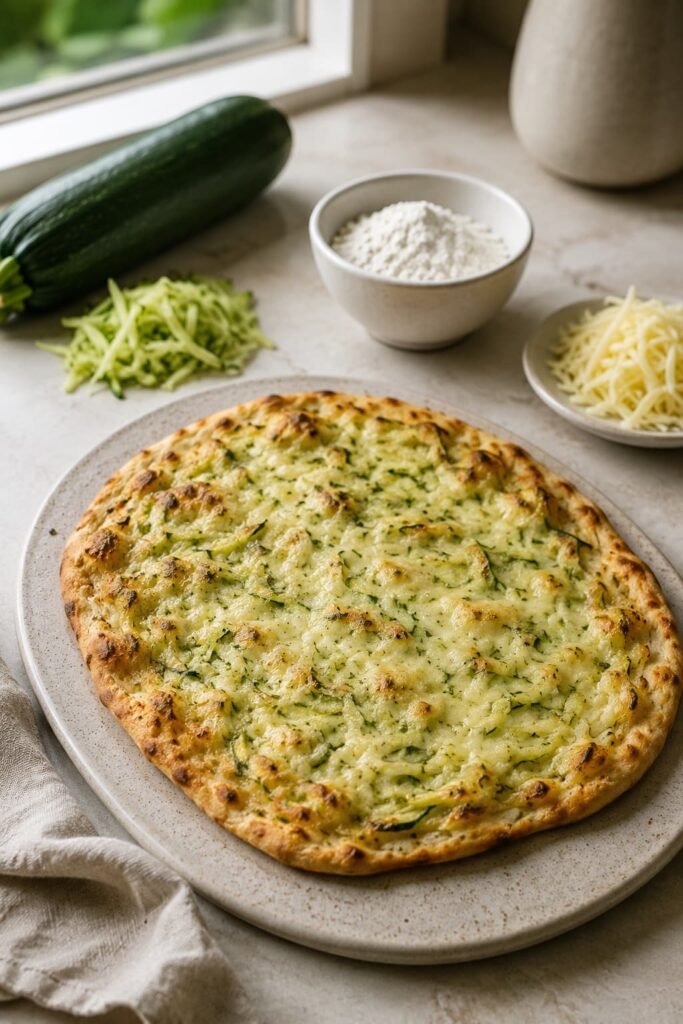
Zucchini flatbread is a thin savory preparation in which zucchini forms part of the base instead of being used only as a topping. Depending on the style, the mixture may also contain cheese, egg, flour, starch, or another ingredient that helps it hold together.
Because zucchini contains a large amount of water, a vegetable-based flatbread behaves differently from conventional flour dough. Moisture, binders, cheese, thickness, and cooking conditions can all affect how firmly the base sets.
The final texture can vary. Some versions remain tender or flexible, while others develop firmer surfaces and browned edges.
What Is Zucchini Flatbread?
Zucchini flatbread generally refers to a thin baked base made with grated or shredded zucchini.
The same name is sometimes used for conventional flatbread dough topped with zucchini. Here, the focus is on versions where zucchini is mixed directly into the base and contributes to its moisture and texture.
Zucchini does not provide the same starch and gluten-forming proteins as wheat flour. Vegetable-based versions therefore commonly use other ingredients to help create structure.
These may include egg, cheese, flour, starch, or another binder.
There is no single standard formula. Some versions contain enough flour to resemble a thin batter-based bread, while others rely more heavily on zucchini, cheese, egg, or alternative binders.
How Is Zucchini Flatbread Different From Regular Flatbread?
The main difference is how the base develops structure.
Many conventional flatbreads are made primarily from flour and liquid. Depending on the style, they may also contain yeast, oil, yogurt, or other ingredients.
A zucchini-based version replaces part of that flour-centered structure with a moisture-rich vegetable. This makes moisture management and binding especially important.
Vegetable-Based Flatbread vs. Flour-Based Flatbread
Wheat-based dough gets structure from starch and gluten-forming proteins.
When wheat flour is mixed with water, proteins in the flour can form gluten. This network contributes strength and elasticity to many types of dough.
Zucchini does not provide this type of structure. Instead, it contributes water and vegetable tissue.
Once grated or shredded, zucchini has more exposed cut surfaces, which can make moisture easier to release.
A zucchini-rich base therefore commonly depends on other ingredients for support. Egg may contribute structure as its proteins set during heating. Flour or starch can help manage moisture and add firmness. Cheese may also affect texture depending on the type and amount used.
Because of these differences, a vegetable-based flatbread should not be expected to behave exactly like conventional bread dough. Some versions may be more tender, flexible, or delicate.
Is Zucchini Flatbread the Same as Scarpaccia?
Not necessarily.
Scarpaccia is a traditional preparation associated with Versilia in Tuscany. Regional versions differ. The style associated with Camaiore is savory and commonly uses zucchini, while Viareggio is known for a sweeter version.
Traditional descriptions commonly include zucchini with ingredients such as flour, eggs, and milk, although preparation can vary.
Because savory scarpaccia is thin and zucchini-forward, it may be described in English as a zucchini pie, tart, or flatbread-like dish.
Zucchini flatbread is a broader description. It can include vegetable-based preparations that are not intended to reproduce traditional scarpaccia.
Some are closer to a thin baked vegetable batter, while others are designed more like a zucchini pizza base or flexible flatbread.
What Ingredients Give Zucchini Flatbread Structure?
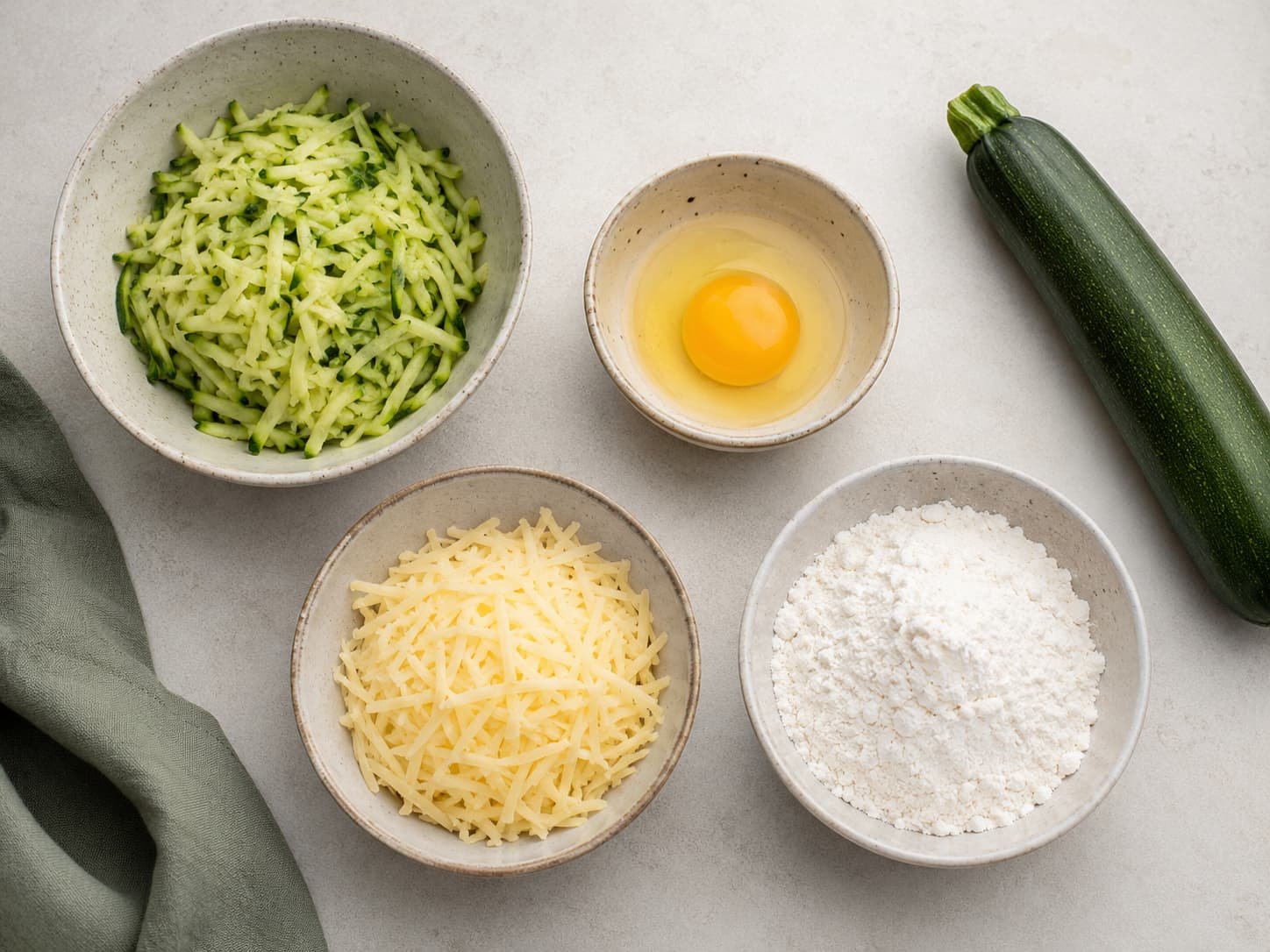
A zucchini-rich mixture usually needs ingredients that help manage moisture and create enough structure for the cooked base to hold together.
The effect of each ingredient depends on the whole formulation.
Zucchini, Egg, Cheese, and Dry Binders
Zucchini provides the main vegetable component and contributes substantial moisture.
Grating or shredding helps distribute it through the mixture, but the amount of liquid retained in the vegetable can affect the final consistency.
Egg may contribute binding and structure. When egg proteins are heated, they set and can help connect the surrounding ingredients.
Adding more egg does not automatically produce a firmer result. Its effect depends on the amount of zucchini, cheese, dry ingredients, and other components.
Cheese can affect flavor, moisture, fat, melting behavior, and texture.
Different cheeses behave differently when heated, so their effect depends on both the variety and the amount used.
Flour, starch, or another dry binder can contribute structure and help manage available moisture.
The type and amount of binder may influence whether the finished base is soft, firm, flexible, fragile, or more bread-like.
How Does the Type of Cheese Affect the Flatbread?
Different cheeses can change both moisture and texture.
Mozzarella is available in forms with different moisture levels. Fresh-style mozzarella generally contains more water than products specifically labeled as low-moisture mozzarella.
In a zucchini-rich mixture, that extra moisture becomes part of the overall liquid balance.
Parmesan is a harder grating cheese and behaves differently from mozzarella. It may be used alone or together with a softer melting cheese.
Neither cheese guarantees a particular texture. Parmesan does not automatically make the base crisp, and mozzarella does not guarantee a soft or stretchy result.
Zucchini moisture, binders, cheese quantity, thickness, and cooking conditions all influence the outcome.
Can Different Flours or Binders Be Used?
Yes, but they should not automatically be treated as direct substitutes.
All-purpose flour provides starch as well as wheat proteins that can form gluten when hydrated.
Oat flour does not provide the same gluten-forming proteins as wheat flour, so its effect on consistency and structure can differ.
Almond flour contains more fat and behaves differently from wheat flour during baking.
Gluten-free flour blends vary widely. They may contain different flours, starches, gums, or other ingredients, so one blend can behave differently from another.
Starch-based binders can thicken or contribute structure when heated with moisture, but their behavior depends on the specific starch and formulation.
Changing the binder may affect moisture management, firmness, flexibility, fragility, and surface texture.
Exact substitution ratios should come from a formulation developed for that change rather than being guessed.
Why Is Moisture Control Important?
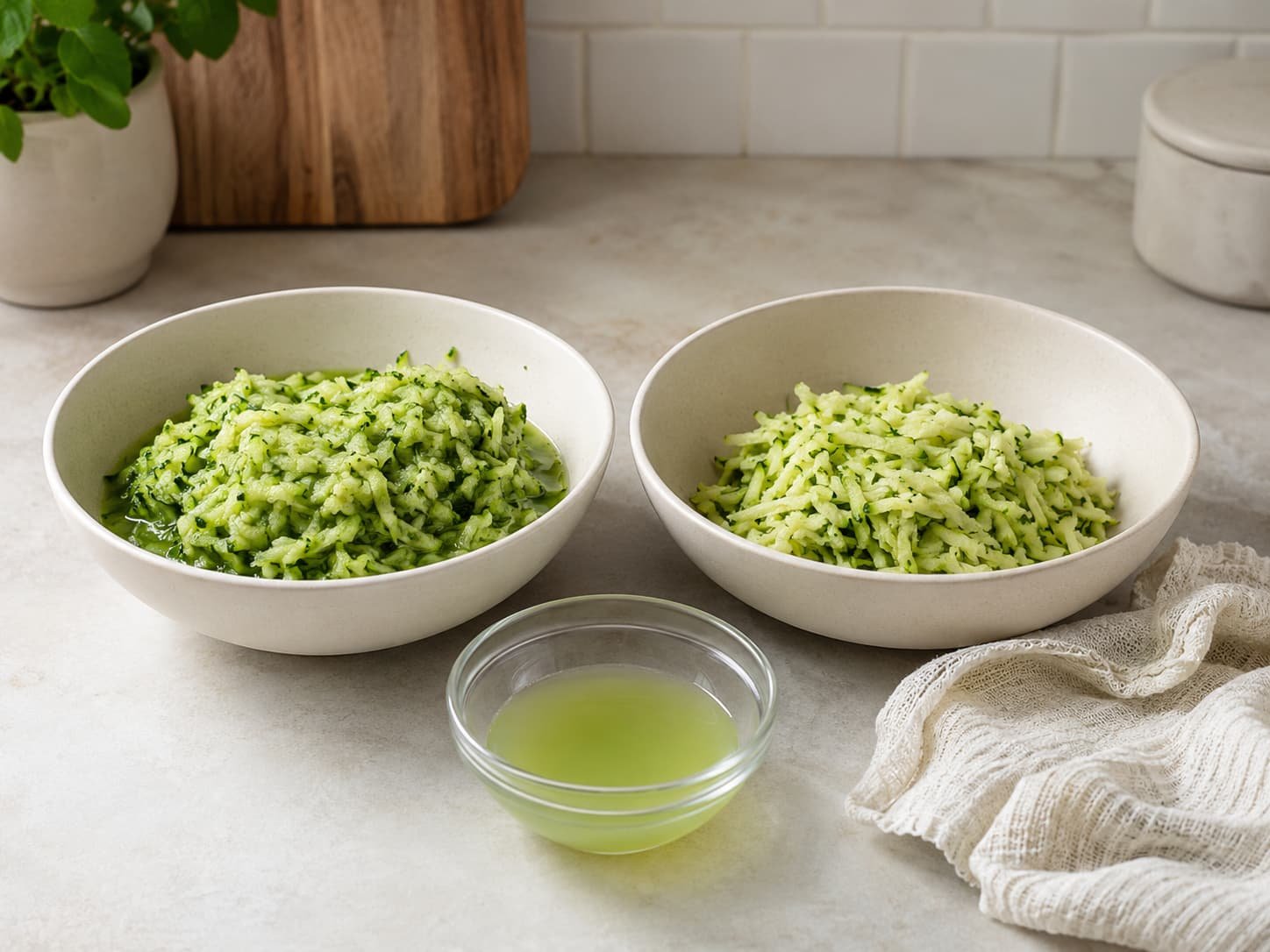
Moisture affects how easily the base sets.
Zucchini contributes a large amount of water, and that liquid needs to work with the egg, cheese, flour, starch, or other binders in the mixture.
Removing more liquid is not automatically better. Some preparations are designed around drained zucchini, while others account for more of its natural moisture.
Why Does Grated Zucchini Release Water?
Grating creates many exposed cut surfaces. This makes liquid easier to release during draining, squeezing, salting, mixing, or cooking.
That moisture becomes part of the flatbread mixture.
If a formulation contains more free liquid than its structural ingredients can manage, the center may remain softer or more delicate.
Zucchini moisture should therefore be considered together with the other ingredients rather than as a separate issue.
Does Zucchini Need to Be Drained or Squeezed?
Not in every preparation.
When a particular preparation calls for removing excess liquid, a clean kitchen towel or reusable cheesecloth can be used to help press moisture from the grated zucchini.
There is no universal rule that zucchini must be completely dry.
A mixture containing more flour or another moisture-absorbing ingredient may behave differently from one containing little dry binder.
If a specific formula expects drained zucchini, retaining much more liquid can change its consistency. Removing substantially more moisture than expected can also change the result.
Moisture balance is more useful than simply removing as much water as possible.
How Does Thickness Affect Moisture and Texture?
Thickness can influence how easily heat and moisture move through the mixture.
A relatively thin layer has more exposed surface compared with the amount of mixture underneath it. This may allow moisture to escape more readily and may encourage more surface browning.
A thicker layer may retain more moisture toward the center and remain softer inside.
Even thickness also matters. If one section is much thicker than another, the thinner area may firm or brown sooner while the thicker area remains softer.
There is no single ideal thickness for every formulation.
How Is Zucchini Flatbread Generally Prepared?
The general process involves preparing the zucchini, managing excess moisture when needed, combining the ingredients, and spreading the mixture before baking.
Exact quantities, pan sizes, temperatures, and cooking times depend on the specific formulation. These steps therefore explain the method rather than provide an unverified recipe.
Preparing and Combining the Ingredients
A box grater can be a useful tool for shredding zucchini into relatively even pieces before it is combined with the other ingredients.
If the formulation requires moisture removal, some liquid may then be drained or squeezed from the vegetable.
The zucchini can be combined with ingredients such as egg, cheese, flour, starch, herbs, and seasonings.
The mixture is generally spread into an even layer before cooking.
Its uncooked texture does not necessarily resemble regular bread dough. Depending on the ingredients, it may be softer or more batter-like.
What Happens During Baking?
Several changes can occur as the mixture heats.
Water evaporates from exposed surfaces.
If egg is present, its proteins set and can contribute to the structure of the cooked base.
Starches also change when heated with enough water. This can help thicken and firm the mixture.
Cheese may soften or melt, while exposed areas can brown depending on moisture, temperature, ingredients, and cooking conditions.
Together, these changes can turn a loose mixture into a more cohesive base.
There is no single baking temperature or cooking time that applies accurately to every version.
Why Can Cooling Make It Easier to Handle?
Some baked mixtures containing vegetables, egg, starch, and melted cheese may be more delicate while very hot.
As the food cools, melted fats and cheeses can become less fluid, and the cooked structure may become easier to cut or lift.
Cooling may improve handling, but it cannot correct a base that failed to develop enough structure during cooking.
No universal cooling time applies to every formulation.
What Texture Can Zucchini Flatbread Have?
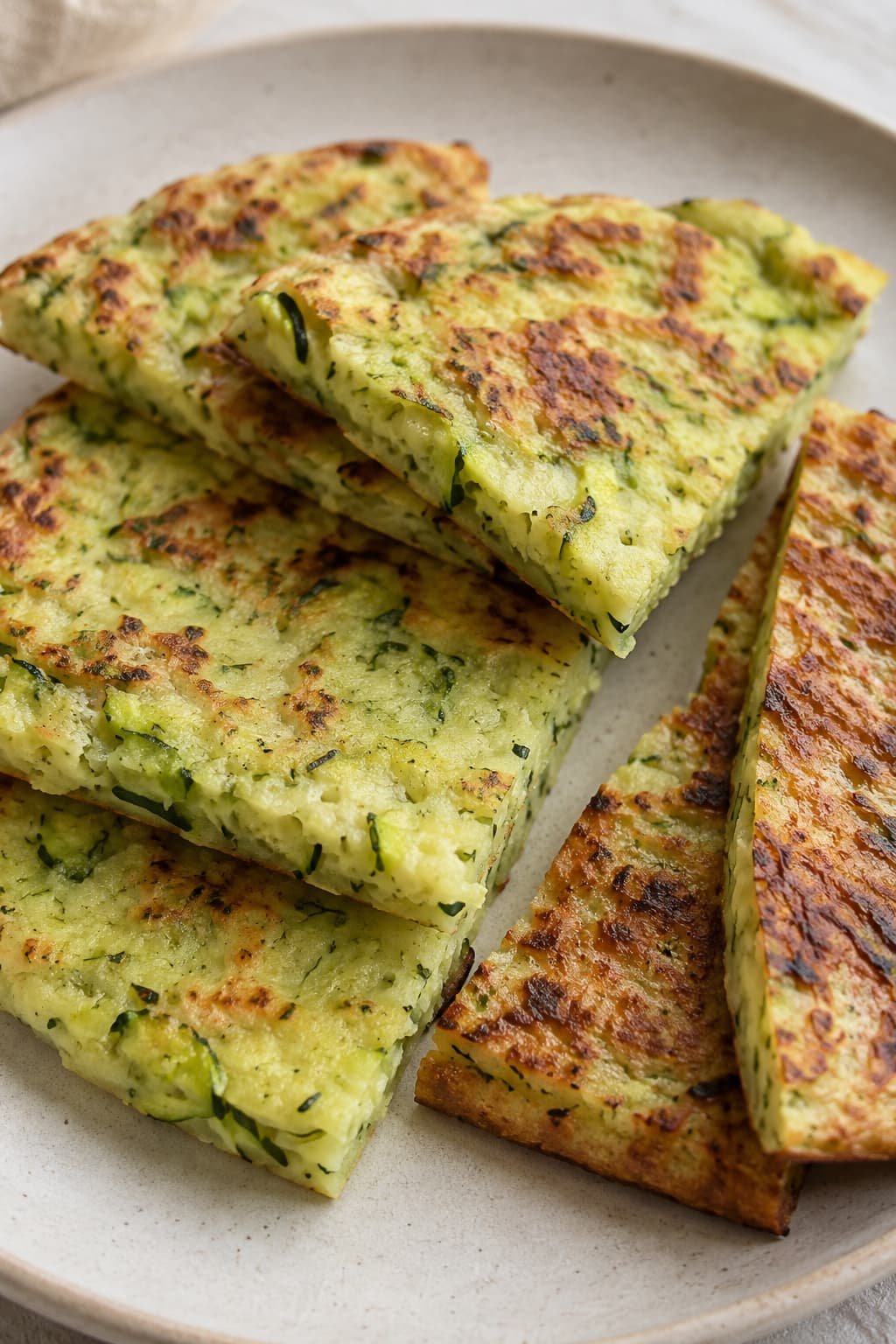
The texture can range from soft and flexible to firmer with browned edges.
Zucchini moisture, binders, cheese, thickness, and cooking conditions all contribute to the final result.
There is no single texture that defines every version.
Soft and Flexible vs. Firm and Browned
A preparation that retains more moisture may remain softer toward the center.
The type and amount of dry binder can affect how firmly the base sets. Cheese can also change the texture because different varieties contain different amounts of water, fat, and protein.
A thinner layer may lose moisture more readily, while a thicker one may stay softer inside.
These factors work together, so one ingredient should not be treated as the only reason for a particular texture.
Can It Become Crispy?
Some areas can become crisp, firm, or browned, especially exposed surfaces and edges.
However, a zucchini-rich center may remain more tender because the vegetable contributes substantial moisture.
It should not automatically be expected to have the same dry texture as a cracker or very thin wheat-based crispbread.
The amount of surface crispness can vary with moisture, thickness, binders, cheese, and cooking conditions.
Why Does Zucchini Flatbread Become Soggy or Fall Apart?
A wet or fragile result can have several causes.
Possible factors include excess moisture, insufficient structure, thickness, ingredient substitutions, toppings, or cooking conditions.
Because several factors can interact, simply adding more flour or baking longer is not always the correct solution.
What Can Cause a Wet or Soggy Center?
Too much available moisture is one possible cause.
If a formula expects drained zucchini but substantially more liquid remains, the consistency can change.
Cheese may contribute additional moisture as well. Changing from a lower-moisture cheese to a wetter variety can affect the overall liquid balance.
A thick or unevenly spread base may also cook differently from a thinner, even layer.
Pizza-style toppings can add more moisture. Sauce, fresh vegetables, and high-moisture cheese may soften an already delicate base.
A wet center should therefore be evaluated by considering the full formulation rather than blaming one ingredient automatically.
Why Can the Flatbread Break?
A base may be difficult to lift or cut when its cooked structure is not strong enough for the amount of moisture present.
Egg, flour, starch, and other binders can contribute structure, but their importance depends on the formulation.
Ingredient substitutions can also change the result. Wheat flour, almond flour, oat flour, starches, and gluten-free blends do not behave identically.
Some baked vegetable-and-cheese mixtures may also be more delicate while very hot.
Why Can It Become Too Dry?
A dry or unusually firm result may occur when too much moisture is removed or when the balance shifts toward dry structural ingredients.
Using considerably more binder than a particular formulation was designed for may produce a firmer or denser texture.
A very thin layer may lose moisture more readily, and continued baking can remove additional water.
These are possible causes, not universal diagnoses. The appropriate adjustment depends on the specific formulation.
Can Zucchini Flatbread Be Used in Different Ways?
Yes. Depending on its structure, it may work as a simple savory flatbread, a pizza-style base, or a flexible wrap.
Not every version will work equally well for each use.
Using It as a Pizza-Style Base
Some versions can support pizza-style toppings, but vegetable-based bases may be more delicate than conventional flour dough.
Wet toppings such as sauce, fresh vegetables, or higher-moisture cheese can add liquid.
Weight also matters. A thin or fragile base may become harder to lift when heavily topped.
The amount and moisture of the toppings should therefore match the strength of the base.
Using It as a Wrap
Some thinner, more flexible versions may work as wraps.
Whether the flatbread bends without breaking depends on its moisture, binders, cheese, thickness, and degree of browning.
A firmer version may crack when folded, while a more flexible formulation may hold a filling.
Gluten-Free, Egg-Free, and Flourless Variations
These variations are possible, but changing a structural ingredient can change the entire preparation.
A gluten-free version must consider every ingredient used, not only the flour. Cross-contact can also matter.
An egg-free version needs another approach to structure because removing egg changes how the mixture sets.
A flourless version may depend more heavily on egg, cheese, starch, or another binder.
Flourless and gluten-free do not mean the same thing. Removing flour alone does not establish that every other ingredient is gluten-free.
These variations are better treated as separate formulations rather than simple one-for-one substitutions.
What Should You Consider Before Changing the Formula?
First identify what the ingredient contributes.
Changing one ingredient can affect several characteristics at the same time, including:
- moisture,
- binding,
- firmness,
- flexibility,
- browning,
- and the ability to support toppings.
Changing the flour may alter both moisture absorption and structure. Changing the cheese may affect moisture and melting behavior. Removing egg may change how the mixture holds together.
Making several substitutions at once can make the outcome harder to predict.
For this reason, substitutions should be evaluated as changes to the whole formulation rather than assuming ingredients are interchangeable.
How Should Zucchini Flatbread Be Stored and Reheated?
A cooked flatbread containing zucchini, cheese, egg, or other perishable ingredients should be treated as a perishable leftover.
USDA guidance recommends refrigerating cooked leftovers within 2 hours and generally using refrigerated leftovers within 3 to 4 days.
When reheating leftovers, USDA guidance recommends an internal temperature of 165°F (74°C).
These figures relate to food safety, not texture.
Why Can Refrigeration Change the Texture?
Refrigerated flatbread may feel different from a freshly baked version.
Moisture can move through the food during storage, which may soften previously browned surfaces.
Cheese and the vegetable-rich base may also feel firmer when cold.
The amount of texture change depends on the formulation and moisture level.
How Can Reheating Affect the Surface?
Different reheating methods can affect surface texture differently.
Dry-heat methods such as an oven or skillet may allow more surface moisture to evaporate, which may produce a firmer exterior.
Microwave reheating may leave the base softer because less surface drying occurs.
Neither method guarantees that the original texture will return.
Frequently Asked Questions About Zucchini Flatbread
Does zucchini flatbread need yeast?
Not necessarily.
Many vegetable-based versions are made without yeast and instead use egg, cheese, flour, starch, or other binders for structure.
Conventional flatbread dough topped with zucchini may use yeast, so it depends on the style being prepared.
Do you have to peel zucchini for flatbread?
Usually not when using young zucchini with tender skin.
The zucchini should be washed before preparation. Larger or more mature zucchini may have firmer skin and more developed seeds, so peeling or removing the seedy center may be chosen depending on the preparation.