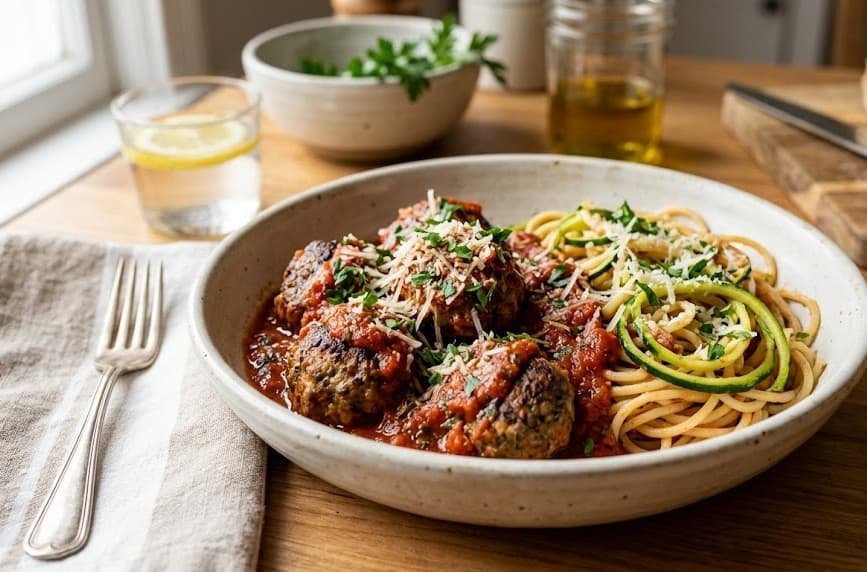
Turkey meatballs can be made without breadcrumbs. However, leaving breadcrumbs out changes the overall balance of the mixture because breadcrumbs can contribute dry material and starch that affect moisture, structure, and texture.
A breadcrumb-free version may use ingredients such as egg, cheese, oats, oat flour, almond flour, vegetables, or seasonings. There is no single replacement that every preparation requires. How the meatballs handle and cook depends on the full combination of ingredients rather than one binder alone.
What Are Turkey Meatballs Without Breadcrumbs?
Turkey meatballs without breadcrumbs are made primarily from ground turkey and other ingredients without adding breadcrumbs to the mixture.
Breadcrumbs are common in many meatball recipes, but they are not required in every formulation. Some breadcrumb-free versions use egg, cheese, oats, or another dry ingredient, while others do not use a direct breadcrumb replacement.
People may omit breadcrumbs because they are unavailable, because another ingredient is being used, or because a recipe is being adapted for a particular preference or dietary requirement.
Removing breadcrumbs alone does not automatically make the finished meatballs gluten-free, low-carb, keto, or suitable for another specific diet. That depends on all of the ingredients used.
What Do Breadcrumbs Normally Do in Meatballs?
Breadcrumbs can affect the structure and moisture balance of a meatball mixture. Research on meat products shows that starches and other non-meat ingredients can influence water retention, cooking loss, firmness, and texture. The effect depends on the ingredient, the amount used, and the rest of the formulation.
This means removing breadcrumbs can change more than the ingredient list. It may also change the balance between meat, moisture, fat, protein, and dry ingredients.
Breadcrumbs can be added dry or combined with liquid before being mixed with the meat. A bread-and-liquid mixture used in this way is commonly known as a panade.
A panade is different from adding a dry ingredient alone because it introduces hydrated bread. Oats, almond flour, cheese, egg, and hydrated bread therefore should not be assumed to behave in the same way.
Breadcrumbs are one possible part of a meatball formulation rather than a requirement. When they are removed, the way the remaining ingredients work together becomes more important than finding one universal substitute.
What Ingredients Are Commonly Used in Breadcrumb-Free Turkey Meatballs?
Breadcrumb-free turkey meatballs usually start with ground turkey and seasonings. Other ingredients may be included for structure, moisture, flavor, or more than one purpose.
There is no universal ingredient list. One preparation may contain egg and Parmesan, another may use oats or oat flour, and another may rely on a simpler combination of ingredients.
Ground Turkey
Ground turkey is the main meat component.
Ground turkey products can vary in composition and may have different lean-to-fat percentages. Those differences can influence how a mixture handles and cooks, although the final result also depends on the other ingredients and preparation method.
There is therefore no reason to describe one particular lean percentage as universally better for breadcrumb-free meatballs. Checking the package label is more useful than assuming every ground turkey product will behave identically.
Ground turkey should also be handled as raw poultry. Food-safety decisions should be based on verified poultry guidance rather than the appearance of the raw or cooked meat.
Eggs and Other Binding Ingredients
Egg appears in many meatball preparations and can contribute to the structure of a cooked mixture. However, it is not required in every breadcrumb-free formulation.
Other ingredients that may appear include:
- Parmesan cheese, which adds flavor and cheese solids.
- Oats or oat flour, which add a dry cereal-based ingredient that can interact with moisture.
- Almond flour, which has a different composition from wheat breadcrumbs or oats.
These ingredients should not be treated as automatic one-for-one substitutes. They contain different amounts and types of protein, fat, starch, fiber, and moisture.
Quantity also matters. Without a specifically developed and verified formula, there is no reliable basis for saying that a fixed amount of oats, cheese, almond flour, or egg will replace a particular amount of breadcrumbs.
Ingredients That Can Add Moisture or Flavor
Onion, garlic, herbs, seasonings, cheese, and added fat may also appear in breadcrumb-free meatballs.
Onion or grated onion adds flavor and introduces some water. Garlic, herbs, and seasonings mainly contribute flavor, although fresh and dried ingredients do not add the same amount of moisture.
Cheese can add flavor along with protein, fat, moisture, and other solids depending on the variety. Some preparations also contain added fat, which changes the overall composition of the mixture.
These ingredients need to be considered together. A mixture containing egg and grated onion, for example, may behave differently from one made mainly with ground turkey, dry seasonings, and a dry binder.
What Can You Use Instead of Breadcrumbs in Turkey Meatballs?
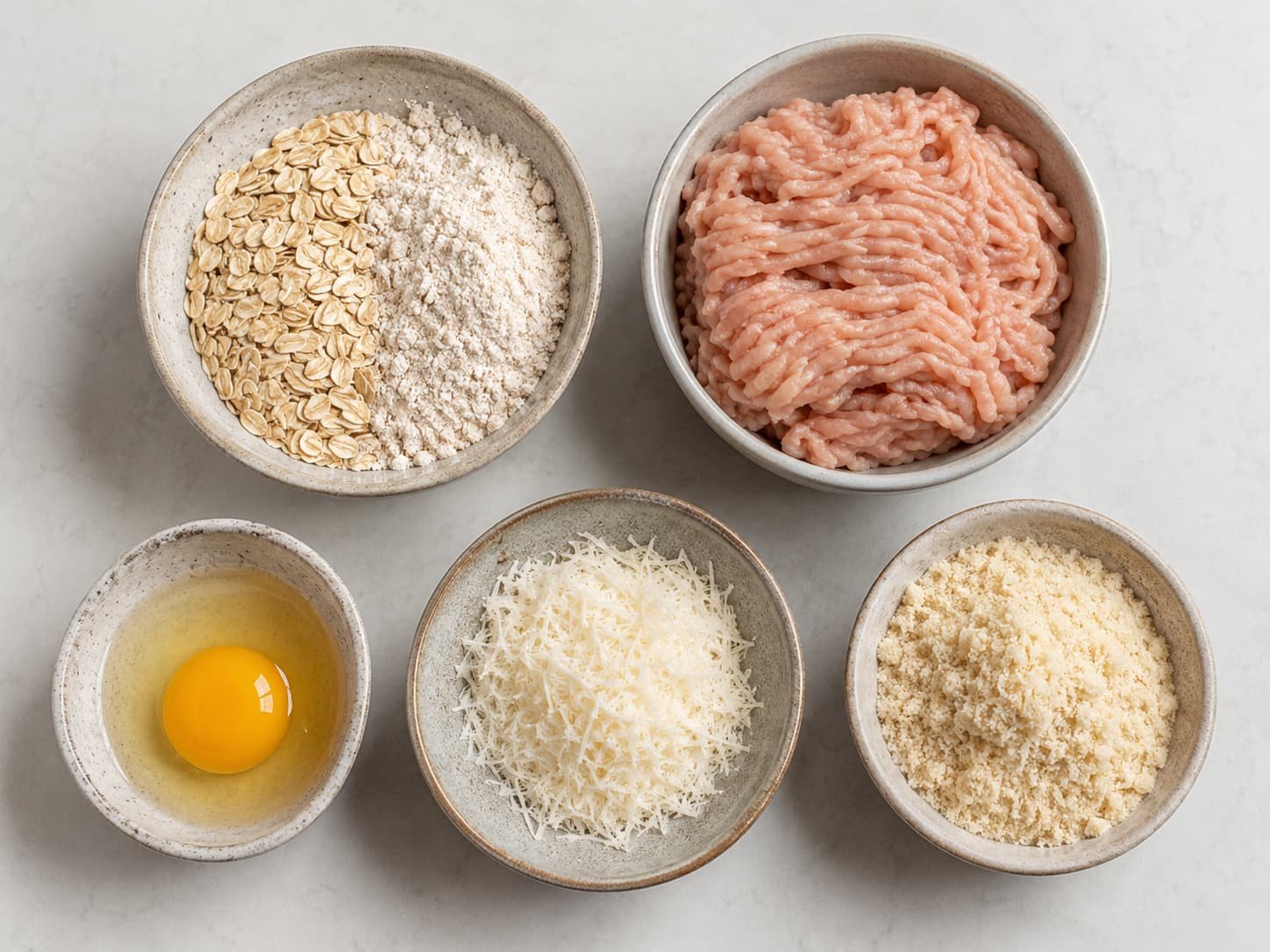
Possible alternatives include oats, oat flour, almond flour, cheese, or a formulation that uses egg without a dry breadcrumb substitute. None of these options behaves exactly like breadcrumbs.
The appropriate choice depends on the rest of the mixture, and fixed substitution ratios should come from a specifically developed recipe rather than being assumed.
Oats or Oat Flour
Oats and oat flour are used as dry cereal-based ingredients in some breadcrumb-free meatball preparations.
Research on ground-meat products shows that oat ingredients can affect water retention, cooking yield, and texture. The effect varies with the type of oat ingredient, the quantity used, and the rest of the formulation.
Whole oats, processed oats, and oat flour should not automatically be treated as identical. Particle size, processing, and available moisture can affect how they interact with the mixture.
Oats are therefore one possible option, not a universal breadcrumb substitute at a fixed ratio.
Almond Flour
Almond flour is another ingredient used in some breadcrumb-free preparations, but it differs substantially from bread-based ingredients.
It contains a different balance of fat, protein, fiber, and carbohydrate than wheat breadcrumbs. Research using almond flour in ground-meat products also shows that its effect can vary depending on the amount used and what it replaces.
Almond flour may change how a mixture handles and cooks, but it should not be described as a direct one-to-one replacement unless a particular recipe has established that substitution.
Parmesan or Other Cheese
Parmesan and other cheeses may contribute flavor and additional solids to a meatball mixture.
Cheese is not compositionally equivalent to breadcrumbs. Depending on the variety, it may contain different amounts of protein, fat, moisture, and salt.
For that reason, Parmesan can be one ingredient in a breadcrumb-free formulation, but it should not be presented as a universal replacement or as a guarantee that the meatballs will hold together.
Egg Without a Dry Breadcrumb Substitute
Some meatball formulations use egg without breadcrumbs or another dry replacement.
Egg proteins can contribute to the structure of cooked ground-meat mixtures, but the presence of egg does not make every breadcrumb-free mixture behave the same way.
Other formulations omit both breadcrumbs and egg. The complete combination of meat, moisture, dry ingredients, cheese, vegetables, and preparation method determines how the mixture behaves.
How Does a Breadcrumb-Free Turkey Meatball Mixture Behave?
A breadcrumb-free mixture can vary from soft and sticky to relatively firm depending on the ingredients used. There is no single consistency that is correct for every formulation.
Mixture Moisture and Stickiness
Ground turkey composition, egg, grated vegetables, cheese, and dry ingredients can all influence moisture and handling.
A mixture containing grated onion may behave differently from one using only dry seasonings. Likewise, adding oats or another dry ingredient can change consistency, but the effect depends on the ingredient and quantity.
Stickiness alone does not mean a mixture is wrong, and a firm mixture is not automatically better. Without a defined recipe, one exact texture should not be presented as the correct consistency.
Mixing and Texture
Mixing distributes the turkey, seasonings, and other ingredients throughout the mixture.
The extent of mixing can also affect how cohesive a ground-meat mixture becomes. More extensive mixing may contribute to a firmer or denser cooked structure depending on the formulation.
There is no useful universal rule such as mixing for an exact number of seconds. The practical goal is to distribute the ingredients sufficiently for the mixture to be portioned and shaped.
Shaping and Portion Consistency
Keeping portions reasonably similar in size can help them cook at a more similar rate.
If some meatballs are much larger than others, smaller pieces may reach the required internal temperature sooner. This can make a batch harder to cook evenly.
There is no need for one universal diameter or weight. Consistency within the batch is the more useful consideration.
How Can Turkey Meatballs Be Cooked?
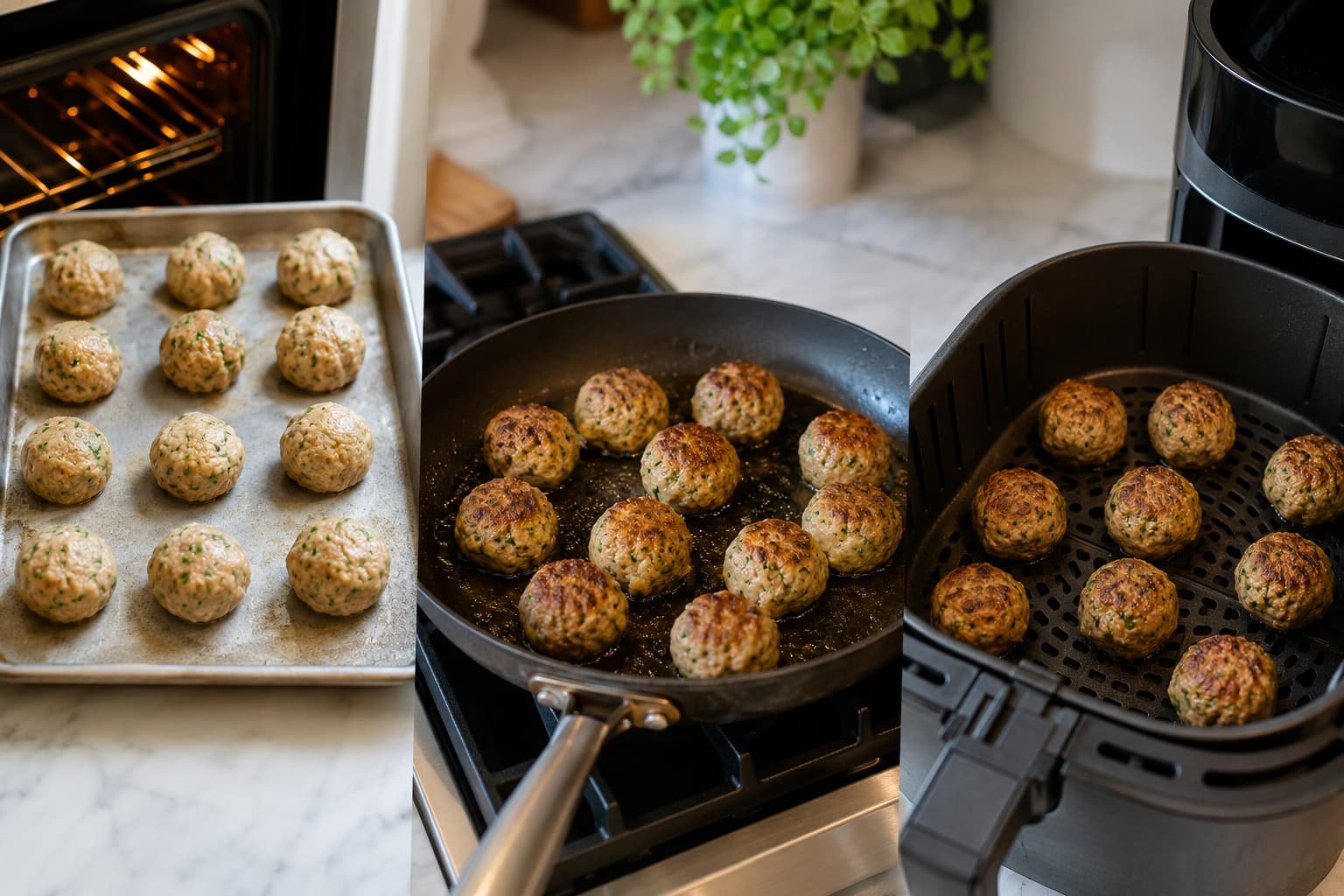
Turkey meatballs can be baked, cooked in a skillet, or air fried. Each method exposes the food to heat differently, so browning and cooking rate can vary.
Exact cooking times cannot be assumed across methods because meatball size, starting temperature, ingredients, equipment, and heat settings all matter.
Regardless of the method, safe doneness should be determined with verified ground-poultry temperature guidance.
Baking
Baking cooks meatballs with hot air inside the oven and generally requires less turning than skillet cooking.
Spacing the portions apart allows more air to move around them. Crowding may change the cooking environment and can affect surface browning.
Size also matters because larger portions generally require more time for heat to reach the center than smaller ones.
Ovens can vary in temperature accuracy and heat distribution, so one baking time should not be presented as universal for every breadcrumb-free preparation.
Skillet Cooking
Skillet cooking places part of each meatball in direct contact with a heated pan, which can encourage browning on the surface touching the pan.
Turning exposes additional sides to the heat. Meatball size, pan temperature, and shape can all affect how evenly the exterior and center cook.
The outside may brown before the center reaches a safe temperature, especially when the meatballs are larger or the surface heat is high. Exterior color should therefore not be used as proof of doneness.
Air Frying
Air fryers cook by circulating heated air around the food.
Spacing in the basket can influence airflow. Crowding may limit how evenly heated air moves around individual meatballs.
Air fryers also vary in basket design, heating elements, airflow, capacity, and temperature accuracy. Because of those differences, instructions developed for one appliance should not automatically be assumed to work exactly the same way in another.
What Internal Temperature Should Turkey Meatballs Reach?
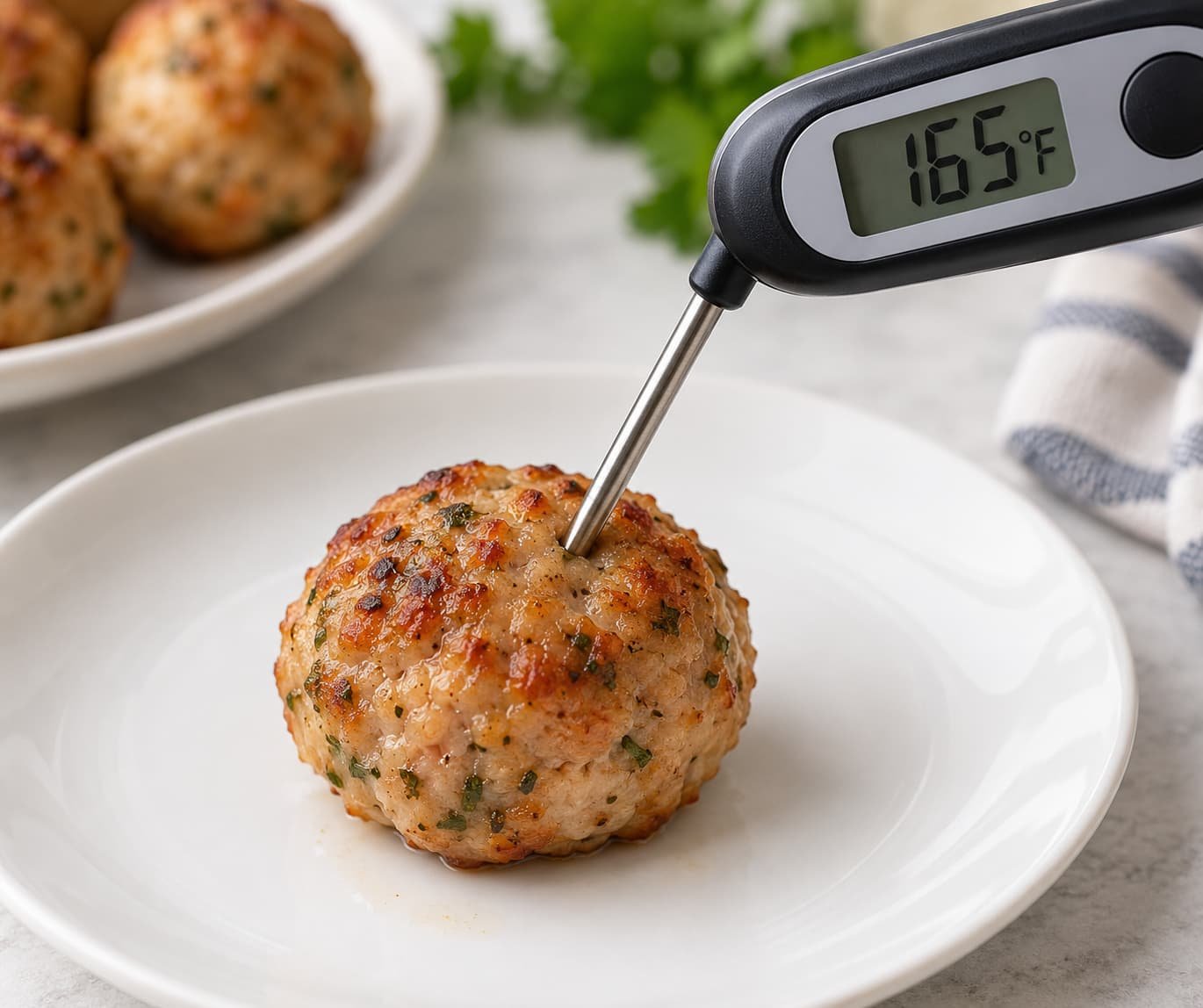
Ground turkey meatballs should reach a minimum internal temperature of 165°F (73.9°C), according to USDA guidance for ground poultry.
Use a food thermometer to check the internal temperature. Appearance alone is not a reliable safety test because safely cooked poultry can vary in color.
Browning on the outside also does not confirm that the center has reached the required temperature.
What Can Affect Turkey Meatball Moisture and Texture?
Moisture and texture depend on several factors working together, including the ground turkey, added ingredients, mixing, meatball size, and cooking conditions.
Different ground turkey products can have different compositions. Egg, grated vegetables, cheese, and other ingredients may change the amount and distribution of moisture and solids in the mixture.
Dry ingredients such as oats, oat flour, or almond flour can also affect moisture differently depending on the ingredient and amount used.
Cooking conditions matter as well. Heat changes meat proteins and can influence water retention and firmness. Meatball size and cooking method further affect how quickly heat reaches the center.
No single ingredient or technique can guarantee moist or tender meatballs in every formulation.
Why Do Turkey Meatballs Fall Apart, Become Dry, or Cook Unevenly?
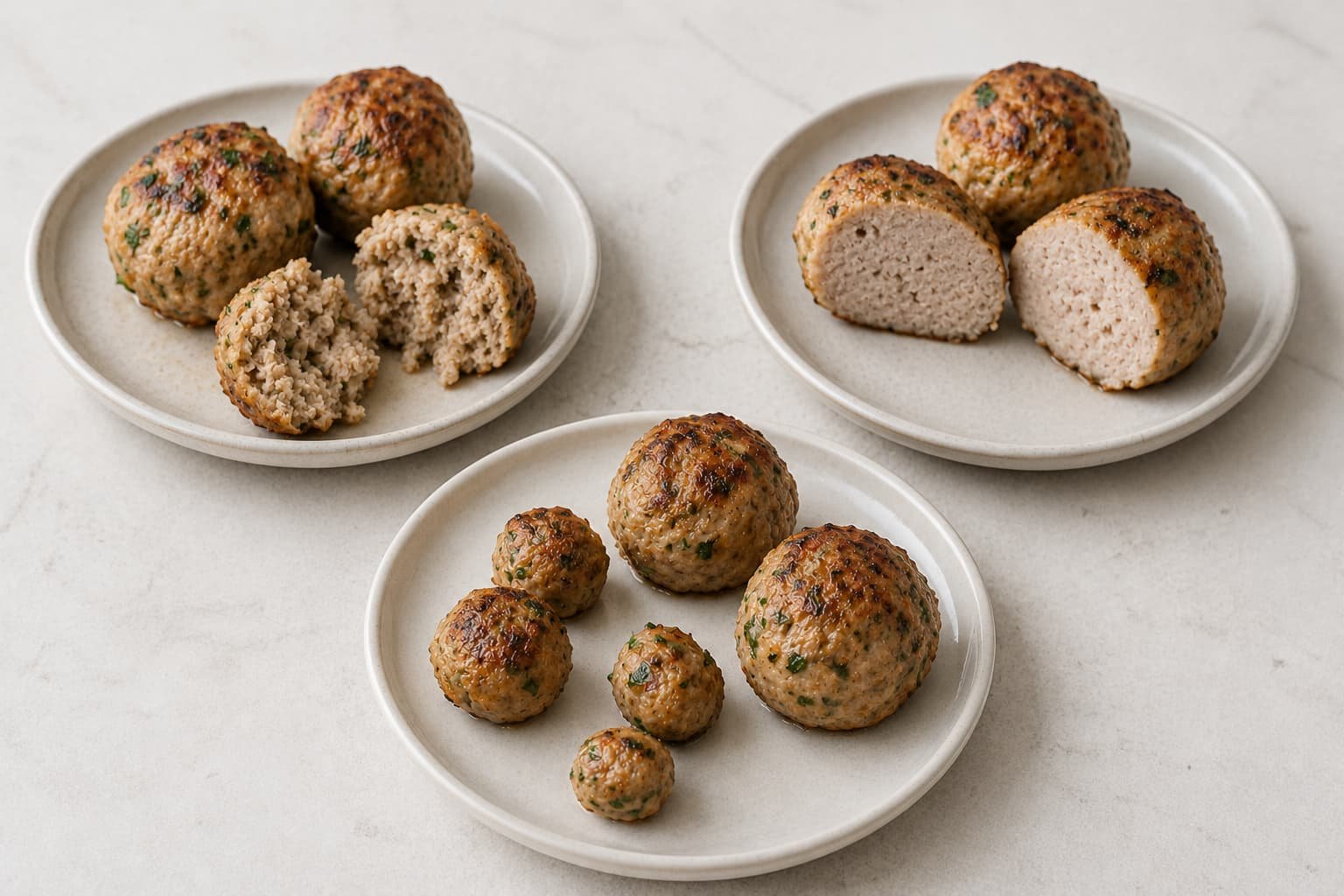
Texture and cooking problems can have several possible causes. Looking at the whole mixture and cooking method is more useful than assuming one ingredient is responsible.
Meatballs Fall Apart
Meatballs may have difficulty holding their shape when the mixture does not develop enough structure during shaping and cooking.
Possible contributing factors include the balance of meat and moisture, the ingredients used for structure, and how the portions are handled.
A very wet mixture may be harder to shape, but excess moisture is not the only possible cause. Moving or turning the meatballs while their structure is still developing may also contribute in some preparations.
Adding more dry binder is not automatically the solution because too much can create a different texture problem.
Meatballs Become Dry or Firm
A dry or firm texture may be related to the formulation, the amount of dry ingredients, mixing, or the extent of cooking.
Heating meat changes its proteins and can reduce water retention. Cooking further than necessary may therefore contribute to moisture loss and firmness, although the effect varies by formulation and cooking conditions.
Dry ingredients may also change moisture distribution, while extensive mixing can contribute to a more cohesive or firm structure.
The Mixture Is Very Wet or Difficult to Shape
A wet or sticky mixture does not have one universal cause.
Ground turkey composition can vary, while ingredients such as egg, grated onion, vegetables, or some cheeses may add additional moisture.
A dry ingredient can change the consistency, but there is no universal quantity that will correct every mixture. Any adjustment needs to account for the complete formulation.
Meatballs Cook Unevenly
Large differences in portion size can cause meatballs to reach the safe internal temperature at different times.
Cooking method also matters. A skillet exposes the food to direct surface heat, while ovens and air fryers rely more heavily on heated air around the food.
Crowding can change airflow or allow moisture to collect around the meatballs. Keeping portions reasonably similar in size makes it easier to judge cooking progress consistently.
What Can You Serve With Turkey Meatballs?
Turkey meatballs can be served with tomato or marinara-style sauce, pasta, rice, vegetables, or grain bowls depending on their seasoning.
Rice is one simple option. Garlic Butter Rice can be served alongside meatballs when the flavors work with the seasonings used.
For a vegetable-based side, Cheesy Italian Squash Bake with Tomatoes may suit meatballs seasoned with Italian-style herbs, cheese, or tomato-based sauce.
The serving choice can be matched to the flavor profile rather than treating one pairing as required.
How Should Cooked Turkey Meatballs Be Stored and Reheated?
Cooked turkey meatballs should be refrigerated promptly.
USDA guidance says perishable leftovers should generally not remain at room temperature for more than 2 hours, or more than 1 hour when the temperature is above 90°F (32.2°C).
Store cooked leftovers in covered containers at 40°F (4.4°C) or below and generally use them within 3 to 4 days.
When reheating leftovers, heat them to an internal temperature of 165°F (73.9°C) and check with a food thermometer.
Cooked ground poultry can also be frozen. USDA lists 2 to 3 months as a freezer-storage period for best quality. Food kept continuously frozen at 0°F (-17.8°C) or below can remain safe beyond that quality period, although flavor and texture may decline over time.
Frequently Asked Questions
Are Turkey Meatballs Without Breadcrumbs Automatically Gluten-Free?
No. Removing breadcrumbs does not automatically make the finished meatballs gluten-free.
Other ingredients, including seasoning blends, sauces, oats, cheese products, and packaged ingredients, may contain gluten or have cross-contact considerations. Anyone who needs to avoid gluten should check the labels of every ingredient used.
Can Breadcrumb-Free Turkey Meatballs Be Made Ahead?
Yes, but raw and cooked meatballs need to be treated differently.
Cooked meatballs can follow the refrigerated leftover guidance described above. Meatballs assembled with raw ground turkey should remain refrigerated and should follow safe raw-poultry handling and storage guidance until they are cooked.
Making them ahead does not change the requirement for ground turkey to reach 165°F (73.9°C) when cooked.
Can You Freeze Cooked Turkey Meatballs?
Yes. Cooked turkey meatballs can be frozen after they have been handled and cooled safely.
USDA guidance lists 2 to 3 months as the freezer period for best quality for cooked ground poultry. This is a quality guideline rather than a point at which continuously frozen food automatically becomes unsafe.
Keep the freezer at 0°F (-17.8°C) or below and reheat thawed leftovers to 165°F (73.9°C) when reheating them.