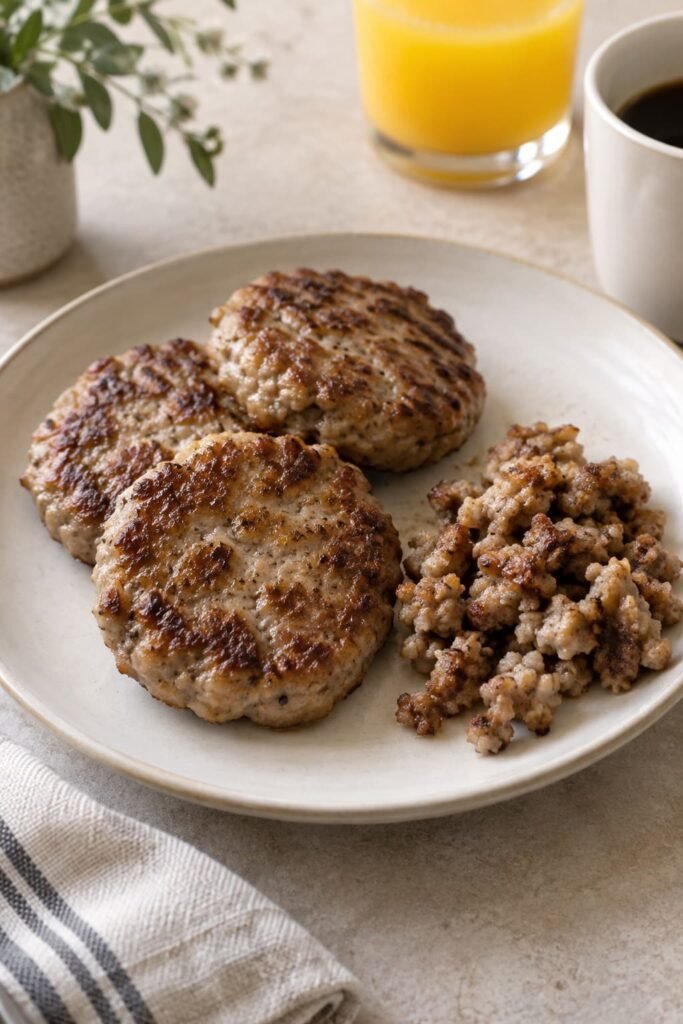
Ground chicken breakfast sausage generally refers to ground chicken seasoned in the style of breakfast sausage. The mixture may be formed into patties or cooked loose, depending on the preparation.
There is no single formula for a ground chicken breakfast sausage recipe. Published versions use different combinations of herbs, spices, sweeteners, and added fats. Sage, fennel, maple syrup, red pepper, and other seasonings appear in some recipes but are not universal ingredients.
The type of ground chicken and the other ingredients used may influence how the mixture handles and cooks. The result can vary between formulations, so an approach developed for one ground-chicken product should not automatically be expected to behave the same with another.
This article explains common ingredient categories and their roles. It does not represent a personally tested Daily Bite Recipes formula.
What Is Ground Chicken Breakfast Sausage?
Ground chicken breakfast sausage is ground chicken combined with seasonings associated with breakfast-style sausage.
Compared with a simply seasoned chicken patty, breakfast sausage typically has a more distinctive herb-and-spice profile. Published versions may include sage, thyme, black pepper, garlic, fennel, paprika, chile flakes, or other seasonings. The exact combination varies by recipe.
Breakfast sausage does not need to be stuffed into a casing. Ground meat seasoned as sausage can also be shaped into patties or prepared loose. Patty-style chicken breakfast sausages are common in published recipes.
The flavor profile can also vary. Some preparations emphasize herbs and savory spices, while others include sweetness or heat. It is therefore more useful to think of chicken breakfast sausage as a style of seasoned ground poultry rather than one fixed seasoning formula.
What Ingredients Are Commonly Used in Ground Chicken Breakfast Sausage?
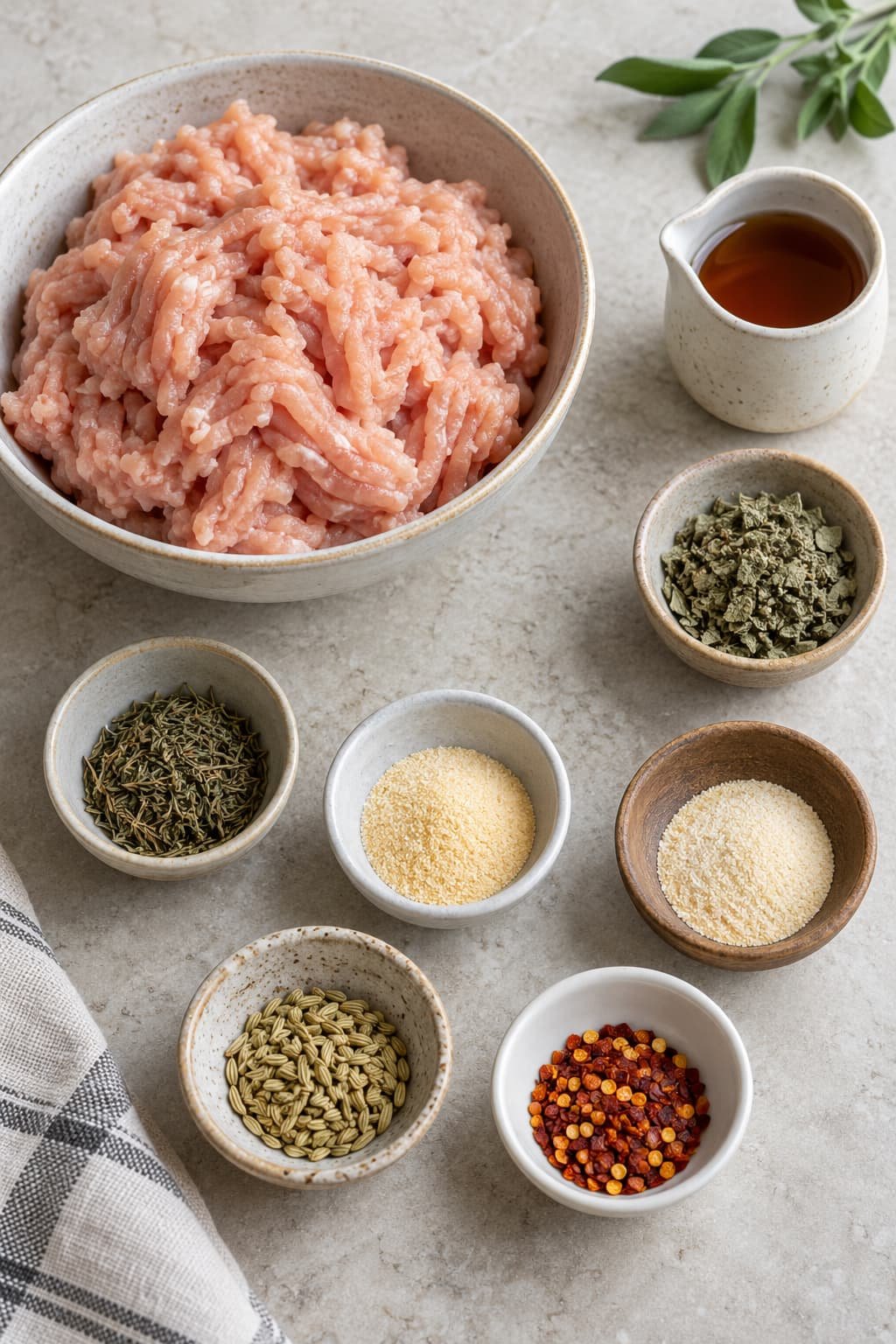
Ground chicken, salt, herbs, and spices form the basic structure of many homemade versions. Beyond those ingredients, recipes differ substantially.
Some formulations include maple syrup or another sweetener. Others use added oil, fennel, chile, or additional herbs. These ingredients belong to particular formulations rather than being requirements for every chicken breakfast sausage.
Ground Chicken and Fat Content
Ground chicken is the base of the sausage, but products sold as ground chicken are not necessarily identical.
USDA states that there is no established federal standard of identity specifically for ground poultry. Ground-poultry products must be made from the type of poultry named on the label, but the raw material used can vary between products.
For a home cook, the practical point is that it is worth checking the package rather than assuming all ground chicken has the same composition or fat content.
Differences in meat composition and fat content may affect how a sausage mixture handles and cooks. For example, a very lean ground-chicken product should not automatically be expected to behave exactly like a product containing more fat.
However, this does not establish one fat percentage as ideal for breakfast sausage. The finished texture also depends on other variables, including the complete ingredient mixture, patty dimensions, and cooking method.
For that reason, claims that a particular lean percentage will always produce softer, firmer, or juicier patties should be avoided unless they refer to a specific tested formulation.
Herbs and Spices Used for Breakfast Sausage Flavor
There is no universal breakfast-sausage seasoning blend. Published chicken breakfast sausage recipes use different combinations of herbs and spices.
Sage appears in many breakfast-sausage preparations and contributes a distinct earthy, herbal flavor. It can be a prominent seasoning, but it is not mandatory in every version.
Black pepper contributes peppery heat, while thyme provides another herbal note that can be combined with sage or other seasonings.
Garlic powder and onion powder are commonly used savory seasonings. Because they are dried ingredients, they do not add the same pieces or moisture that fresh onion or garlic would add to a mixture.
Fennel seed appears in some chicken sausage formulas but is optional. It has a sweet, aromatic flavor often described as licorice-like. One current published chicken breakfast sausage recipe uses fennel, while another specifically lists it as optional, illustrating that it is not a defining ingredient.
Red pepper flakes or cayenne may be used when a preparation is intended to have more heat. Their presence affects the flavor profile rather than determining whether the mixture qualifies as breakfast sausage.
Warm spices can also appear in some formulations. For example, nutmeg is included in certain published seasoning combinations, usually alongside more prominent savory herbs and spices.
Overall, the seasoning should be understood as a flexible combination rather than a fixed list. Sage is common, fennel is optional, and the relative amounts of herbs and spices can change the flavor considerably.
Sweeteners, Added Fat, and Other Optional Ingredients
Some chicken breakfast sausage preparations include a sweet element alongside savory seasonings. Maple syrup is one example used in published versions, but it is not required for chicken breakfast sausage in general.
Added oil or another source of fat also appears in some formulations, either within the mixture or as part of the cooking method. Whether additional fat is appropriate depends on the specific ground chicken, the rest of the ingredients, and the intended preparation. An exact amount should not be suggested without relying on a tested formula.
Egg and breadcrumbs are also not universal components of breakfast sausage patties. Published chicken breakfast sausage formulas exist without either ingredient. Other preparations may use binders or additional ingredients for a particular purpose.
Adding a binder, liquid sweetener, fat, or another ingredient can alter the overall formulation. Depending on the amounts and other ingredients present, such changes may affect moisture, firmness, stickiness, browning, or how easily patties hold their shape.
Those outcomes should not be treated as guaranteed. Without testing a specific formulation, it is more accurate to explain that changing these ingredients can change how the mixture behaves and that the result may vary.
How Do Ingredient Choices Affect the Sausage Mixture?
| How Are Ground Chicken Breakfast Sausage Patties Formed? |
Ingredient choices can affect both flavor and the way a ground-chicken mixture behaves. The exact effect depends on the full formulation, so one ingredient should not be assumed to produce the same result in every sausage mixture.
Chicken composition and fat level are important variables. Ground chicken products can differ in composition, so mixtures made with different products may not handle or cook in exactly the same way. Fat content is one factor that can influence sausage texture, but it should not be used by itself to predict the finished result.
Added liquids become part of the moisture balance of the mixture. Water, liquid sweeteners, and moisture-containing ingredients can affect sausage texture depending on the amount used and the other ingredients present. Sausage-making guidance from the University of Connecticut notes that added water can have a marked effect on texture and tenderness.
Sweeteners primarily change flavor. A liquid sweetener such as maple syrup also adds liquid to the formulation, while sugar-containing ingredients can influence browning during heating. The extent of either effect depends on the amount used and the cooking conditions.
Salt does more than provide flavor. In sausage making, salt helps extract myofibrillar proteins from meat, which contributes to binding. Mixing also affects how those proteins are distributed and developed, so the amount of mixing can influence the structure of the sausage mixture.
This does not mean that more mixing is always better or worse. The appropriate amount depends on the type of sausage and the texture being sought.
Binders, such as egg or breadcrumbs, can change the formulation and structure of a patty. Their effect depends on how much is used and how they interact with the meat, liquids, and other ingredients.
Fresh and dried ingredients can also behave differently. Fresh onion, garlic, or herbs introduce physical pieces and some moisture, while dried herbs and powdered seasonings are more concentrated and contribute much less water. They should not automatically be exchanged in equal amounts unless a reliable recipe provides a substitution.
Does Ground Chicken Breakfast Sausage Need Egg or Breadcrumbs?
No. Egg and breadcrumbs are not required in every ground chicken breakfast sausage preparation.
Many breakfast-sausage formulations are based mainly on ground meat, salt, herbs, and spices. Sausage-making guidance also explains that salt helps extract meat proteins involved in binding, so meat mixtures do not necessarily depend on egg or breadcrumbs to hold together.
Other preparations may use egg, breadcrumbs, or another binder for a particular purpose. Whether one is useful depends on the complete formulation.
Adding a binder does not guarantee that the patties will become softer, firmer, or easier to shape. Likewise, omitting one does not mean the patties will necessarily fall apart.
Why Can Ground Chicken Be Sticky or Difficult to Shape?
A ground-chicken sausage mixture may sometimes feel soft or sticky, but there is no single explanation that applies to every formulation.
Several factors may contribute, including the composition of the ground chicken, added moisture, salt, and the amount of mixing. Salt-assisted protein extraction is an intentional part of sausage binding, and this can contribute to the tacky character of a mixed sausage batter.
Temperature can also affect handling. Sausage-making guidance emphasizes keeping meat cold during preparation, and USDA advises keeping raw chicken refrigerated at 40°F (4.4°C) or below when it is being stored.
If a mixture becomes particularly soft during preparation, chilling it in the refrigerator before shaping may make it easier to handle. This is a practical handling approach, not a guaranteed correction for every sticky mixture.
Stickiness also does not automatically mean breadcrumbs, flour, or another dry ingredient should be added. Doing so changes the formulation and may affect the final texture.
It is more useful to consider the mixture as a whole: the ground chicken being used, added liquids, salt, binders, and how extensively the ingredients have been mixed.
How Are Ground Chicken Breakfast Sausage Patties Formed?
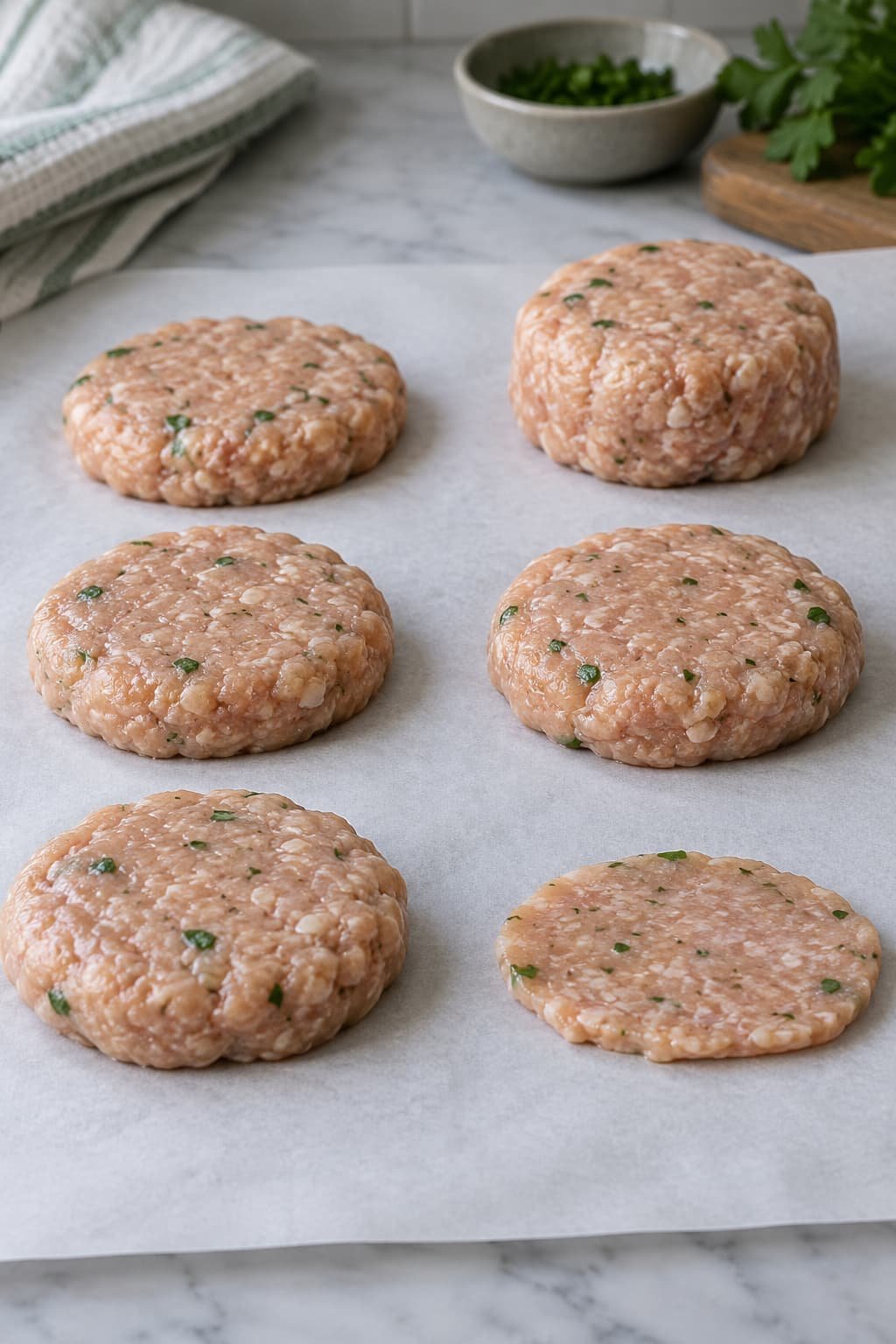
Chicken breakfast sausage can be divided into similar portions and shaped into patties of reasonably consistent size and thickness.
Similar dimensions help reduce large differences in cooking rate between patties. A substantially thicker piece generally requires more heating for its center to reach the same temperature as a thinner one.
The exact patty weight, diameter, thickness, number of patties, and yield depend on the specific formula. There is no reliable universal measurement that should be applied to every ground chicken breakfast sausage mixture.
If the mixture already holds together, it can be shaped without deliberately packing it as tightly as possible. How much handling is appropriate may vary with the formulation.
For a mixture that becomes difficult to handle as it warms, returning it to the refrigerator before continuing is a reasonable option. Raw poultry should be kept cold and should not be left unrefrigerated for extended periods.
How Can Chicken Breakfast Sausage Patties Be Cooked?
Chicken breakfast sausage patties can be cooked in a skillet, oven, or air fryer. There is no single cooking time that works for every patty.
Cooking rate can vary with patty thickness, starting temperature, meat composition, added ingredients, cookware, and appliance performance.
For food safety, time and appearance should not be used as the final test of doneness. USDA states that ground poultry should reach a safe minimum internal temperature of 165°F (73.9°C), measured with a food thermometer. Color is not considered a reliable indicator of whether ground poultry is safely cooked.
Skillet Cooking
A skillet places the patty in direct contact with a heated surface, allowing the exterior to brown as the center cooks.
How quickly this happens depends on several variables. A thin patty can heat differently from a thick one, and cookware can differ in how it stores and transfers heat. Ingredients containing sugars, liquids, or additional fat may also change how the surface cooks.
For those reasons, a universal instruction such as a fixed number of minutes per side should not be applied to every chicken sausage patty.
The patties can be turned during cooking as needed, but safe doneness should ultimately be confirmed with a food thermometer rather than judged from browning alone. USDA advises that thin meat patties can be temperature-checked by inserting the thermometer through the side so the sensing area reaches the center.
Oven and Air-Fryer Cooking
An oven or air fryer can also be used for chicken sausage patties.
An oven surrounds the food with heated air, while an air fryer moves heated air rapidly around the food. Neither method has one universal cooking time because appliance design, patty dimensions, spacing, and starting temperature can all affect cooking.
USDA specifically notes that air fryers vary in size and power and therefore have different cooking times. Ground poultry cooked in an air fryer still needs to reach 165°F (73.9°C) as measured with a food thermometer.
Manufacturer instructions can be useful for operating a particular oven or air fryer, but the thermometer reading should be used to confirm food safety rather than relying only on a timer or exterior color.
What Internal Temperature Should Ground Chicken Sausage Reach?
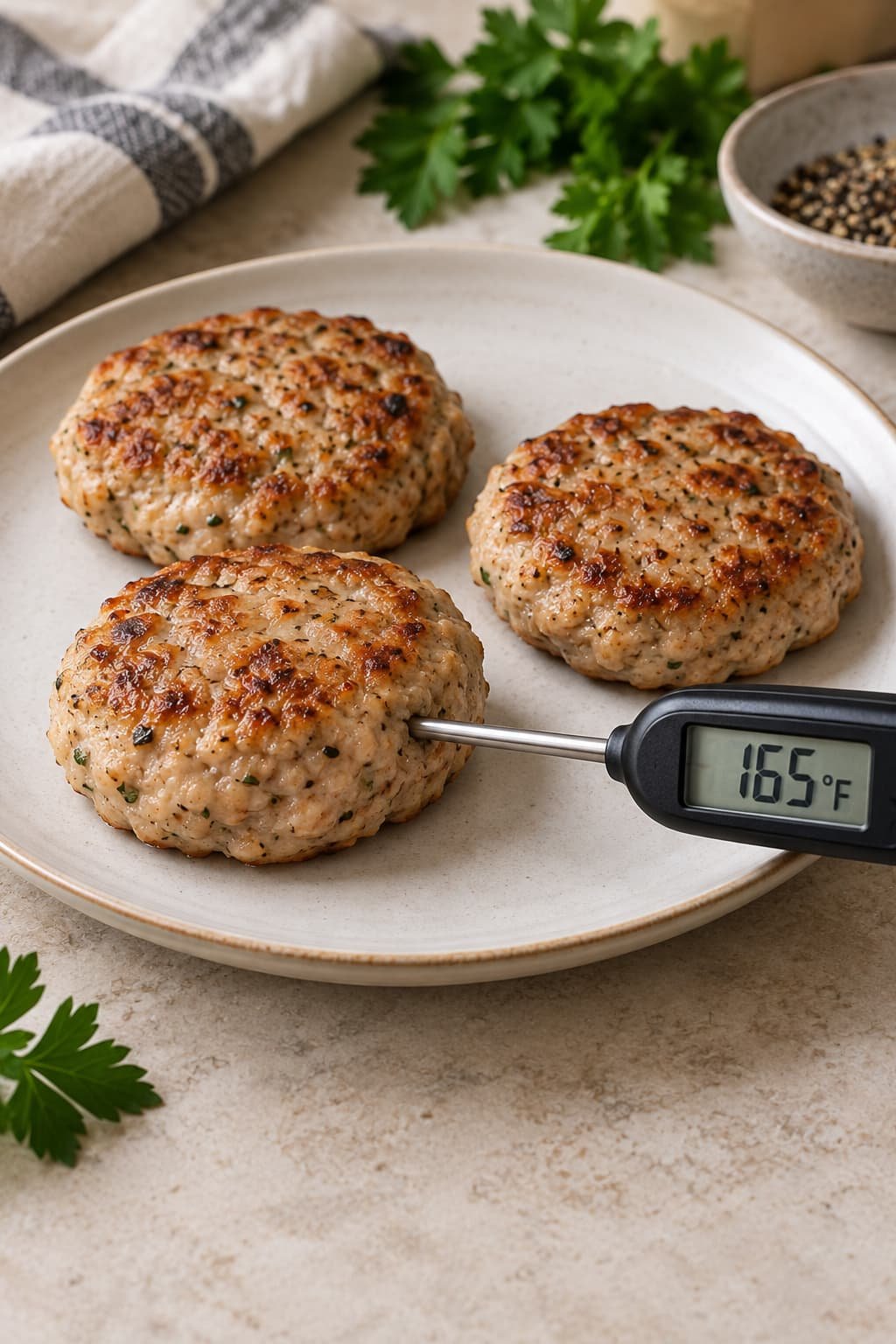
Ground chicken sausage patties should reach a minimum internal temperature of 165°F (73.9°C). USDA applies this safe minimum temperature to ground poultry.
A food thermometer should be used to check doneness. For a thin sausage patty, USDA recommends inserting the thermometer through the side so the sensing area reaches the center of the thickest part.
Color, firmness, or surface browning should not be used as the final safety test. USDA states that the color of ground meat and poultry is not a reliable indicator of doneness. Ground poultry can be safely cooked even if some pink color remains, provided it has reached the required internal temperature.
Cooking time alone is also not enough to confirm safety. Patty thickness, cooking method, starting temperature, and equipment can affect how quickly the center heats, so temperature measurement is the more reliable endpoint.
What Can Make Chicken Sausage Patties Dry, Firm, or Difficult to Handle?
Several factors can influence the texture and handling of chicken sausage patties. A dry, firm, sticky, or difficult-to-shape mixture should not automatically be blamed on one ingredient.
Chicken composition and fat level are possible factors. Sausage-making guidance notes that the balance of lean meat and fat affects the characteristics of the finished sausage. However, the exact effect in a chicken breakfast sausage depends on the complete formulation, so a specific fat level should not be assumed to guarantee a particular texture.
Prolonged cooking may contribute to moisture loss. USDA recommends using a thermometer partly because it helps determine when food has reached a safe temperature without relying on prolonged cooking or visual cues. Once the required internal temperature has been reached, additional cooking can continue to change the texture.
Patty dimensions can affect cooking rate. A thicker patty generally takes longer for heat to reach its center than a thinner one. Patties that differ noticeably in thickness may therefore reach 165°F at different times.
Extensive mixing can affect the structure of fresh sausage. Salt extracts meat proteins that help the mixture bind, and Extension guidance notes that continued mixing can make the meat batter increasingly sticky. For fresh sausage, excessive mixing may also contribute to a firmer or more rubbery texture.
Added liquid can also affect texture. University of Connecticut Extension notes that added water can influence sausage texture and tenderness. Liquid sweeteners, fresh vegetables, or other moisture-containing ingredients therefore may affect more than flavor, depending on how much is used and what else is in the mixture.
These are possible contributing factors rather than automatic diagnoses. A dry patty does not prove that the chicken was too lean, and a sticky mixture does not necessarily need breadcrumbs. The overall formulation, handling, and cooking method all matter.
What Should You Consider Before Adapting a Ground Chicken Breakfast Sausage Recipe?
Changing one ingredient can affect more than flavor. It may also influence moisture, structure, seasoning strength, or how the mixture behaves during cooking.
Changing the type of ground chicken: Ground poultry can vary in the proportions of light meat, dark meat, skin, and attached fat. USDA notes that these differences can affect the appearance and composition of ground poultry products. A different ground-chicken product therefore should not automatically be expected to behave exactly the same as the one used in another formula.
Adding or removing maple syrup: Maple syrup contributes sweetness and liquid. Removing it changes both parts of the formulation. Another sweetener should not automatically be substituted in the same amount unless a reliable recipe supports that change.
Changing fresh herbs to dried herbs: Fresh and dried herbs differ in concentration and physical form. They should not automatically be exchanged in equal quantities. Use a reliable conversion when one is available rather than guessing.
Increasing or removing fennel: Fennel mainly changes the seasoning profile. It is used in some sausage styles but is not required for every breakfast sausage. Removing it changes the flavor direction rather than preventing the mixture from functioning as sausage.
Adding vegetables or other moisture-rich ingredients: Ingredients such as fresh onion, apple, or other vegetables add both solids and moisture. Depending on the amount used, they may change how soft the raw mixture feels and how it cooks.
Changing binders: Egg, breadcrumbs, or other binders can affect the structure of the mixture. Adding one does not guarantee stronger patties, and removing one from a formula developed with it may change the result.
When adapting a reliable recipe, changing one major variable at a time is a cautious approach because it makes it easier to understand which change affected the final result.
Can Ground Turkey Be Used Instead of Ground Chicken?
Ground turkey can be used in a similar breakfast-sausage-style preparation, but it should not be assumed to produce an identical result.
USDA treats chicken and turkey as separate types of ground poultry, and individual products can differ in their composition. Because of those differences, switching from ground chicken to ground turkey may affect handling, cooking behavior, or texture depending on the product and the rest of the formulation.
For that reason, an automatic one-to-one substitution should not be presented as a guarantee unless the specific recipe has been developed or verified for both meats.
The food-safety requirement remains the same: ground turkey, like ground chicken, should reach at least 165°F (73.9°C) as measured with a food thermometer.
How Should Raw and Cooked Chicken Sausage Be Stored?
Raw ground poultry should be refrigerated at 40°F (4.4°C) or below and used or frozen within 1 to 2 days, according to USDA guidance.
That USDA time range is specifically given for ground poultry. Seasoning or shaping raw ground chicken into sausage patties should not be assumed to extend its refrigerated storage life.
After cooking, refrigerate the sausage promptly. USDA advises that perishable food should not remain unrefrigerated for more than 2 hours, or more than 1 hour when the temperature is above 90°F (32.2°C).
Cooked ground poultry can generally be refrigerated for 3 to 4 days at 40°F or below.
Freezing allows longer storage, but the recommended freezer periods are mainly about quality rather than a point at which continuously frozen food suddenly becomes unsafe. USDA gives the following guidance for ground poultry:
- Raw ground poultry: best used within 3 to 4 months.
- Cooked ground poultry: best used within 2 to 3 months.
USDA states that food kept continuously frozen remains safe beyond these recommended periods, although flavor and texture may decline.
These are general USDA storage guidelines for ground poultry. They should not be interpreted as guarantees that every homemade sausage formulation will maintain the same quality throughout the full storage period.
What Can Be Served With Chicken Breakfast Sausage?
Chicken breakfast sausage can be paired with a range of breakfast foods, depending on its seasoning and how it is being served.
Common options include eggs, toast, pancakes, potatoes, or fruit. A patty can also be used in a breakfast sandwich with ingredients such as egg, cheese, or vegetables.
For a larger meal, it may be served alongside an egg bake, roasted potatoes, vegetables, or a simple salad. Cooked sausage prepared in loose form can also be used in breakfast bowls or similar dishes.
The seasoning can help guide the pairing. A version containing maple or another sweet element may pair naturally with pancakes or waffles, while a more savory herb-forward sausage may fit more naturally with eggs, potatoes, or vegetables. These are serving suggestions rather than fixed combinations.