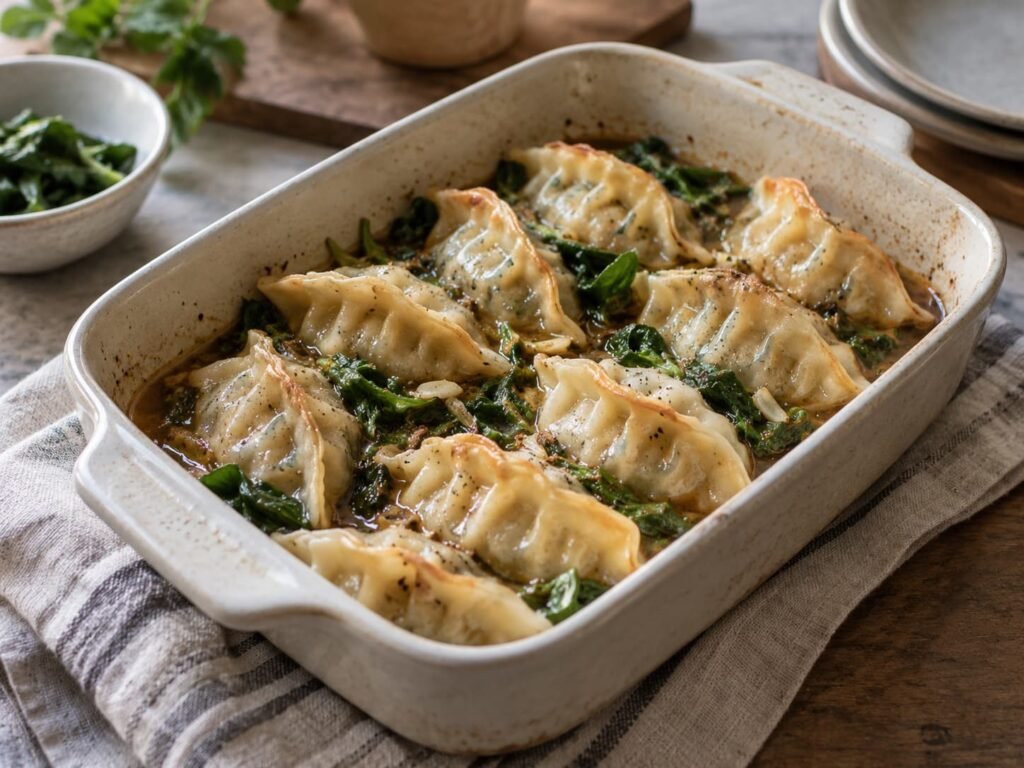
Baked dumplings, in this guide, are savory filled dumplings such as gyoza or potstickers cooked in the oven, often with sauce, vegetables, or another source of moisture.
A one-pan dumpling bake may combine frozen dumplings with spinach, a seasoned liquid, and chili crisp. The exact method can vary because frozen dumplings differ in size, wrapper thickness, filling, and manufacturer cooking instructions.
This is an informational guide to how the method works. It is not a personally tested recipe or a universal formula for cooking every type of frozen dumpling.
What Are Baked Dumplings?
Baked dumplings are filled dumplings prepared in the oven rather than cooked only by boiling, steaming, or pan-frying.
In the one-pan style discussed here, the dumplings usually cook in or around a sauce. This creates a different cooking environment from placing dumplings on a dry baking sheet.
The term can also describe other foods, including sweet fruit dumplings or biscuit-style dumplings baked over casseroles. Those dishes are not the focus here.
How is a dumpling bake different from other dumpling methods?
The main difference is how heat and moisture reach the dumplings.
Boiled dumplings are surrounded by hot water. Steamed dumplings cook in moist steam. Pan-fried dumplings receive direct heat from a pan and may also be steamed with a small amount of water.
A saucy oven bake combines oven heat with surrounding liquid. Different areas of the wrapper may have different levels of contact with that liquid, so the surface texture can vary.
Can Frozen Dumplings Be Baked?
Some frozen dumplings can be used in oven-baked dishes, including one-pan preparations with sauce. However, there is no single oven method that should automatically be applied to every frozen dumpling.
Products can differ in filling, wrapper thickness, size, and whether their ingredients are raw, partially cooked, or fully cooked.
Do frozen dumplings need to be thawed first?
Not always.
Some dumpling-bake preparations use dumplings directly from frozen, but this should not be treated as a universal instruction.
If the package gives specific thawing or cooking directions, those directions should take priority. Thawing may also change how a wrapper handles moisture, depending on the product.
Can gyoza and potstickers be used in a dumpling bake?
Gyoza and potstickers can both appear in oven-baked dumpling dishes, but they should not be treated as identical products.
A smaller, thinner-wrapped dumpling may behave differently from a larger dumpling with a thicker wrapper and more filling.
The specific product and its instructions matter more than the label “gyoza” or “potsticker” alone.
Why do package cooking instructions matter?
Package instructions provide product-specific cooking information.
The FDA advises following cooking instructions on commercially frozen ready-to-cook foods because bacteria can survive freezing. Foods that were partially cooked during manufacturing may still require thorough cooking at home.
Appearance alone is also not a reliable way to determine whether frozen food has heated adequately throughout.
How Does a One-Pan Dumpling Bake Work?
A one-pan dumpling bake generally combines filled dumplings with a seasoned liquid or sauce and, in some versions, vegetables such as spinach.
The basic structure is:
dumplings + cooking liquid or sauce + optional vegetables + oven heat
If you are comparing chili crisp products, check the ingredient list, allergen information, and stated heat level rather than assuming every product is similar. [Browse chili crisp]
Why is sauce or liquid used around the dumplings?
The sauce adds flavor while also providing moisture around the dumplings.
Common sauce components may include coconut milk, broth, soy-based seasoning, curry paste, ginger, garlic, vinegar, or sesame oil.
These are ingredient categories, not a required formula.
Sauce thickness and the amount of surrounding moisture can affect how much of the wrapper remains in contact with liquid. Because products and ingredients vary, there is no universal sauce ratio that should be assumed to work for every dumpling.
Why are some dumpling bakes covered?
Covering a baking dish reduces evaporation and helps retain more moisture inside the pan.
An uncovered dish allows more moisture to escape and exposes the tops of the dumplings more directly to oven heat.
Neither approach is automatically correct for every dumpling. The effect can depend on the wrapper, sauce level, baking dish, and intended texture.
How do dumpling size and wrapper thickness matter?
Size and wrapper thickness can change how a dumpling responds to the cooking environment.
A larger dumpling has more distance between its surface and center than a smaller one. Wrapper thickness and shape can also change how much dough comes into contact with the sauce.
These differences are another reason not to assume that one fixed cooking method works for every frozen dumpling.
What Roles Do Spinach and Chili Crisp Play?
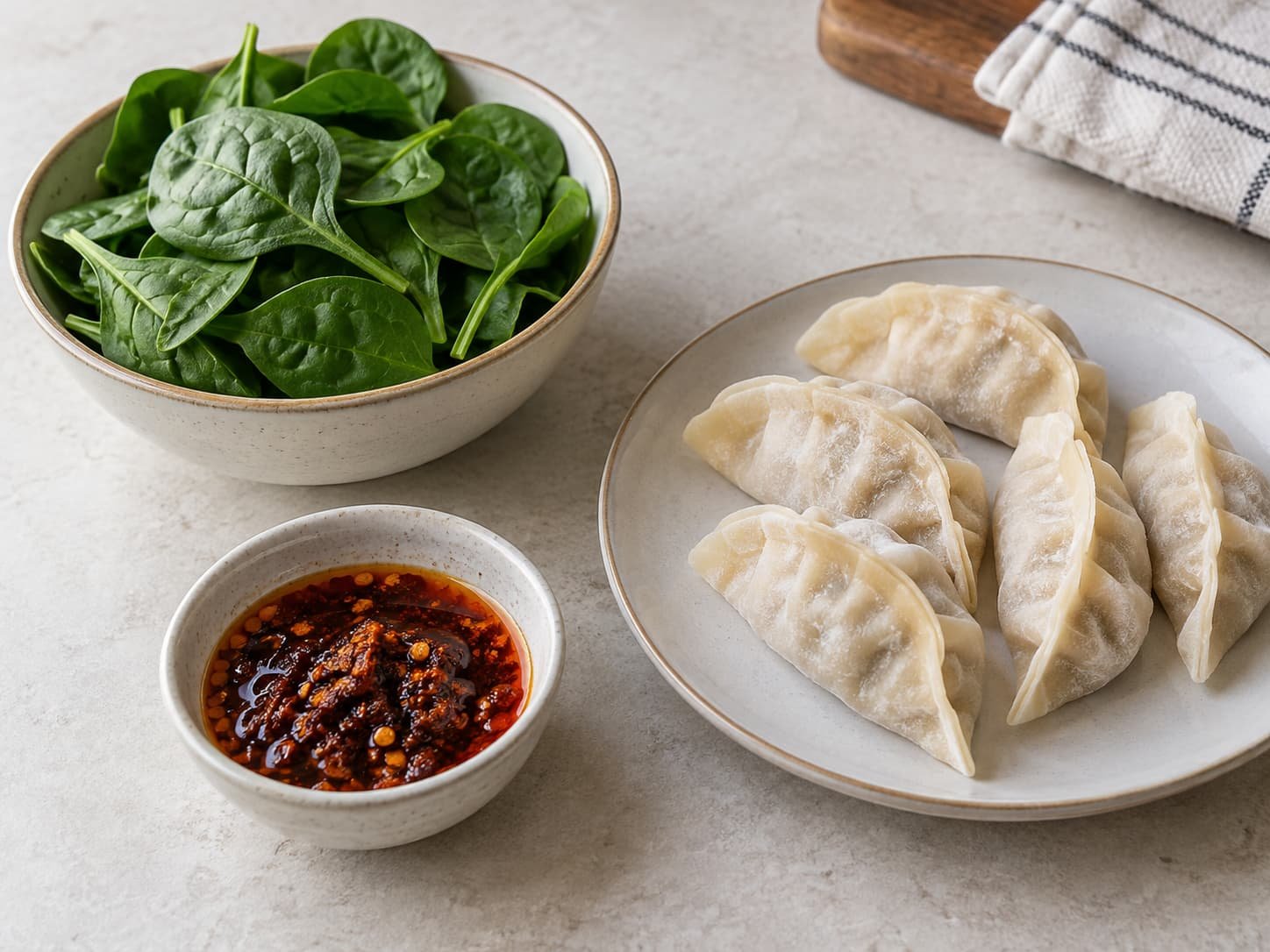
Spinach and chili crisp serve different purposes.
Spinach adds a leafy vegetable component and can contribute moisture as it cooks. Chili crisp can add chile heat, seasoned oil, aromatic ingredients, and crunchy pieces.
Neither ingredient is required for the basic idea of an oven-baked dumpling dish.
How does spinach behave in a dumpling bake?
Fresh spinach wilts substantially when heated and can release moisture into the surrounding sauce.
Frozen spinach may contribute a different amount of liquid as it thaws, depending on the product and how it is prepared.
For that reason, fresh and frozen spinach should not automatically be treated as exact substitutes in an untested formula.
What does chili crisp add?
Chili crisp is generally an oil-based condiment containing chile and crisp or fried seasoned ingredients.
Formulations vary. Products may contain garlic, shallots, seeds, spices, or other seasonings.
In a dumpling bake, chili crisp may contribute chile heat, seasoned oil, savory or aromatic flavor, and crunchy texture.
Its heat level can vary considerably between products.
Should chili crisp go into the sauce or be added afterward?
Either approach is possible.
Mixing chili crisp into the sauce distributes its oil and seasoning throughout the dish. Adding it after cooking keeps it more separate from the liquid and may preserve more textural contrast.
Adding it at serving time can also make it easier to adjust the amount of heat for individual portions.
One method does not need to be described as better than the other.
What Types of Sauces Are Commonly Used With Baked Dumplings?
There is no single sauce that defines a dumpling bake.
Sauce choices generally fall into a few broad categories, and those categories can overlap.
Coconut-based sauces
Coconut milk can provide a creamy liquid base.
It may be paired with ginger, garlic, lime, curry paste, chile, or soy-based seasoning.
Coconut milk products vary in thickness, fat content, and formulation, so different products should not be expected to behave identically.
Broth and soy-based sauces
Broth can provide a thinner liquid base than coconut milk.
It may be combined with soy-based seasoning, ginger, garlic, vinegar, or sesame oil.
Soy sauce and similar condiments are generally used for seasoning rather than as the entire cooking liquid. Saltiness and concentration can vary between products.
Curry and chili-based sauces
Curry pastes, chili sauces, and chili crisp can add heat and stronger seasoning.
These products can vary in concentration, saltiness, sweetness, and spice level. They should not automatically be treated as equal substitutes.
A curry or chili-style sauce may use coconut milk, broth, or another suitable liquid as its base.
What Affects the Texture of Baked Dumplings?
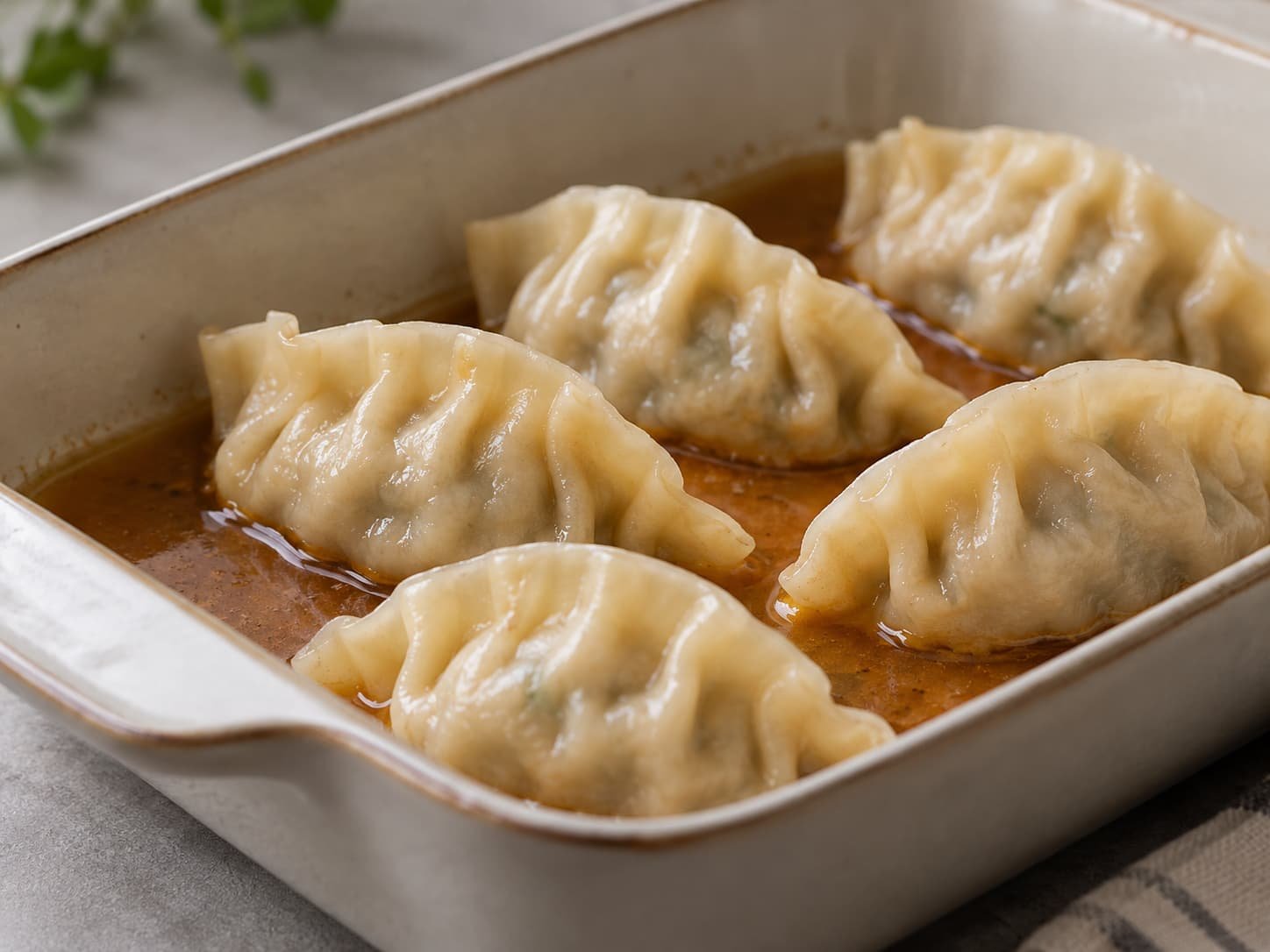
Wrapper texture can be affected by surrounding moisture, sauce depth, covering, dumpling size, wrapper type, and spacing in the baking dish.
There is no single texture that every oven-baked dumpling should have.
Why can wrappers become dry or very soft?
A portion of wrapper exposed to hot oven air with limited moisture may become firmer or drier.
Possible factors include less surrounding liquid, more wrapper sitting above the sauce, uncovered cooking, or longer exposure to dry heat.
The opposite may happen when more of the wrapper remains in contact with liquid. It can become softer as it absorbs moisture.
Neither result should automatically be described as a mistake. A saucy oven bake creates a different cooking environment from pan-frying.
How do moisture, covering, and spacing affect texture?
Moisture affects how much of the wrapper stays in contact with liquid instead of dry oven air.
Covering can reduce evaporation and retain more moisture inside the dish.
Spacing can change how much wrapper surface is exposed and how individual dumplings contact the sauce.
These factors interact, so changing one part of the method may influence the others.
Are Baked Dumplings Crispy?
Not necessarily.
Dumplings cooked in sauce are exposed to more moisture than dry-roasted or directly pan-fried dumplings. Areas sitting in liquid are therefore more likely to remain tender than develop a dry, crisp surface.
Exposed areas may become firmer or show some browning depending on the cooking conditions, but baking alone does not guarantee crisp dumplings.
How does a saucy dumpling bake differ from pan-fried dumplings?
Pan-fried dumplings receive direct heat where the wrapper touches the pan. This can encourage browning on the base.
Some pan-frying methods also add water and cover the pan, combining direct heat with steam.
A saucy oven bake relies on oven heat while the dumplings sit in or around more liquid. It may therefore produce less concentrated browning on the bottom and a softer overall wrapper.
Neither method is inherently better. They create different cooking environments.
Baked vs Steamed vs Boiled vs Pan-Fried Dumplings
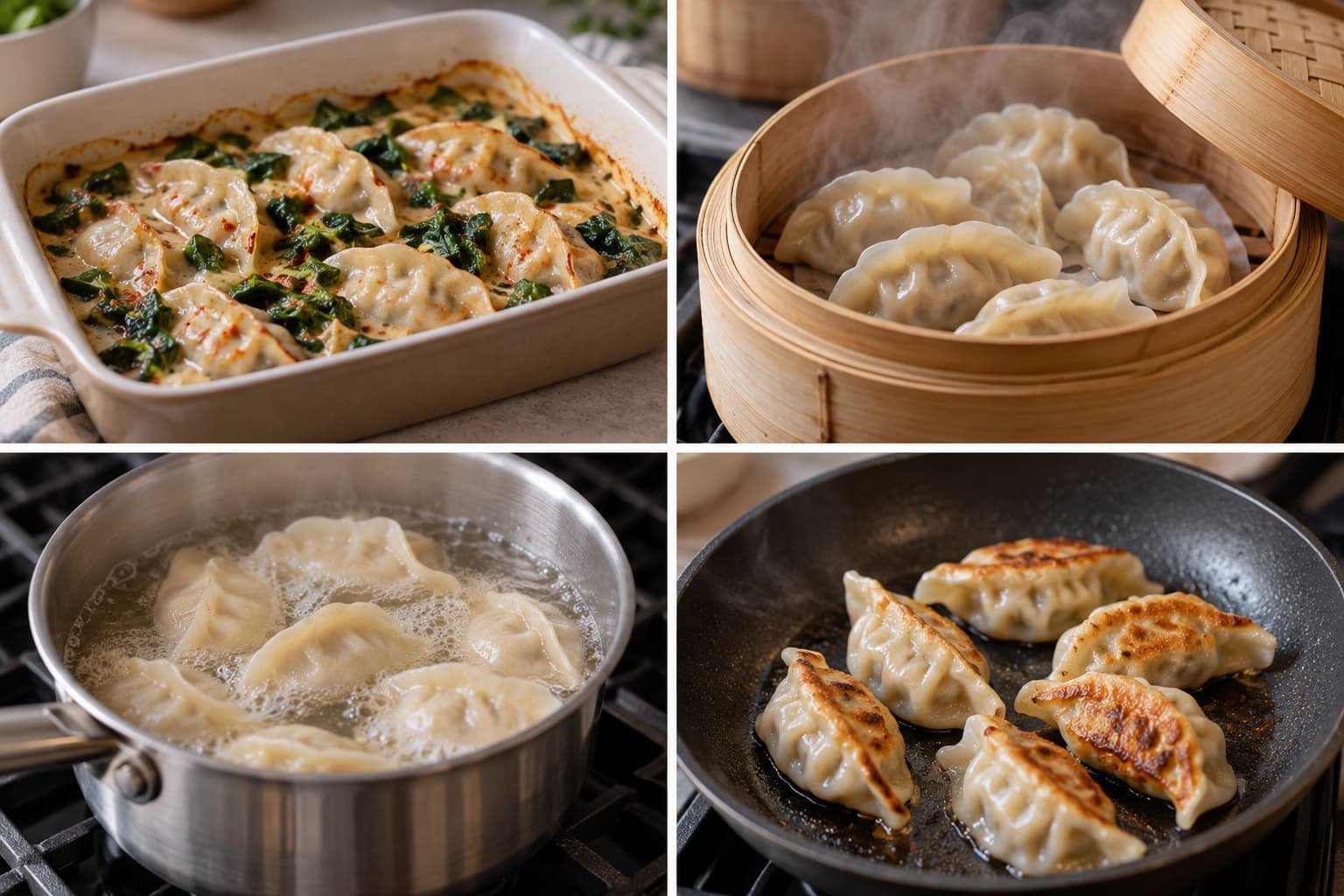
The main difference between these methods is how heat and moisture reach the wrapper.
| Cooking Method | Cooking Environment | Moisture Level | General Wrapper Texture | Browning Potential |
|---|---|---|---|---|
| Saucy baked dumplings | Oven heat with surrounding sauce or liquid | Moderate to high | Often softer where the wrapper contacts liquid | May occur on exposed areas |
| Steamed dumplings | Hot steam | High | Usually soft and tender | Very limited |
| Boiled dumplings | Surrounded by hot water | Very high | Generally soft across the exterior | Little to none |
| Pan-fried dumplings | Direct pan heat, sometimes combined with steaming | Variable | Can have a tender wrapper with a firmer or browned base | Greater where the dumpling touches the pan |
These are general differences rather than guaranteed results. Wrapper composition, filling, equipment, moisture, and preparation can all affect texture.
What Should You Check Before Adapting a Dumpling Bake?
Before changing the dumplings, vegetables, sauce, or seasonings, consider the product instructions, added moisture, seasoning strength, and allergens.
Package directions: Frozen dumplings can have different filling and cooking requirements. Check the specific product before changing its preparation method.
Added moisture: Switching between fresh and frozen greens or between broth and a thicker sauce may change the amount and consistency of liquid in the dish.
Seasoning strength: Chili crisp, curry paste, broth, and soy-based condiments can vary substantially between products.
Allergens: Check the labeling on each packaged ingredient rather than assuming a dumpling dish meets a particular dietary requirement.
In the United States, the FDA recognizes nine major food allergens: milk, egg, fish, crustacean shellfish, tree nuts, peanuts, wheat, soybeans, and sesame. Several of these can appear in dumplings, wrappers, fillings, sauces, and seasonings.
Food-Safety Considerations for Frozen Dumplings
Do not assume that a frozen dumpling is fully cooked simply because it looks precooked.
The FDA advises following package cooking instructions for commercially frozen ready-to-cook foods. Bacteria can survive freezing, and partial cooking during manufacturing does not guarantee that harmful bacteria have been eliminated.
For dumplings containing raw ground beef, pork, lamb, or veal, USDA guidance lists a minimum internal temperature of 160°F (71.1°C). Poultry, including ground poultry, should reach 165°F (73.9°C).
When an internal-temperature check is appropriate for the filling, a digital instant-read food thermometer can provide an actual temperature reading instead of relying only on appearance. [ Browse instant-read food thermometers ]
The specific package directions should remain the main product-level cooking reference.
Frequently Asked Questions
Can other leafy greens be used instead of spinach?
Other leafy greens may be possible, but they should not automatically be treated as direct substitutes.
Tender greens and thicker leaves can differ in structure, moisture, and how they respond to heat. Changing the green may therefore affect both texture and the amount of liquid in the dish.
Without testing a specific substitution, it is more accurate to describe another green as a possible variation rather than an equivalent replacement.
Can baked dumplings be reheated?
Yes. Cooked dumplings can be reheated, although refrigeration and reheating may change the wrapper texture.
USDA guidance recommends reheating leftovers to 165°F (73.9°C) and using most properly refrigerated cooked leftovers within 3 to 4 days.
Those figures address food safety. They do not guarantee how long the dumplings will retain their original texture or quality.