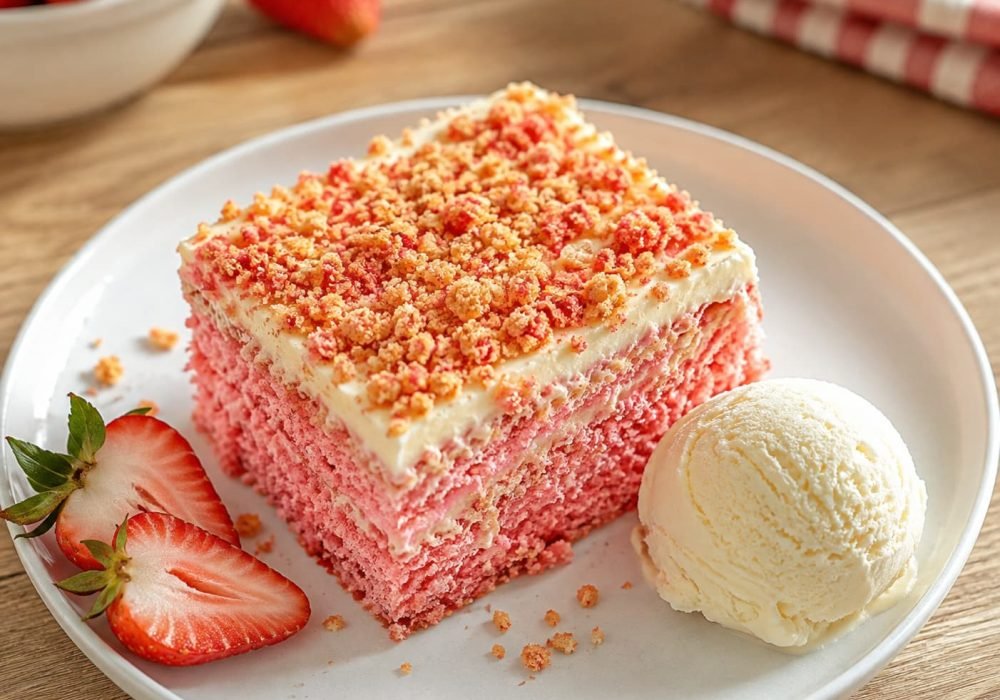
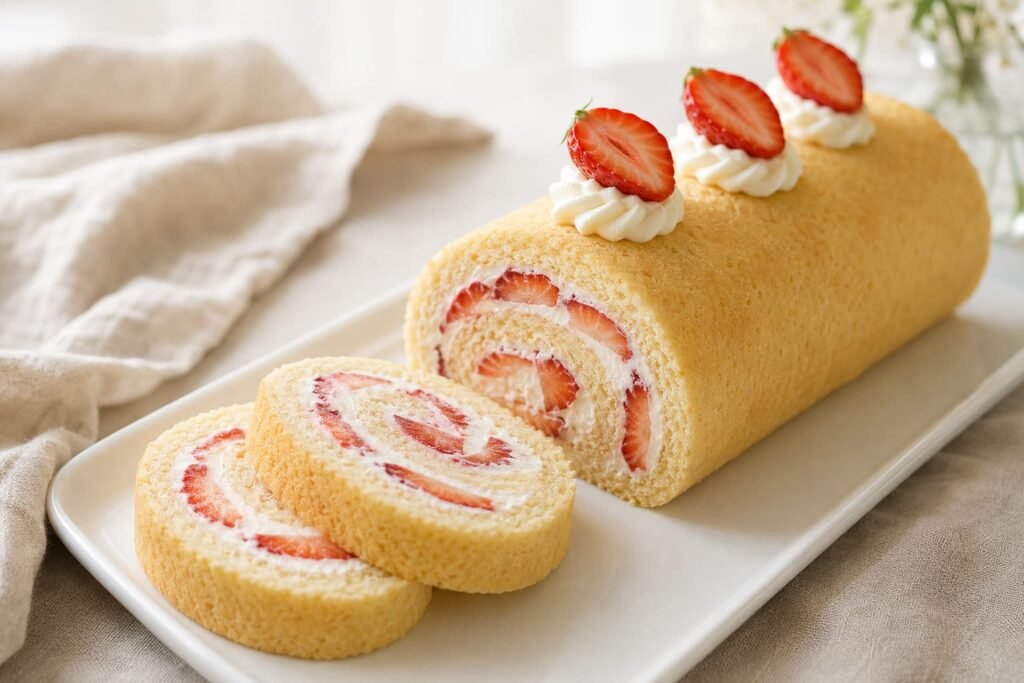
A strawberry Swiss roll is a thin sponge cake rolled around strawberries and a cream-based filling. The spiral comes from wrapping the cake sheet around the filling rather than stacking separate cake layers.
Different versions use different sponge styles, strawberry preparations, and cream fillings. These choices can affect moisture, flexibility, texture, and how easily the cake can be rolled and sliced.
What Is a Strawberry Swiss Roll?
A strawberry Swiss roll is a type of rolled sponge cake. The sponge is typically baked as a relatively thin sheet, covered with filling, and shaped into a spiral.
The terms Swiss roll, cake roll, and roll cake are commonly used for similar desserts. Roulade is a broader culinary term for food rolled around a filling, so a Swiss roll can also be described as a sweet cake roulade.
It differs from a conventional strawberry layer cake mainly in structure. A layer cake uses separate stacked cake layers, while a Swiss roll uses one sheet of cake that needs enough flexibility to curve around its filling.
There is no single required formula. Some versions use genoise or another egg-foam sponge, while others use chiffon-style cakes or different sponge formulas. Fillings may contain fresh strawberries, preserves, whipped cream, mascarpone-based cream, or combinations of these ingredients.
What Are the Main Components of a Strawberry Swiss Roll?
A strawberry cake roll has three basic parts: the sponge, the strawberry component, and the cream filling.
Each has a different role. The sponge provides structure, the strawberries add fruit flavor and texture, and the cream creates the soft layer between the turns of cake.
The Sponge Cake
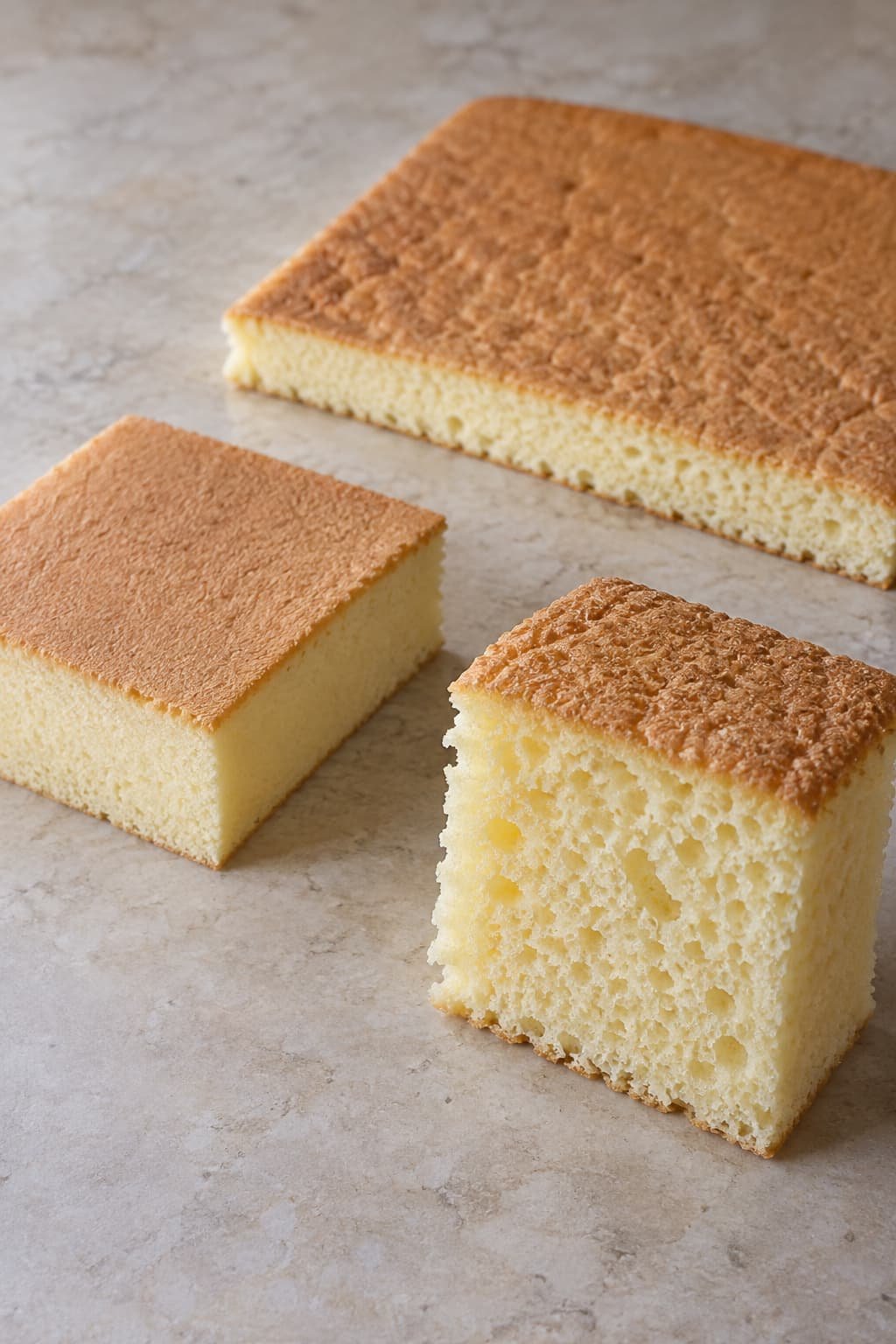
A roll cake usually uses a relatively thin sponge because a thin cake sheet can bend more readily than a thick layer.
Many sponge formulas rely heavily on air incorporated into eggs for their rise and structure. Genoise is one example. It typically uses whipped whole eggs and sugar, with flour folded into the aerated mixture. Some formulas also include melted butter.
A chiffon-style sponge uses a different approach. Chiffon cakes commonly include oil and whipped egg whites and may also use chemical leavening, depending on the formula.
Neither style is required for every Swiss roll. Different recipes create a flexible crumb in different ways.
The main sponge ingredients also perform different functions:
- Eggs may contribute aeration, moisture, richness, and structure.
- Flour helps form the framework of the crumb.
- Sugar provides sweetness and can also influence moisture and cake structure.
- Fat, when included, can affect tenderness and texture.
Because sponge formulas differ, a technique designed for one type of cake should not automatically be assumed to work the same way with another.
The Strawberry Component
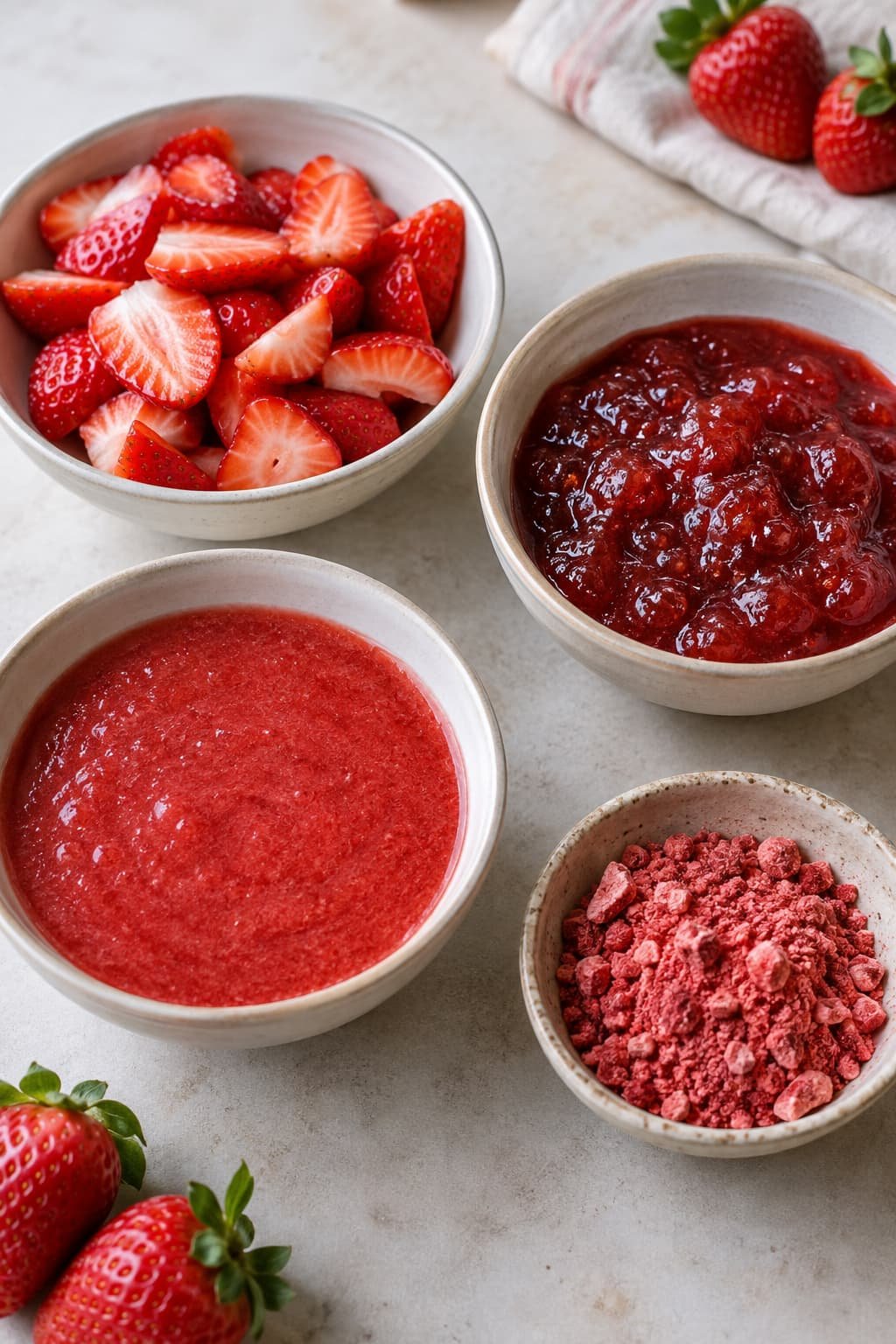
Strawberries can appear in several forms, and each affects the filling differently.
Fresh strawberries add recognizable pieces of fruit but also introduce moisture.
Strawberry preserves or jam create a smoother, more spreadable fruit layer. Their thickness and sweetness vary between products.
Strawberry purée can distribute fruit flavor more evenly but also adds liquid, which may affect a cream filling.
Freeze-dried strawberries contain far less water than fresh berries and may be crushed or ground when a recipe calls for concentrated strawberry flavor without the same amount of fresh-fruit moisture.
These forms are not automatic one-for-one substitutes. They differ in moisture, sweetness, concentration, and texture.
The Cream Filling
Whipped cream is commonly used in strawberry roll cakes, but it is not the only option.
Some recipes use mascarpone, cream cheese-based fillings, or other stabilized cream mixtures. Mascarpone is one ingredient that can add body and stability to whipped cream, although the appropriate stabilizer depends on the particular dessert and formula.
Consistency matters in a rolled cake. A very soft filling may move as the sponge is rolled, while an excessive or very thick layer can make the spiral harder to form.
There is no universal filling thickness or ingredient ratio that works for every cake roll. The appropriate consistency depends on the sponge and strawberry preparation being used.
Why Does Sponge Flexibility Matter in a Swiss Roll?
A Swiss roll needs enough structure to hold together while also being flexible enough to bend into a spiral.
Cake thickness, moisture, aeration, crumb structure, baking conditions, and handling can all affect that balance.
A thin sponge generally requires less bending than a thick cake layer. Moisture can also matter because a cake that becomes excessively dry during baking may be more prone to cracking.
Aeration is particularly important in sponge formulas that rely on whipped eggs. If too much incorporated air is lost during mixing, the finished cake may become denser.
Different formulas achieve flexibility in different ways, so there is no single texture that guarantees a successful roll.
Why Can a Swiss Roll Crack?
A Swiss roll can crack when the sponge cannot accommodate the stress of being curved, but there is rarely one universal cause.
Possible contributing factors include:
- Excessive dryness: An overbaked or otherwise dry sponge may be less flexible.
- Cake thickness: A thicker sheet generally has to bend more sharply around the center.
- Rolling pressure: Forcing the cake into a very tight curve can place additional stress on the sponge.
- Cooling method: Some formulas become harder to shape once completely cool.
Several of these factors can occur together. A crack should therefore not automatically be treated as proof of one specific mistake.
Should a Swiss Roll Be Rolled While Warm?
Many cake-roll methods use a warm pre-roll. The sponge is loosely rolled without its final filling while still warm, cooled in that curved position, then opened and filled.
This approach shapes the cake while it is relatively pliable. However, it is not required for every cake roll. Some sufficiently flexible sponge formulas are designed to cool flat and be rolled only after the filling is added.
The appropriate method depends on the particular sponge formula. Following the shaping method designed for that cake is more useful than applying one rule to every roll cake.
How Do Fresh Strawberries Affect the Filling?
Fresh strawberries add moisture as well as fruit texture. Once berries are cut, juice can collect around the fruit as it sits.
Inside a cake roll, that moisture comes into contact with the cream and sponge. Over time, it may loosen a soft filling or make nearby cake feel wetter. How noticeable the change becomes depends on the fruit preparation, filling, sponge, and storage conditions.
Fruit size can also affect the roll. Large strawberry pieces create thicker areas between the cake layers and may make rolling or slicing less even. Smaller pieces generally fit more easily into a thin filling layer, although the appropriate preparation depends on the recipe.
Water left on washed strawberries introduces additional surface moisture. Allowing the berries to drain and dry before using them is a reasonable way to avoid adding unnecessary water to the filling.
Fresh Strawberries vs. Strawberry Preserves
Fresh strawberries and strawberry preserves can both provide strawberry flavor, but they create different textures.
Fresh berries add distinct fruit pieces and may release juice after cutting. Their shape can also make the filling less uniform.
Preserves are more spreadable and can form a relatively even fruit layer. Their thickness, sweetness, and amount of fruit pieces vary between products.
Neither option is inherently better. Fresh fruit is useful when recognizable strawberry pieces are wanted, while preserves create a smoother layer. Some cake-roll formulas combine both.
Can Frozen Strawberries Be Used?
Frozen strawberries can work in some preparations, but thawed berries do not behave exactly like fresh fruit.
Freezing forms ice crystals inside fruit tissue. These crystals can damage plant cell walls, which is why thawed fruit generally becomes softer and may lose moisture as it thaws.
That difference matters in a cream-filled cake. Thawed strawberries may be less suitable when firm, distinct pieces of fruit are wanted.
They may be more practical in preparations where a softer texture is expected, such as a purée, sauce, or cooked filling.
Fresh and frozen strawberries should not be assumed to work in equal quantities or in exactly the same way. Any specific substitution ratio should come from a formula designed for that use.
What Can Cause Filling and Texture Problems?
Filling leakage, a dense sponge, or uneven texture can have several possible causes. Fruit moisture, filling consistency, mixing technique, cake structure, baking conditions, and handling may all contribute.
Troubleshooting is therefore more useful when it considers several factors instead of treating one symptom as proof of one mistake.
Why Can the Filling Squeeze Out?
Filling may move toward the ends or sides of the cake because rolling places pressure on the layers.
Possible reasons include:
- Too much filling: A thick layer has less room once the sponge begins wrapping around itself.
- Very soft cream: A loose filling can move more easily under pressure.
- Large strawberry pieces: Thick pieces can create uneven areas and displace nearby cream.
- Tight rolling: Greater pressure may push filling outward.
- Filling spread to the edges: Cream positioned very close to the sides has little room to move before reaching the edge.
These are possible causes rather than guaranteed diagnoses. More than one factor may be involved.
A small amount of filling movement is also possible because cream and fruit are soft components.
Why Can the Sponge Become Dense or Rubbery?
A dense or unusually firm sponge can have several causes, depending on the cake formula.
Many sponge cakes depend on air incorporated into eggs. Vigorous mixing after that foam has formed can release some of the trapped air, potentially producing a denser crumb.
Excessive mixing after flour is added may also encourage more gluten development in some cake formulas, which can contribute to a firmer or tougher texture.
However, density does not automatically mean the cake was overmixed. Ingredient balance, mixing technique, and baking conditions can all influence the crumb.
Without a specific tested formula, it would be misleading to identify one ingredient or one technique as the universal cause of a dense or rubbery sponge.
What Affects the Spiral and Slicing?
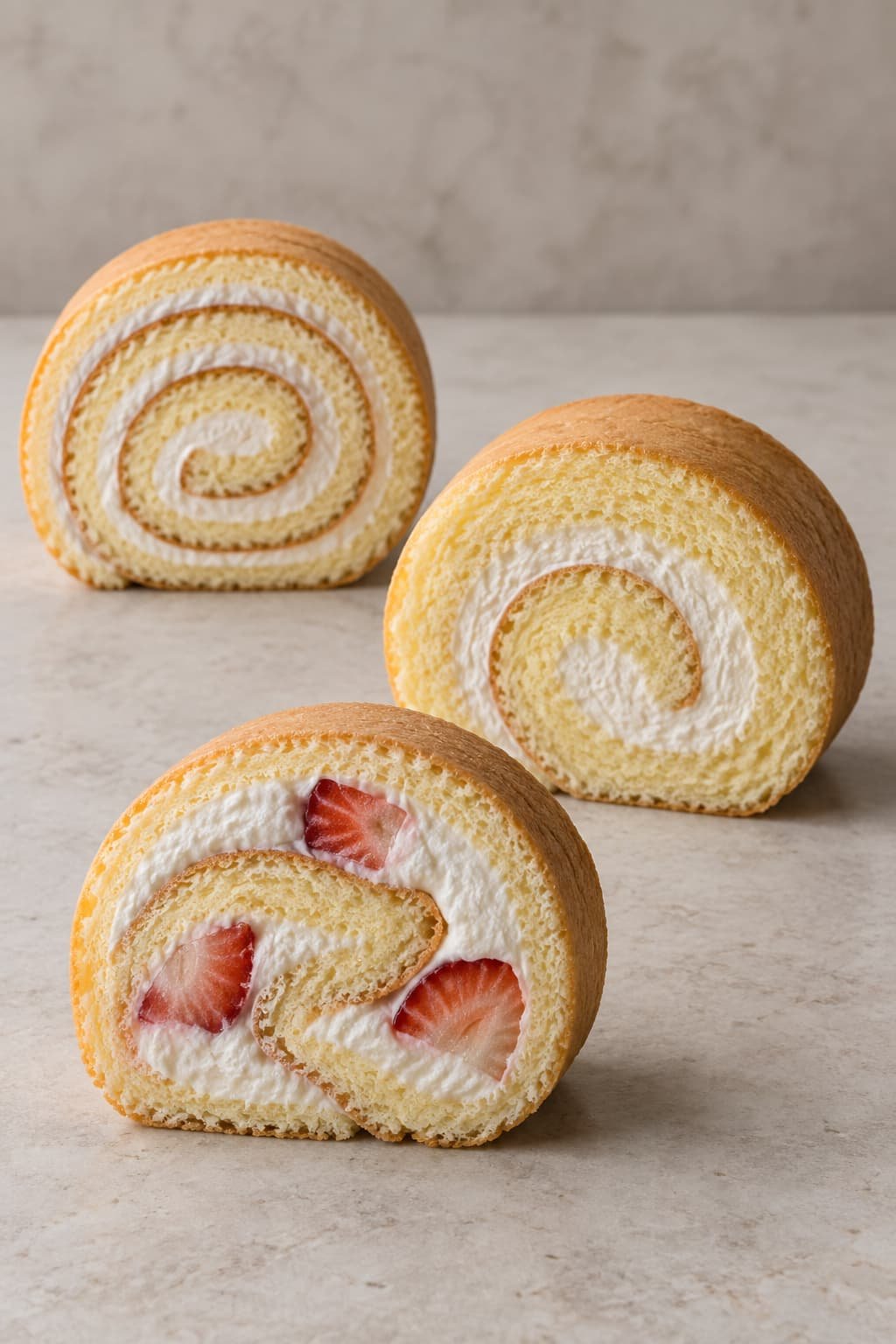
The spiral is influenced mainly by sponge thickness, filling quantity, and how evenly the filling is distributed.
A relatively thin sponge can bend more readily around the filling. A thicker filling layer increases the space between each turn of cake, which can create a wider spiral.
Uneven filling can also affect the shape. Thick patches of cream or large fruit pieces may create raised areas as the cake is rolled.
Chilling a filled roll before cutting may make handling easier because a colder cream filling can be firmer. This may reduce smearing during slicing, although it does not guarantee perfectly defined slices.
The final appearance will still vary with the sponge, filling consistency, fruit preparation, and rolling method.
How Should a Strawberry Swiss Roll Be Stored?
A cake roll containing whipped cream or another perishable dairy filling should be refrigerated.
FDA guidance recommends keeping refrigerators at 40°F (4°C) or below. Perishable foods should generally be refrigerated within 2 hours, or within 1 hour when the surrounding temperature is above 90°F (32°C).
These figures are food-safety guidance. They do not establish how long a particular strawberry cake roll will maintain its preferred flavor, texture, or appearance.
Quality may change during refrigeration. Fresh fruit can release moisture, cream may change in firmness, and the sponge may absorb liquid from the filling.
For that reason, there is no universal “keeps for X days” claim here. Quality duration depends on the particular formula and handling conditions.
Can a Strawberry Swiss Roll Be Made Ahead?
Some strawberry cake rolls can be prepared ahead, but how well they hold depends on the sponge, fruit, and filling.
Fresh strawberries may release moisture after cutting. As the assembled cake sits, that moisture can come into contact with the cream and sponge and gradually change their texture.
The filling also matters. Plain whipped cream and more stabilized cream mixtures do not necessarily behave the same way during refrigerated storage.
Food safety and eating quality are separate considerations. Proper refrigeration is part of safe food handling, while changes in moisture, softness, and appearance are quality issues.
For a specific recipe, its tested make-ahead directions are more useful than applying one universal time limit.
Can a Strawberry Swiss Roll Be Frozen?
Some cake-roll formulas can be frozen, but a roll containing fresh strawberries and cream may change in texture after thawing.
Fresh fruit is particularly affected by freezing. Ice crystals can damage fruit cell walls, so thawed strawberries may become softer than fresh berries.
Cream fillings vary. The National Center for Home Food Preservation notes that some cream and custard fillings can separate and become watery or lumpy after freezing and thawing. That does not establish that every whipped-cream or mascarpone filling will behave the same way.
Different stabilizers and dairy formulations can respond differently to freezing.
Without a tested formula for the specific cake, the most accurate conclusion is that freezing may alter the texture of the strawberries or filling. A universal freezing duration or guaranteed thawed result should not be assumed.