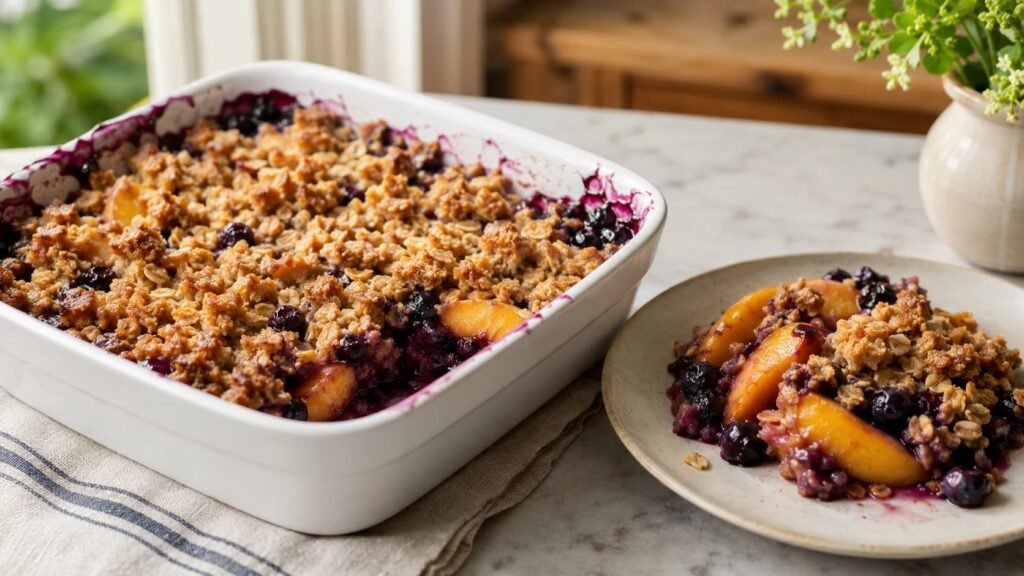
A peach blueberry crisp is a baked fruit dessert made with peaches and blueberries beneath a crumbly topping. The topping commonly contains oats, flour, sugar, and butter or another fat.
The final texture depends on several factors, including the condition of the fruit, the amount of moisture in the filling, the type of thickener, the topping ingredients, and the baking conditions. Fresh, frozen, and canned fruit can also behave differently.
Unlike a fruit pie, a crisp generally does not use pastry around the filling. Instead, the fruit is covered with a loose crumb topping that can brown and become firmer during baking.
What Is Peach Blueberry Crisp?
Peach blueberry crisp has two main parts: a peach-and-blueberry filling and a crumb topping.
Peach slices or chunks provide larger pieces of fruit, while blueberries are smaller and may soften or release juice as they heat. Depending on the fruit and the formula, the filling may contain both recognizable fruit pieces and thickened fruit juices.
The topping is scattered over the fruit rather than formed into a pastry crust. Oats are common in crisp toppings, although recipes vary in their use of flour, sugar, fat, nuts, spices, and other ingredients.
What Ingredients Commonly Make Up Peach Blueberry Crisp?
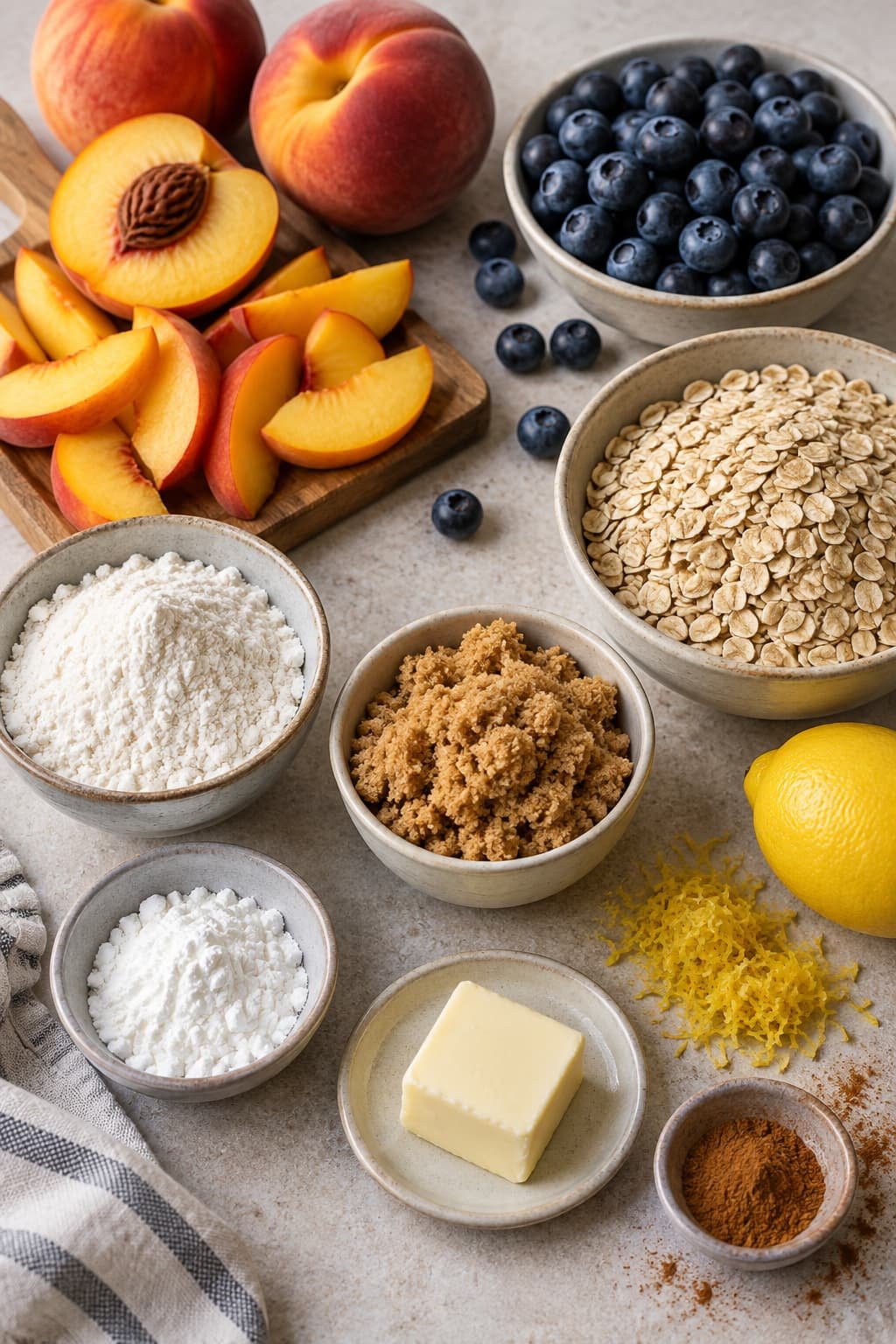
Most versions can be divided into three ingredient groups: fruit, crumb-topping ingredients, and ingredients used for thickening or flavor.
There is no single required formula. Ingredient choices and proportions vary between recipes.
Peach and Blueberry Fruit Filling
Peaches and blueberries form the main fruit layer.
Peach firmness varies with ripeness and variety. Oregon State University Extension recommends firm, ripe peaches for preservation and advises against immature or overripe fruit. In a baked dessert, starting firmness may influence the final texture, although slice size, heating, and the specific recipe also matter.
Blueberries are smaller and may release juice as they heat. Some berries may remain recognizable while others soften more fully, so the finished filling does not necessarily have one uniform texture.
Both fruits naturally contain water. During heating, some of that moisture can become part of the surrounding filling, which is one reason many fruit-dessert formulas use a thickening ingredient.
Fruit sweetness can also vary. An amount of added sugar that suits one batch of fruit should not automatically be assumed to suit every batch.
Oat Crisp Topping
A crisp topping commonly contains rolled oats, flour, sugar, and butter or another fat.
Oats provide texture and visible flakes. Flour helps form the crumb mixture. Sugar adds sweetness and contributes to browning, while fat helps the dry ingredients form crumbs or clusters.
The resulting texture depends on the complete formula. Some toppings remain fine and crumbly, while others form larger clusters.
Oat type can also make a difference. Rolled oats and more finely processed oats differ in size and structure, but neither should be considered universally better for a fruit crisp.
Thickeners and Flavoring Ingredients
A thickener helps manage liquid released by the fruit.
Cornstarch, flour, tapioca, and modified food starches are used in different fruit fillings. They should not automatically be treated as interchangeable because their thickening characteristics can differ.
Penn State Extension also notes differences in how flour, cornstarch, tapioca, and modified starches behave during freezing and thawing.
Flavoring ingredients have a different role. Lemon juice or zest may add citrus flavor, while cinnamon, vanilla, or other spices may be included depending on the dessert.
A starch primarily affects consistency, while spices and extracts mainly affect flavor and aroma.
Fresh, Frozen, or Canned Fruit: What Changes?
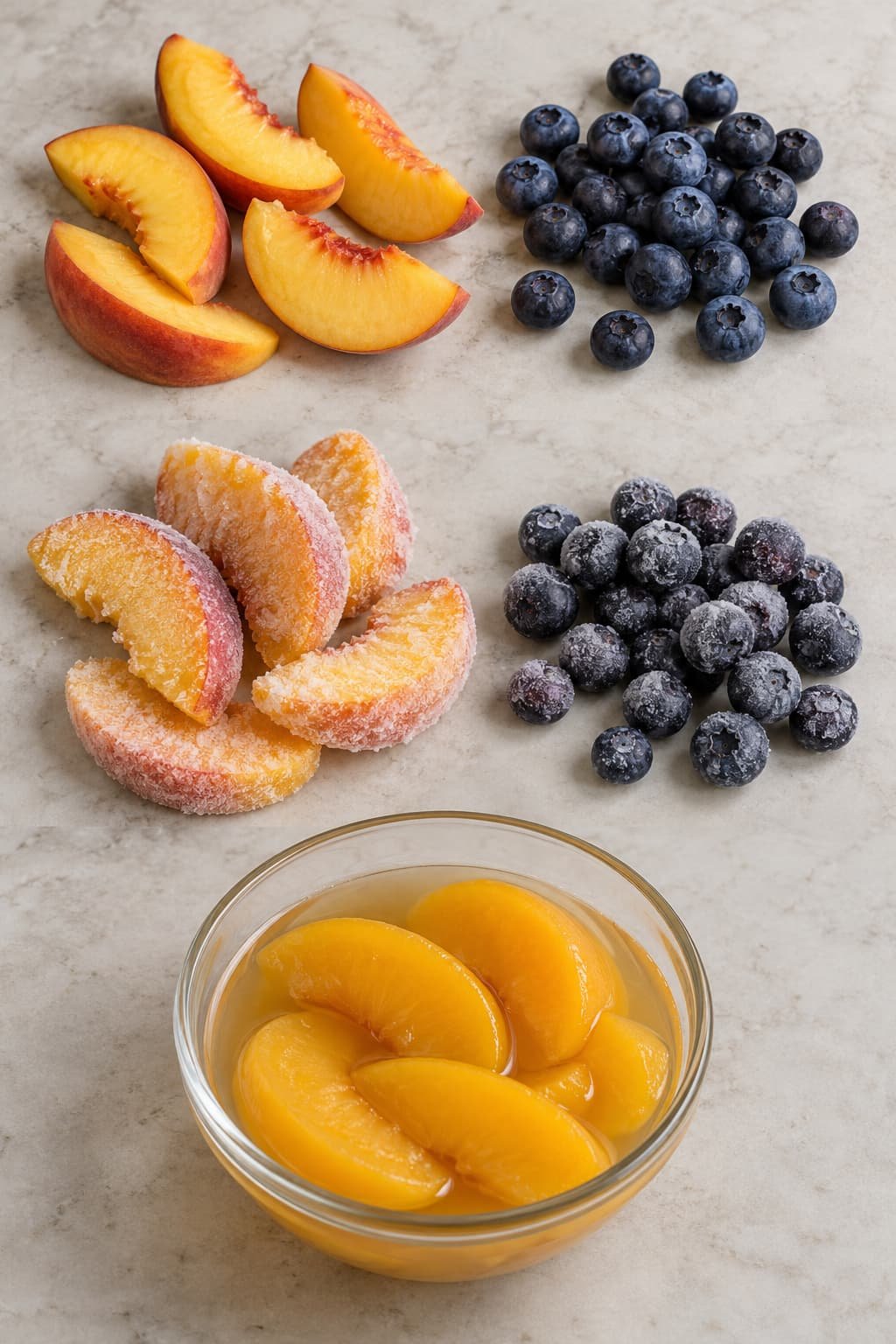
Fresh, frozen, and canned fruit can all be used in fruit-crisp formulas, but they do not begin in the same condition.
The main differences involve texture, moisture behavior, previous processing, and whether additional packing liquid is present.
A formula developed for fresh fruit should therefore not automatically be expected to behave the same way when frozen or canned fruit is substituted.
Fresh Peaches and Blueberries
Fresh fruit has not undergone the structural changes caused by freezing or the heat processing involved in canning.
Peach ripeness affects starting texture. A firm-ripe peach and a very soft peach do not begin with the same structure, so their baked textures may differ.
Fresh blueberries also vary in size, maturity, and condition. Individual berries may soften differently during baking.
For this reason, the condition of the fruit matters more than simply describing it as fresh.
Frozen Peaches and Blueberries
Frozen fruit can behave differently from fresh fruit because freezing changes plant tissue.
University of Minnesota Extension explains that ice crystals can rupture plant cell walls during freezing, making thawed produce softer. Penn State Extension also notes that damage from larger ice crystals can contribute to liquid loss as food thaws.
Frozen peaches and blueberries may therefore handle moisture differently from fresh fruit.
This does not create one universal thawing rule. Some formulas are designed for fruit used directly from frozen, while others account for thawed fruit and the liquid it releases.
Whether frozen fruit should be thawed first depends on the specific formula.
Canned Peaches
Canned peaches have already undergone heat processing and are packed with liquid.
National Center for Home Food Preservation guidance allows yellow-flesh peaches to be packed in water, apple juice, white grape juice, or sugar syrup. Commercial products can vary, so the label is the best source for identifying the packing liquid in a specific product.
That liquid can affect the overall moisture level of a fruit filling if a recipe does not account for it.
Canned peaches also do not begin in the same physical condition as raw fresh peaches. Their exact texture varies by product and processing method.
Whether they should be drained and how much should replace fresh fruit depends on the formula. A universal substitution ratio should not be assumed.
Do Peaches Need to Be Peeled for a Crisp?
No. Peaches do not have to be peeled for a fruit crisp.
Peach skin is edible, and extension guidance includes examples of peaches being cooked with the skin attached.
The decision is mainly about preparation and eating texture. Leaving the skin on means pieces of skin remain with the fruit, while peeling removes that element from the filling.
Neither approach is automatically better. If a particular formula specifies peeled or unpeeled peaches, following that guidance is the more reliable approach.
Why Can Peach Blueberry Crisp Become Watery?
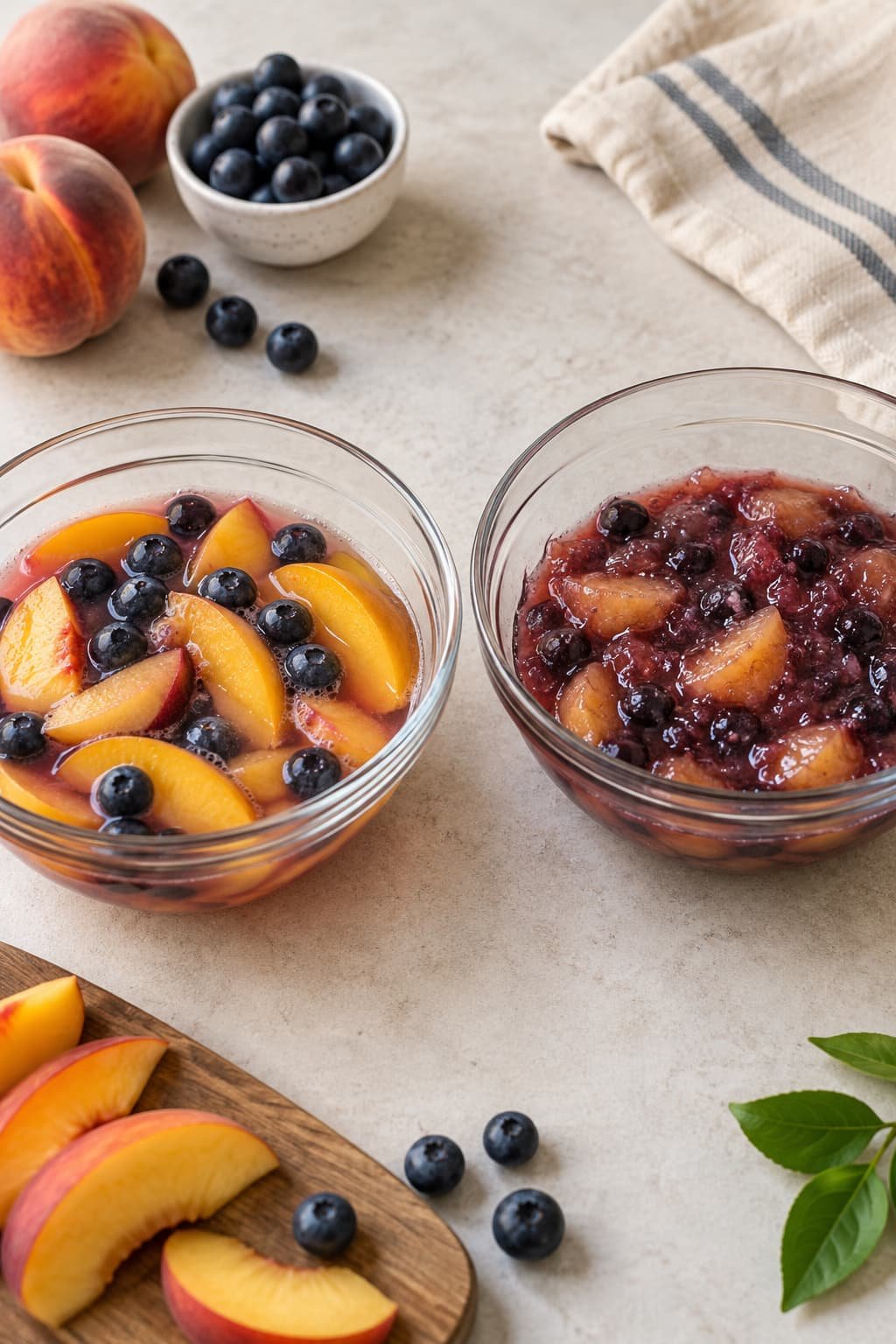
A loose filling can develop when the fruit contributes more liquid than the filling can adequately hold or thicken.
Several factors may contribute:
- fruit condition and natural moisture
- liquid released from frozen fruit
- packing liquid from canned peaches
- the type or amount of thickener
- heating conditions
- evaluating the filling while it is still very hot
A watery filling therefore cannot always be traced to one ingredient.
What Does a Thickener Do?
A thickener helps make fruit juices more cohesive.
Starch-based thickeners increase the viscosity of liquid when used under suitable conditions. In a fruit filling, this can help turn released juice into a sauce-like mixture rather than leaving it completely fluid.
Common options include cornstarch, flour, tapioca, and modified food starches.
These ingredients do not behave identically. They can differ in thickening strength, clarity, texture, and performance during cooling or freezing.
The appropriate choice depends on the particular formula rather than a universal substitution rule.
Why Can the Filling Look Looser While Hot?
Some starch-thickened fruit fillings become more set as they cool.
Fruit-filling guidance from King Arthur Baking notes that freshly baked fillings can be quite fluid while hot and continue to set as their temperature falls.
This means the appearance immediately after baking may not represent the final consistency.
Cooling does not guarantee that an overly wet filling will become properly thickened. It simply means that very hot and cooled fruit fillings should not always be expected to behave the same way.
What Makes an Oat Topping Crisp or Soft?
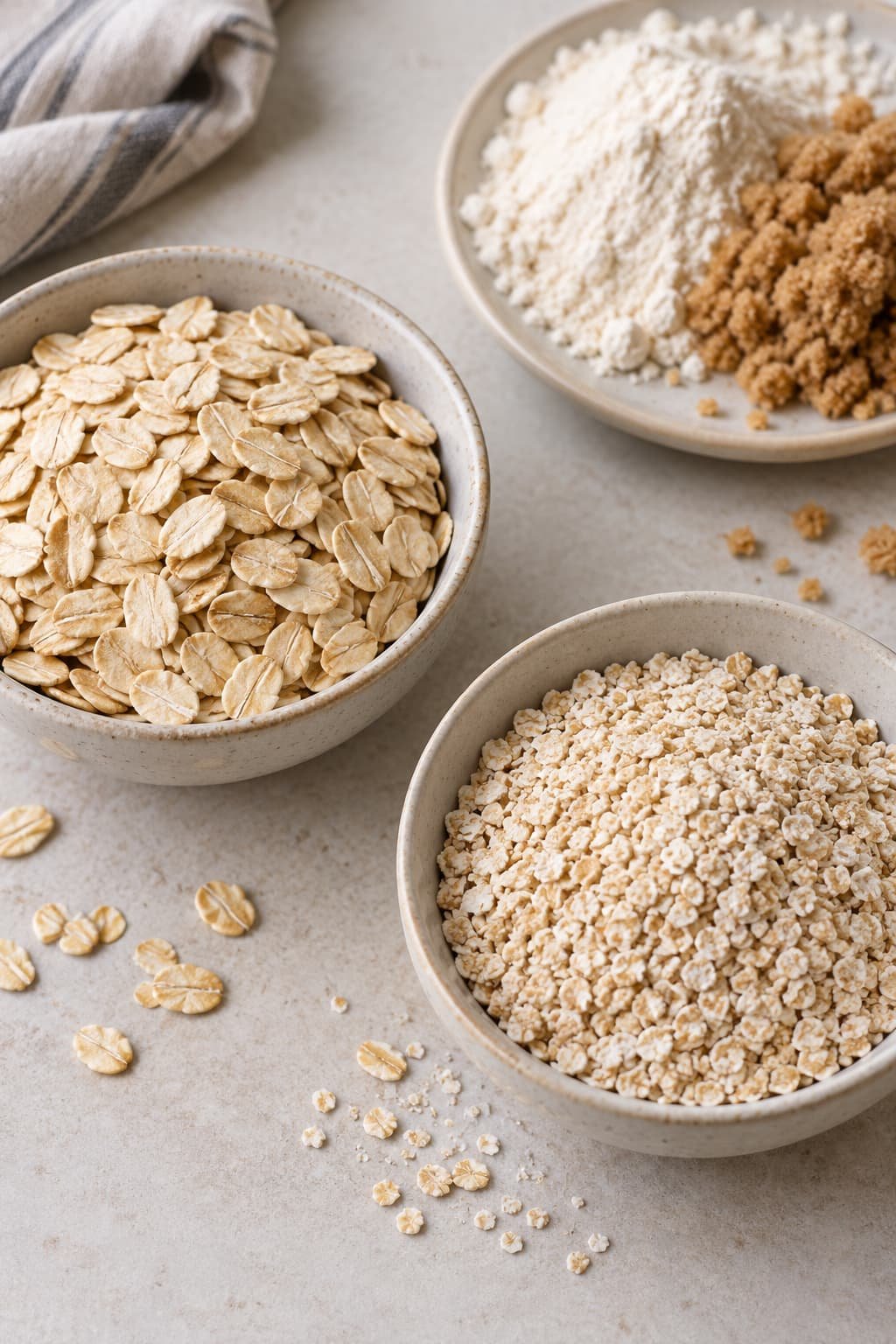
Oat-topping texture depends on the topping ingredients, moisture exposure, and baking conditions.
The upper surface is exposed directly to oven heat, while the underside sits above a moist fruit filling. Because those areas experience different conditions, they may develop different textures.
Rolled Oats vs. Quick Oats
Rolled oats and quick oats come from the same grain, but they are processed differently.
Illinois Extension explains that old-fashioned rolled oats are steamed and rolled into flakes, while quick oats are steamed longer and rolled thinner.
Rolled oats therefore have larger flakes, while quick oats are thinner and more finely processed. Those structural differences may produce different-looking crumb mixtures.
Neither type is universally better. The final result also depends on the flour, sugar, fat, moisture, and proportions used in the topping.
How Fat, Sugar, and Moisture Affect the Topping
Fat, sugar, and moisture each influence the crumb layer in different ways.
Butter or another fat helps combine dry ingredients into crumbs or clusters. Sugar provides sweetness and can contribute to surface browning during heating.
Moisture tends to soften the topping. Because the lower portion sits directly above the fruit filling, it is exposed to more moisture than the upper surface.
As a result, the top can become firmer or drier while the portion closest to the fruit remains softer.
A topping may also soften after baking as it remains in contact with the moist filling. This does not by itself indicate that the dessert was prepared incorrectly.
What Baking Factors Can Change the Result?
Baking conditions affect both the fruit filling and the crumb topping.
The filling needs sufficient heating for the fruit and any thickener to develop as intended, while the topping needs enough heat exposure for moisture loss and browning.
Dish dimensions, fruit depth, topping thickness, and oven conditions can all influence the result.
Baking-Dish Depth and Surface Area
Changing the depth or surface area of the baking dish can change how a fruit crisp heats.
A wider, shallower fruit layer has more surface area relative to its depth. A deeper layer places more fruit farther from the exposed surface.
A substantially deeper or shallower dish should therefore not automatically be expected to behave the same way during baking.
There is no single pan size that applies to every peach-and-blueberry crisp. The appropriate dish depends on the specific formula.
What Do Browning and Bubbling Indicate?
Browning and bubbling are useful baking observations, but neither is absolute proof that every fruit crisp is finished.
Browning shows that the exposed topping has undergone surface changes during heating. Its color can be influenced by sugar, other ingredients, oven conditions, and baking duration.
Visible bubbling shows that liquid in the fruit layer is actively heating. This can be particularly relevant when starch-based thickeners are present.
Fruit-pie guidance sometimes uses visible bubbling as a sign that a thickened filling has received substantial heating. However, that should not be converted into an exact rule for every fruit crisp because fruit depth, topping style, thickener, and other variables differ.
A browned topping and visible bubbling are therefore better treated as useful cues rather than universal doneness tests.
What Is the Difference Between a Crisp, Crumble, and Cobbler?
Crisps, crumbles, and cobblers are all baked fruit desserts, but their toppings commonly differ.
In North American usage, a crisp often has a crumb topping containing oats along with ingredients such as flour, sugar, and fat.
A crumble is closely related. Some sources distinguish it as a crumb topping without oats, but that distinction is not used consistently across all recipes or regions.
A cobbler is usually more distinct because it commonly uses biscuit dough, batter, pastry, or another dough-like topping rather than a loose crumb mixture.
Because naming conventions vary, the topping ingredients are often more informative than the dessert name alone.
What Should You Consider Before Adapting a Peach Blueberry Crisp?
Changing one major ingredient can affect more than flavor.
Fresh, frozen, and canned fruit differ in structure and moisture. Different thickeners can produce different consistencies. Changing the oats, flour, sugar, or fat may alter the topping, while a different baking dish can change fruit depth and surface exposure.
For these reasons, substitutions should not automatically be made in equal amounts simply because two ingredients appear to serve a similar purpose.
When a substitution materially changes the fruit, thickener, or topping, a formula specifically developed for that substitution is more reliable than guessing a ratio.