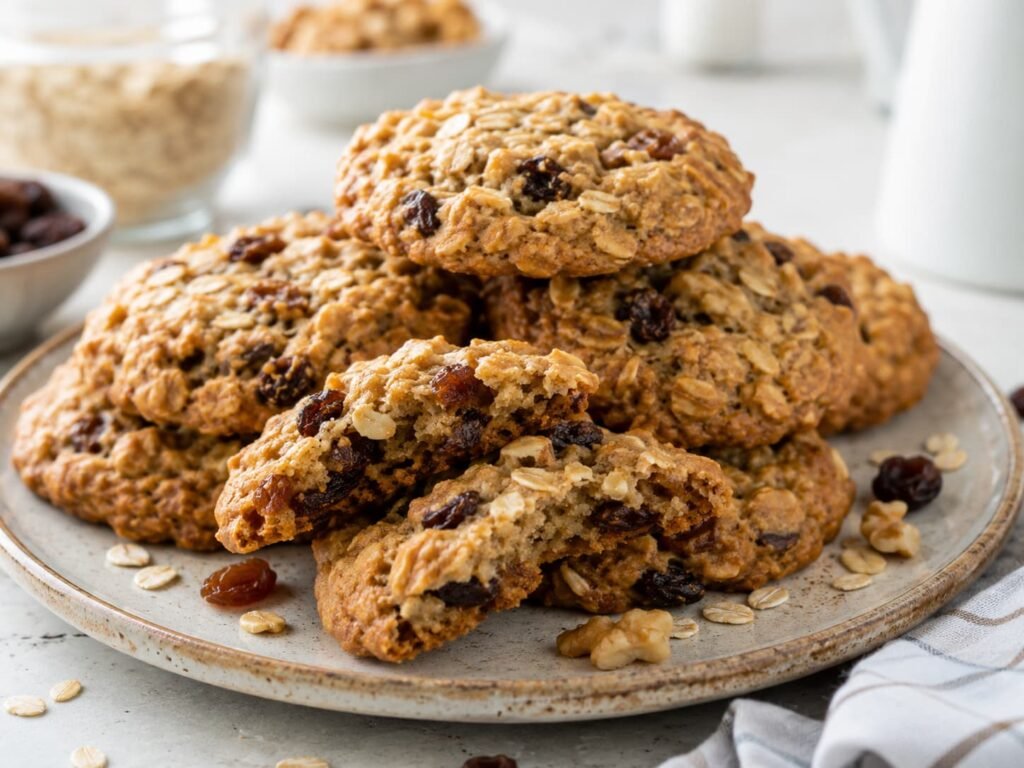
Oatmeal raisin walnut cookies combine an oatmeal-based cookie dough with raisins and walnuts. Oats contribute to the cookie’s structure and texture, raisins provide dried-fruit sweetness, and walnuts add nutty flavor and a contrasting bite.
The finished texture can vary from one recipe to another. Ingredient proportions, the type of oats used, dough temperature, preparation method, and baking conditions can all influence how a cookie spreads and its final texture.
What Are Oatmeal Raisin Walnut Cookies?
Oatmeal raisin walnut cookies are a variation of oatmeal raisin cookies that also include walnuts.
The dough commonly combines oats with ingredients such as flour, fat, sugar, eggs, and a leavening ingredient. Raisins and chopped walnuts are added as mix-ins.
The walnuts are the main feature that distinguishes this variation from a standard oatmeal raisin cookie. Their flavor and firmer texture provide a contrast to the oats and dried fruit.
There is no single formula for this type of cookie. Recipes may differ in their choice of oats, sugars, spices, mixing method, and treatment of the raisins or walnuts. For that reason, ingredient and preparation instructions should be followed according to the specific recipe rather than treated as universal rules.
Common Ingredients in Oatmeal Raisin Walnut Cookies
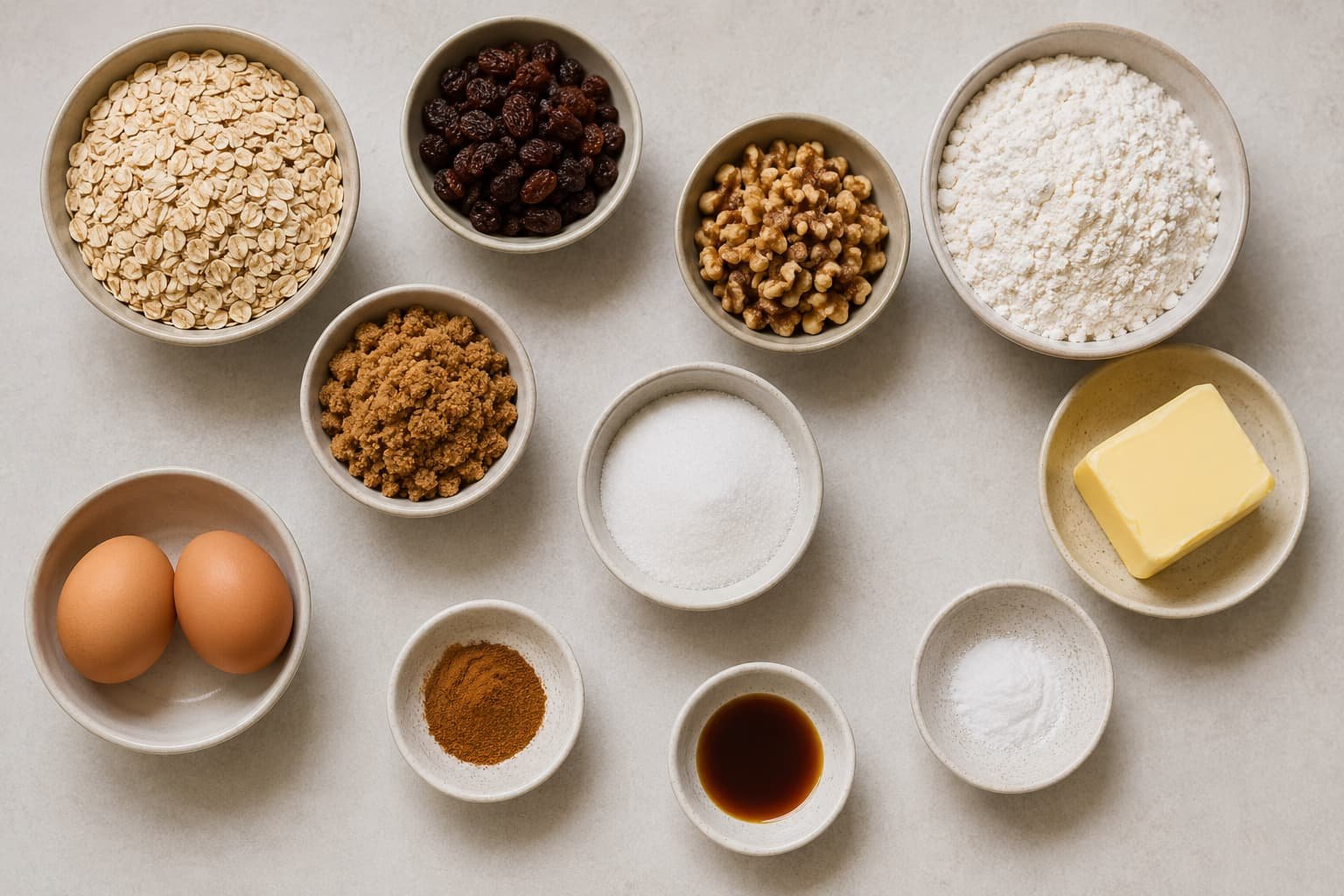
Although recipes vary, several ingredient categories appear commonly in oatmeal cookie formulas.
The ingredients work together, so changing one component can sometimes influence more than flavor alone. The effect of any change depends on the proportions and method used in the particular recipe.
Oats
Oats are a defining ingredient in oatmeal cookies and contribute substantially to their texture.
Old-fashioned oats, also called rolled oats, are flattened oat grains. Quick oats are processed into smaller, thinner pieces so they cook more quickly. Quaker describes quick oats as being cut before steaming and rolling, while old-fashioned oats remain larger rolled flakes.
Because the two forms differ in size and processing, they should not automatically be assumed to behave identically in every cookie formula.
Depending on the recipe, changing the oat type may affect characteristics such as:
- dough consistency
- how noticeable the oat pieces are
- finished cookie texture
- cookie spread
This does not make one type universally better than the other. Some recipes are designed for old-fashioned oats, while others use quick oats successfully.
Following the oat type specified by a particular recipe is therefore a more reliable approach than making an untested substitution.
Raisins
Raisins are used as a dried-fruit mix-in in oatmeal cookies. They contribute sweetness and a texture that contrasts with the oats and nuts.
Preparation methods vary. Some recipes add raisins directly to the dough, while others soak or plump them before mixing.
Soaking should therefore be treated as an optional, recipe-specific technique rather than a required step for all oatmeal cookies. The effect on the finished cookie can depend on the liquid used, soaking method, ingredient proportions, and overall formulation.
Regular and golden raisins may both appear in oatmeal cookie recipes. They differ somewhat in flavor and appearance, so changing between them may alter the character of the finished cookie.
Adding substantially more dried fruit than a recipe specifies can also change the balance of mix-ins relative to the dough. Any large adjustment is better treated as a recipe modification rather than assumed to produce the same result.
Walnuts
Walnuts are commonly chopped before being incorporated into cookie dough. Smaller pieces can help distribute the nuts throughout the mixture, although the preferred size is largely a matter of the recipe and intended texture.
Walnuts can be added raw or toasted, depending on the recipe. Toasting can develop a more pronounced roasted flavor, but it is not a requirement for oatmeal raisin walnut cookies.
As with raisins, substantially changing the amount of walnuts alters the balance between the dough and mix-ins. The effect on the finished cookies will depend on the specific formula.
Walnuts also require an important allergy consideration. In the United States, walnuts are among the tree nuts recognized by the FDA as major food allergens. People with a walnut allergy should avoid walnuts, and packaged ingredients should be checked for relevant allergen information.
Removing walnuts for allergy reasons is different from simply choosing a flavor variation. Cross-contact and the allergen status of other ingredients can also matter, so an article should not describe a modified cookie as allergy-safe without appropriate evidence.
Flour, Butter, Sugar, Eggs, and Leavening
The oats, raisins, and walnuts define the style of cookie, but the underlying dough also affects structure, spread, and texture.
Flour contributes structure to cookie dough. Measurement and ingredient proportions matter because changing the balance between dry and wet ingredients can alter how cookies behave during baking.
Butter or another specified fat contributes flavor and influences dough consistency and cookie spread. Replacing the fat or changing its amount can alter the result and should not be treated as an automatic substitution.
Sugar provides sweetness but can also influence browning, moisture behavior, and spread. Baking references note that ingredient ratios, including sugar relative to other ingredients, can affect how much cookies spread.
Eggs contribute liquid and proteins to many cookie formulas. Their role depends on the amount and type used, so changing the number or size of eggs can affect the dough rather than simply changing flavor.
Leavening ingredients, such as baking soda when called for, form part of the recipe’s overall chemical balance. Their amount should follow the specific formula rather than be increased or reduced without a reason.
Cinnamon, vanilla, and other flavorings are also common in oatmeal cookie recipes, although they are not required to define a cookie as an oatmeal raisin walnut cookie.
The important point is that a cookie recipe functions as a combination of interacting ingredients. Changing several components at the same time can make the result difficult to predict, especially when the revised version has not been tested.
Old-Fashioned Oats vs Quick Oats
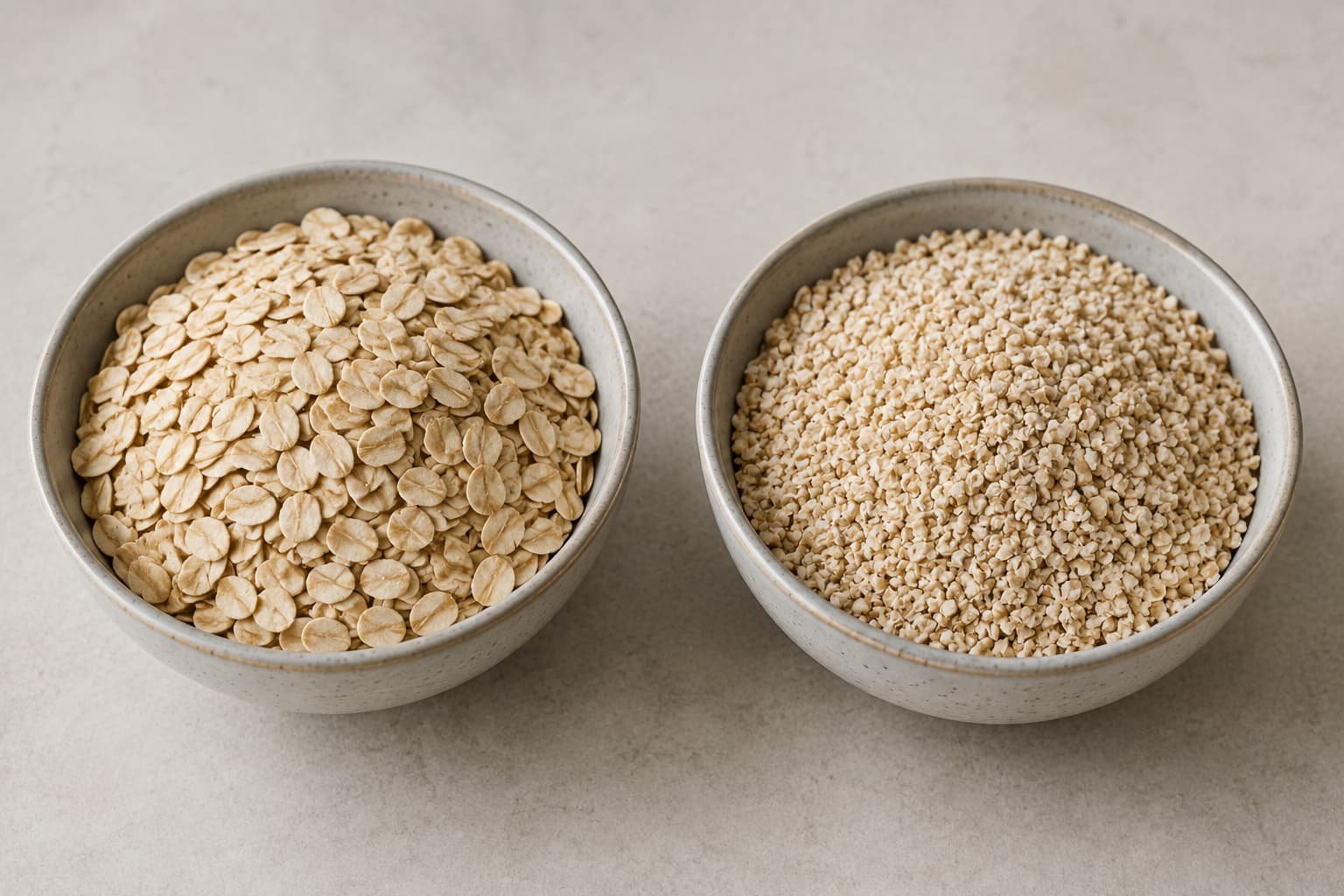
Old-fashioned oats and quick oats come from the same grain, but they differ in size and processing.
Old-fashioned oats are rolled into flattened flakes. Quick oats are cut into smaller pieces so they cook faster. Quaker describes the difference in size and shape as one reason the two types have different cooking times and textures.
That difference can also be noticeable in baking. Old-fashioned oats have larger flakes, while quick oats have a finer texture. Quaker notes that quick oats can give baked goods a somewhat thinner texture than old-fashioned oats.
Changing the oat type may therefore affect characteristics such as:
- how noticeable the oat pieces are
- how coarse or fine the finished texture feels
- how the oats blend into the dough
- overall dough consistency
The exact result depends on the complete recipe. Quick oats and old-fashioned oats should not automatically be treated as interchangeable in every cookie formula.
If a recipe specifies one type, following that choice is the more reliable approach. Substituting another oat may change the finished texture, even if both products can be used successfully in different oatmeal-cookie recipes.
Should Raisins Be Soaked Before Adding Them?
No. Raisins do not have to be soaked for every oatmeal cookie recipe.
Established recipes use both approaches. Food Network has an oatmeal, walnut, and raisin cookie recipe that adds the raisins directly to the dough, while the American Heart Association uses a soaking and draining step in its oatmeal raisin walnut cookie formula.
Soaking is one way to plump dried raisins before they are mixed into the dough. The American Heart Association notes in its specific recipe that dry raisins can absorb liquid from baked goods, which is why that formula calls for soaking them first.
That does not establish soaking as a universal way to make oatmeal cookies softer. Other established formulas use unsoaked raisins successfully, and the effect of soaking depends on the complete recipe.
If a formula calls for soaked raisins, they should be prepared and drained according to those instructions. If it calls for dry raisins, there is no need to add a soaking step simply because another recipe uses one.
What Affects the Texture of Oatmeal Raisin Walnut Cookies?
Cookie texture depends on several interacting factors rather than one ingredient alone.
Research and baking tests on cookie dough show that ingredient ratios, dough temperature, sugar, fat, and oven conditions can influence spread and texture. The exact effect in an oatmeal raisin walnut cookie still depends on its particular formulation.
For that reason, changing several ingredients or preparation steps at once can make the result difficult to predict.
Ingredient Ratios
The balance between flour, fat, sugar, eggs, oats, and other ingredients helps determine how a cookie dough behaves.
King Arthur Baking identifies excess liquid or sugar relative to the dry ingredients as one possible cause of excessive spread. Its cookie-development testing also shows that changing the proportion of sugar can alter spread and texture in a tested cookie formula.
Flour contributes to the structure of baked cookies. Food Network also cautions that compacting flour when measuring can result in dry baked goods, which shows why flour quantity and measurement method can matter.
Fat, sugar, and liquid ingredients also interact with the flour and other dry ingredients. Their effects should therefore be considered as part of the full formula rather than in isolation.
Oats add another substantial dry ingredient to this style of cookie. Adding more oats than a recipe specifies should not be assumed to leave the result unchanged.
The same caution applies to reducing sugar, adding extra raisins or walnuts, or changing the amount of flour. These are recipe modifications, and their exact effects cannot be predicted reliably without testing the revised formula.
Dough Temperature and Chilling
Some cookie recipes call for chilling the dough, while others are designed to be baked without a chilling period.
King Arthur Baking tested refrigerated and unrefrigerated drop-cookie dough and found that the refrigerated dough spread less in that particular test. The explanation given is that chilled fat remains solid longer as the cookie begins baking.
That evidence supports chilling as a factor that can influence spread in drop cookies. It does not prove that every oatmeal raisin walnut cookie must be chilled.
A formula written for immediate baking may behave differently from one developed around refrigerated dough. Likewise, omitting a chilling step from a recipe that specifically requires it may change the finished result.
Other temperature-related factors can matter as well. King Arthur lists overly warm dough, warm baking sheets, and oven temperature among possible contributors to cookie-spread problems.
The practical approach is to follow the chilling instructions for the specific recipe instead of applying one rule to all oatmeal cookies.
Oat Type
Old-fashioned and quick oats differ mainly in the size and processing of the oat pieces.
Old-fashioned oats retain larger flakes, while quick oats are cut into smaller pieces. That difference can change how noticeable the oats are in the finished cookie and how finely they blend into the dough.
Quick oats may produce a finer or somewhat thinner oat texture, while larger rolled oats can remain more distinct.
It would be too strong, however, to claim that switching oat types will always produce a specific change in spread or moisture. Those outcomes depend on the rest of the recipe.
Oat type is therefore best treated as one part of the complete formulation rather than as an isolated texture control.
Baking Conditions
Oven conditions and baking duration can affect the way cookies set, spread, brown, and develop their final texture.
King Arthur identifies an oven that is too cool as one possible reason cookies may spread excessively because the fat can melt before the cookie has set sufficiently.
Baking duration can also change texture. In controlled cookie-development examples, King Arthur shows that changes in baking time, together with formulation changes, can produce noticeably different finished textures.
These are general cookie-baking principles rather than a verified temperature-and-time formula for this specific oatmeal raisin walnut cookie.
There is no single baking temperature or duration that can safely be applied to every version. Cookie size, dough formulation, ingredient proportions, and preparation method can differ considerably.
Exact baking temperature and time should therefore come from a verified recipe rather than being estimated from general baking advice.
Why Can Oatmeal Raisin Cookies Turn Out Dry or Spread Incorrectly?
Dryness and unexpected spreading can have several possible causes. Ingredient proportions, dough temperature, baking conditions, oat type, and substitutions may all influence the result.
Because these factors work together, a problem should not automatically be blamed on one ingredient or one step.
Cookies That Turn Out Dry
Too much flour is one possible cause of a dry or firm cookie. Measuring flour inaccurately can change the balance between dry and liquid ingredients.
Baking a cookie longer than its particular formula requires can also lead to greater moisture loss and a firmer finished texture.
Other possible factors include:
- adding more oats than the formula was designed for
- reducing fat or other ingredients that contribute moisture
- making substitutions that change the original ingredient balance
- using a different type of oat than the recipe specifies
These are possible explanations rather than definite diagnoses. Without testing the exact formula, it is not possible to say that one factor caused a particular batch to turn out dry.
If the texture is not as expected, checking the original measurements, substitutions, baking conditions, and preparation method is more useful than changing several ingredients at once.
Cookies That Spread Too Much
Cookies can spread more than expected for several reasons.
General cookie-baking research identifies factors such as warm dough, insufficient flour relative to other ingredients, a warm baking sheet, and oven conditions as possible contributors to excessive spread.
Ingredient proportions also matter. Changing the balance of flour, sugar, fat, or liquid can affect how a cookie behaves as it heats.
These principles apply broadly to cookie baking, but they do not identify the cause of every oatmeal cookie problem. The exact effect depends on the particular formula and preparation method.
Cookies That Do Not Spread Enough
A cookie that remains thicker than expected can also have several possible causes.
A larger proportion of flour or other dry ingredients may limit spread in some cookie formulas. Increasing the amount of oats can also change dough consistency because oats make up a substantial part of this type of cookie.
Dough temperature can matter as well. Chilled dough has spread less than comparable unchilled dough in controlled cookie tests, but that result should not be treated as a universal rule for every oatmeal cookie recipe.
Some formulas are also intentionally designed to spread very little or to be flattened before baking.
If the cookies stay thicker than expected, review the ingredient measurements, oat quantity, dough preparation, and instructions for the specific recipe before assuming that one factor is responsible.
Can You Change the Raisins or Walnuts?
Raisins and nuts can be varied in some oatmeal cookie formulas, but substitutions can change flavor, appearance, texture, and the balance of mix-ins.
Because this specific formula has not been tested with every substitution, alternative ingredients should be presented as possibilities rather than guaranteed replacements.
Can Pecans Replace Walnuts?
Pecans are used in established oatmeal raisin cookie recipes, so they are a reasonable variation to consider when a different nut flavor is wanted.
However, pecans and walnuts do not have identical flavor or texture. Replacing one with the other may therefore change the finished cookie.
An exact replacement quantity should come from a verified recipe rather than being assumed for an untested formula.
Walnuts and pecans are both tree nuts. Replacing walnuts with pecans is therefore not an appropriate way to make a recipe suitable for someone who needs to avoid tree nuts.
Can Golden Raisins Replace Regular Raisins?
Golden raisins also appear in established oatmeal cookie recipes.
They differ from standard dark raisins in color and flavor, so using them can change the appearance and taste of the cookie.
For an untested formula, it is safer to describe golden raisins as a possible variation rather than claim that they can always replace regular raisins without affecting the result.
If an exact quantity is needed, it should come from a recipe that has been developed or reliably verified with that substitution.
Can the Walnuts Be Left Out?
Leaving out walnuts changes the cookie by removing the nutty flavor and contrasting texture they provide.
The result would be closer to a traditional oatmeal raisin cookie, but the effect on the dough depends on how much of the original formula consists of walnuts.
It should not be assumed that removing a substantial amount of nuts will leave the recipe completely unchanged.
If a nut-free version is needed, using a formula developed without walnuts is more reliable than assuming the remaining ingredients require no adjustment.
For allergy-related preparation, omitting walnuts alone does not establish that a cookie is safe for someone with a tree-nut allergy. The ingredients used and the possibility of allergen cross-contact also need to be considered.
What Should You Consider Before Changing an Oatmeal Raisin Walnut Cookie Recipe?
Changing a major ingredient can affect more than flavor. Flour, sugar, fat, eggs, and oats all contribute to how cookie dough behaves, so substantial substitutions may change spread, structure, or texture.
If several major ingredients need to be changed, using a formula developed for those substitutions is generally more reliable than assuming a standard recipe will behave the same way.
Changing the Type of Oats
Old-fashioned oats and quick oats differ in size and processing. Because of those differences, switching between them may change how noticeable the oats are and how they blend into the dough.
That does not mean one type is always better. The result depends on the recipe.
If a formula specifies a particular oat, following that choice is the more predictable approach unless the substitution has been accounted for.
Reducing or Replacing Sugar
Sugar affects more than sweetness in cookie dough.
King Arthur Baking tested reduced-sugar versions of several cookie recipes, including oatmeal-raisin cookies, and found that reducing sugar changed both spread and texture in those tested formulas. The effects varied according to how much sugar was removed.
Those results support a general point: substantially reducing sugar can change the cookie rather than simply make it less sweet.
A different sweetener can introduce additional differences in moisture, composition, and behavior. Without a formula developed for that sweetener, it should not be assumed to produce the same result.
Changing the Fat
Changing the type or quantity of fat can affect how a cookie dough behaves during baking.
For example, King Arthur identifies the type of fat as one factor that can influence cookie spread. However, the exact effect depends on the complete recipe rather than the fat alone.
A different fat should therefore be treated as a recipe modification, not an automatic equivalent.
Replacing the Flour
Different flours do not necessarily behave the same way in a cookie formula.
This becomes particularly important when converting a conventional wheat-flour cookie into a gluten-free version. Simply replacing one ingredient does not establish that the complete recipe will have the same structure or texture.
There is also an important distinction between a recipe variation and a regulated gluten-free claim. Under U.S. FDA rules for foods carrying that label, the food must meet specific ingredient requirements and any unavoidable gluten must remain below 20 parts per million. Oats do not have to carry a particular certification under the rule, but oats represented as gluten-free must meet the same less-than-20-ppm standard.
For a homemade recipe article, it is therefore better not to describe a converted version as suitable for a gluten-free diet unless the complete ingredient selection and preparation requirements have been appropriately established.
Removing Eggs
Eggs provide liquid and proteins in many conventional cookie formulas, so simply removing them changes the composition of the dough.
Egg-free cookie recipes do exist, but that does not establish that an egg can be omitted from every conventional oatmeal cookie without other changes.
If an egg-free or vegan version is needed, a formula specifically developed around those requirements is more predictable than removing eggs from an untested standard recipe.
Adding Extra Raisins or Nuts
Increasing the raisins or walnuts changes the ratio of mix-ins to dough.
A small adjustment may not produce the same effect as a large increase, and there is no verified amount that can be recommended here for this untested formula.
Adding substantially more raisins, walnuts, or several additional mix-ins should therefore be treated as a recipe modification rather than assumed to leave the dough unchanged.
Converting the Recipe to Gluten-Free or Vegan
Gluten-free and vegan versions are better treated as separate formulations when they require several major ingredient changes.
A gluten-free version may involve changes to flour and careful selection of other ingredients. A vegan version may require alternatives for eggs, butter, or other animal-derived ingredients.
Those are legitimate recipe categories, but they should not be added to this article merely to target extra search terms. Readers specifically seeking those versions are better served by recipes developed for those requirements.
Storing and Freezing Oatmeal Raisin Walnut Cookies
The following figures come from general USDA guidance for homemade cookies and cookie dough. They are not storage-test results for this specific oatmeal raisin walnut cookie formula, and they do not guarantee that flavor or texture will remain unchanged for the full period.
Storing Baked Cookies
USDA Food Safety and Inspection Service guidance states that bakery or homemade cookies can generally be stored at room temperature for 2 to 3 weeks or in the refrigerator for 2 months.
These are broad storage guidelines for cookies rather than a verified shelf-life study of this particular recipe.
Airtight storage can help limit exposure to air, but this article should not promise that these cookies will remain equally soft or retain the same texture throughout the USDA storage period.
Freezing Baked Cookies
USDA states that bakery or homemade cookies can retain their quality in the freezer for 8 to 12 months.
The wording retain their quality is important. This is general freezer-quality guidance, not evidence that this specific cookie has been tested and will maintain its original texture for 8 to 12 months.
No exact thawing method or post-freezing texture claim should be added unless it is verified for the actual recipe.
Freezing Cookie Dough
USDA guidance states that homemade cookie dough can be refrigerated for 2 to 4 days or frozen for 2 months. It also notes that small portions can be frozen and thawed in the refrigerator as needed.
Those figures can be used as general storage guidance.
An exact bake-from-frozen time, temperature adjustment, or doneness instruction should not be supplied for this oatmeal raisin walnut dough because those details depend on the specific recipe and have not been verified here.
For that reason, frozen dough should be baked according to instructions established for the actual formula rather than by adding an assumed amount of extra baking time.
Frequently Asked Questions About Oatmeal Raisin Walnut Cookies
What type of oats are commonly used in oatmeal raisin cookies?
Old-fashioned rolled oats are commonly used in oatmeal cookies. Quaker identifies old-fashioned oats as a common choice for cookies and other baked goods. Their larger flakes also give a more noticeable oat texture than more finely cut quick oats.
Quick oats are also used in baking, but their smaller pieces create a finer texture. The type specified in the particular recipe is generally the more reliable choice.
Can quick oats be used instead of old-fashioned oats?
Sometimes, but they should not be treated as interchangeable in every recipe.
Quick oats are cut into smaller pieces than old-fashioned oats, and Quaker notes that they can produce a somewhat thinner texture in baked goods.
Changing the oat type may therefore alter dough consistency or finished texture. The exact effect depends on the complete formula.
Should raisins be soaked before making oatmeal cookies?
Not always. Both soaked and unsoaked raisins are used in established oatmeal cookie recipes.
For example, Food Network’s oatmeal, walnut, and raisin cookie recipe adds raisins directly to the dough, while other oatmeal-cookie formulas use a soaking step.
Soaking can plump dried raisins, but it should be treated as a recipe-specific technique rather than a requirement. It does not guarantee a softer finished cookie.
Do oatmeal raisin cookie doughs need to be chilled?
No. Chilling is not required for every oatmeal cookie formula.
In King Arthur Baking’s controlled drop-cookie test, refrigerated dough spread less than dough baked without chilling. The source explains that chilled fat takes longer to melt in the oven.
That is useful general baking evidence, but it does not mean every oatmeal raisin cookie must be chilled. Follow the instructions for the specific formula.
Why can oatmeal raisin cookies turn out dry?
Several factors may contribute.
Too much flour is one possible cause. Food Network warns that scooping flour directly from the bag can compact it and result in more flour than intended, which may contribute to dry baked goods.
Other possible factors include baking longer than the recipe calls for, changing ingredient proportions, adding extra dry ingredients, or making substitutions that alter the original formula.
Without evaluating the exact batch, none of these should be presented as the definite cause.
Can pecans be used instead of walnuts?
Pecans are a reasonable alternative to consider because oatmeal-raisin cookie recipes using pecans already exist.
However, changing the nut changes the flavor and may also alter the texture of the mix-ins. An exact replacement quantity should come from a verified formula rather than be assumed for this untested recipe.
Walnuts and pecans are both included among tree nuts recognized by the FDA as major food allergens. Replacing walnuts with pecans therefore does not make the cookies suitable for someone who needs to avoid those tree nuts.
Can walnuts be omitted?
They can be left out as a recipe variation, but the result should not be assumed to behave exactly like the walnut-containing version.
Removing walnuts changes the flavor and eliminates their contribution as a solid mix-in. The cookie would be closer to a standard oatmeal raisin cookie.
Because this specific formula has not been tested without walnuts, no claim should be made that spread, texture, or dough consistency will remain identical.
For allergy-related baking, simply omitting walnuts does not by itself establish that the finished food is safe for someone with a tree-nut allergy. Ingredient labels and possible allergen cross-contact also need to be considered.
Can golden raisins replace regular raisins?
Golden raisins are used in established oatmeal cookie recipes, including recipes containing oats and walnuts.
They have a different appearance from standard dark raisins and may also change the flavor of the cookie.
For this untested formula, golden raisins are better described as a possible variation rather than a guaranteed identical replacement. An exact substitution quantity should not be supplied unless it has been verified.
Can oatmeal raisin walnut cookies be frozen?
Yes, general USDA guidance supports freezing homemade cookies.
The USDA Food Safety and Inspection Service states that cookies can retain their quality in the freezer for 8 to 12 months.
That figure is general freezer-quality guidance. It is not a storage test of this particular oatmeal raisin walnut cookie formula and does not guarantee that the cookies will maintain exactly the same flavor or texture throughout that period.
Final Considerations
Oatmeal raisin walnut cookies depend on more than the three main mix-ins. Oat type, ingredient proportions, dough temperature, substitutions, and baking conditions can all influence the final result.
For the most predictable outcome, follow a verified formula rather than making several major changes at once. Gluten-free, vegan, egg-free, and nut-free versions are better treated as separately developed recipes when they require changes to important structural ingredients.