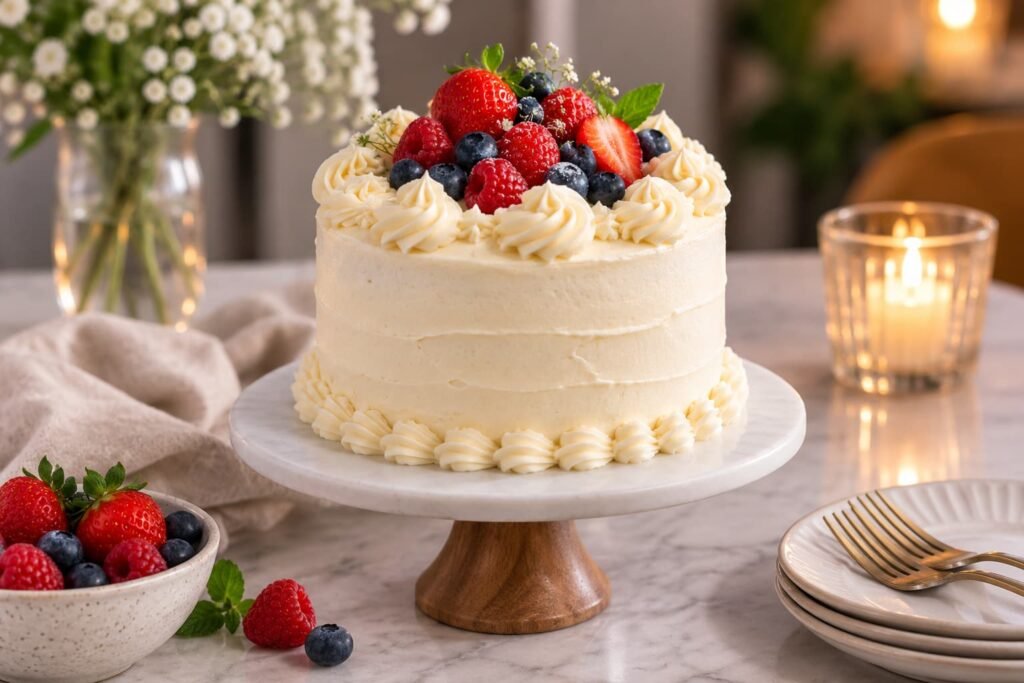
A 6 inch cake can work well for a small birthday, anniversary, date night, or another celebration where a large cake is not needed.
The term 6 inch cake recipe usually refers to a cake made in a round pan measuring 6 inches across. However, diameter alone does not tell you how large the finished cake will be. Pan depth, batter quantity, number of layers, filling, and frosting can all affect its final height and serving potential.
Understanding those differences makes it easier to choose a recipe that fits the occasion rather than assuming every 6-inch cake produces the same amount of cake.
What Does a 6 Inch Cake Recipe Usually Refer To?
A 6-inch cake recipe is generally a recipe designed for a round cake pan that measures 6 inches in diameter.
That measurement does not specify the cake’s height, number of layers, or yield.
A 6-inch cake may be made as:
- one cake layer
- two stacked layers
- three stacked layers
Two recipes can both use 6-inch pans and still produce noticeably different cakes. One may divide batter between several thin layers, while another may create fewer, deeper layers.
Pan depth matters as well. Two pans with the same diameter can have different capacities if one is deeper than the other.
Before choosing a recipe, check:
- pan diameter
- pan depth
- number of pans required
Those details give a clearer picture of the cake than the 6-inch diameter alone.
How Do One-, Two-, and Three-Layer 6 Inch Cakes Differ?
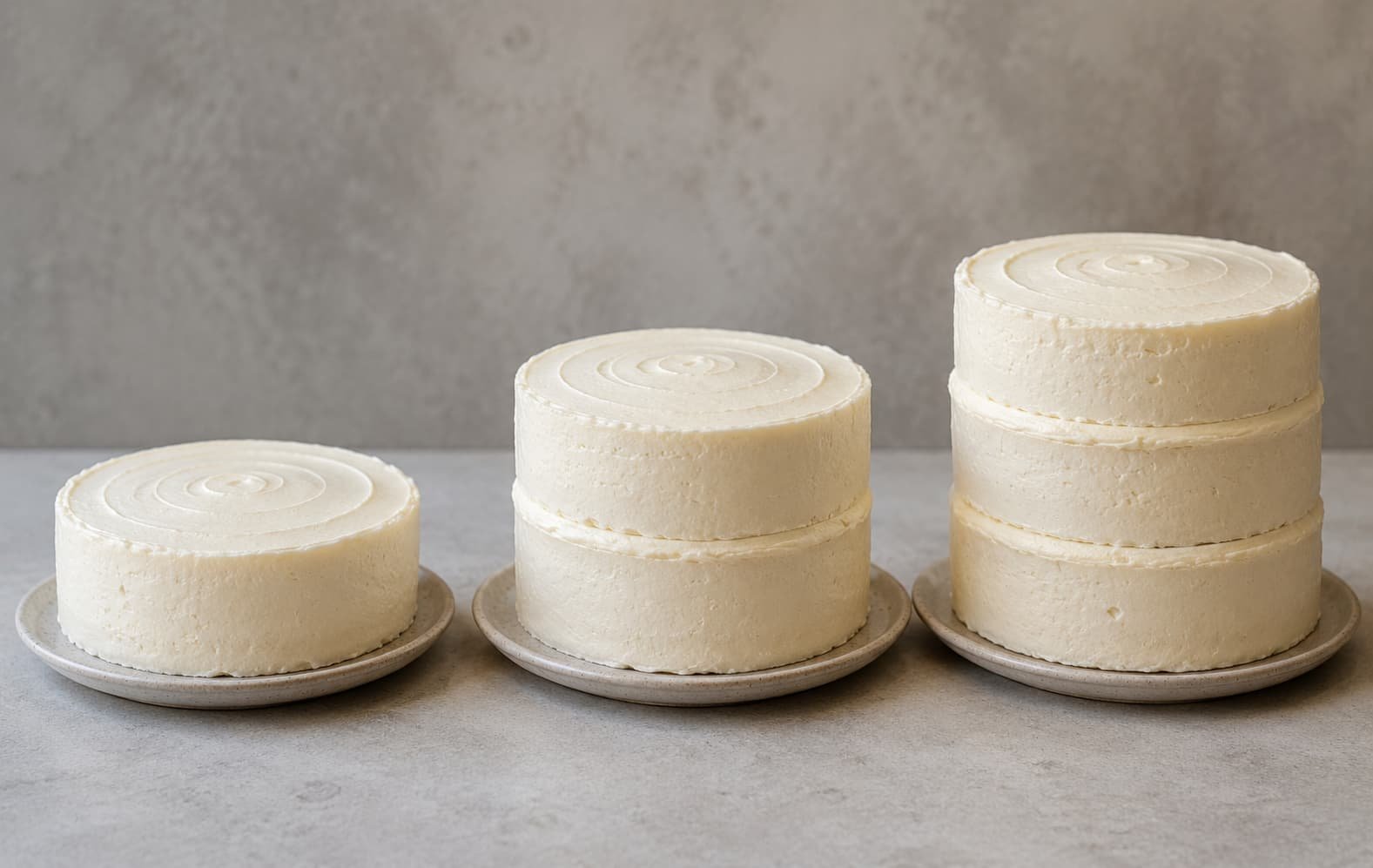
The number of layers mainly changes the cake’s height, appearance, filling opportunities, and how it may be portioned.
It does not automatically tell you how much total cake there is. If the same quantity of batter is divided among more pans, the layers may simply become thinner.
Single-Layer 6 Inch Cakes
A single-layer cake has the simplest structure.
It may suit a casual dessert, small dinner, or date night where a tall layer cake is unnecessary. Because there are no stacked layers, there is also no need for a filling between cakes.
The top can still be decorated with frosting, berries, chocolate, sprinkles, candles, or another simple finishing element.
Two-Layer 6 Inch Cakes
A two-layer cake provides space for frosting or filling between the layers and creates a taller presentation than a comparable single-layer cake.
This format can suit birthdays, anniversaries, or other small celebrations where a traditional layer-cake appearance is wanted without using a wider cake.
Possible fillings include buttercream, ganache, fruit preserves, or another filling suited to the recipe.
Three-Layer 6 Inch Cakes
Three layers create additional height and more spaces for filling.
They may also require more frosting if the cake is being fully covered.
However, three layers do not necessarily mean more total cake. If one batch of batter is simply divided among three pans instead of two, the individual layers may only become thinner.
Choose the number of layers based on the specific recipe, desired appearance, and amount of cake needed.
How Many People Can a 6 Inch Cake Serve?
There is no single serving number for every 6-inch cake.
Serving potential depends on several factors, including cake height, total batter quantity, layer thickness, slice size, and cutting method.
Cake Height
A taller cake may provide more cake per portion than a shallow cake with the same diameter.
This is why height should be considered alongside diameter when estimating servings.
Number of Layers
More layers can increase the total amount of cake when additional batter is used.
If the same batter is simply divided among more pans, however, the total yield does not automatically increase.
Slice Size
Large dessert wedges produce fewer portions than narrow celebration-style slices.
For a date night, two people may choose larger pieces. At a small birthday, the same cake might be cut into smaller portions.
Other Desserts
Serving needs can also change depending on the rest of the menu.
If cake is the main dessert, larger slices may make sense. If other sweets are available, smaller portions may be enough.
The most reliable approach is to use the serving guidance for the specific recipe and consider how the cake will actually be cut.
What Should You Check Before Choosing a 6 Inch Cake Recipe?
Before choosing a recipe, make sure its pan setup matches the cake you plan to make.
Diameter is only one part of the equation.
Pan Diameter and Depth
A 6-inch round pan measures 6 inches across, but pans with the same diameter can still differ in depth and capacity.
A deeper pan can hold more batter than a shallower one. Batter depth can also affect how the cake bakes.
For that reason, follow the pan dimensions given with the recipe whenever possible.
Number of Pans Required
Some recipes are written for one 6-inch pan, while others divide the batter between two or more pans.
Changing the number of pans changes the depth of the batter in each pan.
If the same quantity of batter is divided among more pans, the layers will generally be thinner. Using fewer pans can create deeper layers.
Batter Quantity
There is no universal batter amount for every 6-inch cake.
The appropriate quantity depends on:
- pan depth
- number of layers
- desired layer thickness
- the specific cake formula
- how much the batter is expected to rise
Use the quantity specified by the particular recipe rather than relying on one fixed cup measurement for every 6-inch pan.
Cake Formula
Cake ingredients work together as a formula.
Flour, sugar, eggs, fat, liquid, and leavening all influence how the batter behaves and how the finished cake develops.
Because of this, resizing a cake should not be treated as casually reducing ingredients without considering the original formula.
When practical, a recipe already designed for the intended 6-inch pan setup is the simpler option.
What Ingredient Categories Are Commonly Used in 6 Inch Cakes?
A smaller cake does not require a completely different type of ingredient list from a larger cake.
The exact amounts depend on the recipe, but many cake formulas use similar ingredient categories.
Flour, Sugar, Eggs, Fat, and Liquid
Flour contributes structure to the cake.
Sugar adds sweetness and also affects browning, tenderness, and the balance of the batter.
Eggs can contribute structure, moisture, richness, and help combine fat and liquid ingredients.
Fat may come from butter, oil, or another ingredient depending on the cake style.
Liquid may come from milk, buttermilk, water, coffee, or another ingredient depending on the formula.
Because these ingredients interact, changing one can affect more than one part of the finished cake.
Leavening and Flavoring
Cake formulas may use baking powder, baking soda, whipped eggs, or other methods to create lift.
The correct leavening depends on the rest of the ingredients and should not be changed casually.
Flavoring ingredients may include:
- vanilla or other extracts
- cocoa powder
- citrus zest or juice
- spices
- fruit-based ingredients
Some flavoring ingredients also change the balance of the formula.
For example, cocoa adds dry ingredients, while citrus juice adds both liquid and acidity. This is why flavor changes are more reliable when the recipe has already been developed for that variation.
Can an 8 Inch Cake Recipe Be Adapted for a 6 Inch Pan?
Yes, but the recipe usually needs to be scaled rather than transferred directly into the smaller pan.
For round pans of the same depth, a 6-inch pan has about 56% of the surface area of an 8-inch pan.
That difference means simply cutting every ingredient exactly in half is not a precise area-based conversion.
Weight-based measurements can make scaling easier because ingredient quantities can be adjusted proportionally.
Even then, some ingredients are harder to divide. Eggs, small amounts of leavening, and similar ingredients may require more careful measurement.
Pan depth must also be considered because two 6-inch pans can have different capacities.
When possible, using a formula already designed for 6-inch pans avoids much of this conversion work.
Does a 6 Inch Cake Need a Different Baking Time?
Not necessarily.
A smaller diameter does not create one universal shorter baking time. Batter depth, cake formula, pan material, oven performance, and the number of pans all influence how the cake bakes.
Batter Depth
Shallower batter layers generally heat differently from deeper ones.
If the same quantity of batter is divided among more pans, each layer may be thinner and may bake differently from a deeper layer.
Cake Formula
Different cake formulas do not necessarily bake at the same rate.
A butter cake, oil-based cake, chocolate cake, and sponge-style cake may all behave differently.
Pan Material
Pan material and surface color can influence how heat reaches the batter and how quickly the exterior browns.
Oven Performance
Actual oven temperature can differ from the temperature shown on the control panel, and ovens may distribute heat differently.
For these reasons, follow the baking guidance for the specific recipe and pan setup rather than applying one fixed temperature or baking time to every 6-inch cake.
What Flavors Work Well for a 6 Inch Cake?
A 6-inch cake can use many of the same flavor combinations as a larger celebration cake.
The cake’s diameter does not determine its flavor.
Vanilla and Chocolate
Vanilla provides a flexible base that can be paired with:
- vanilla buttercream
- chocolate buttercream
- berry preserves
- ganache
- fresh berries
Chocolate cake can be paired with chocolate frosting, vanilla buttercream, ganache, raspberry, or strawberry.
If a chocolate version is wanted, use a formula developed for chocolate cake rather than adding an unverified amount of cocoa to a vanilla recipe.
Strawberry, Lemon, and Other Fruit-Based Options
Fruit flavor can come from the cake, filling, frosting, or decoration.
Possible combinations include strawberry with vanilla frosting, lemon with berry filling, or vanilla cake topped with fresh fruit.
Fresh berries can also add color without requiring complicated decoration.
Red Velvet and Sprinkle-Style Cakes
Red velvet is another option for birthdays, anniversaries, or other celebrations and is commonly paired with cream cheese frosting.
A sprinkle-style cake can create a colorful birthday presentation without requiring a complicated decorating theme.
These are options rather than rules. The appropriate flavor depends on the occasion and the recipe being used.
How Can Frosting and Filling Change a Small Cake?
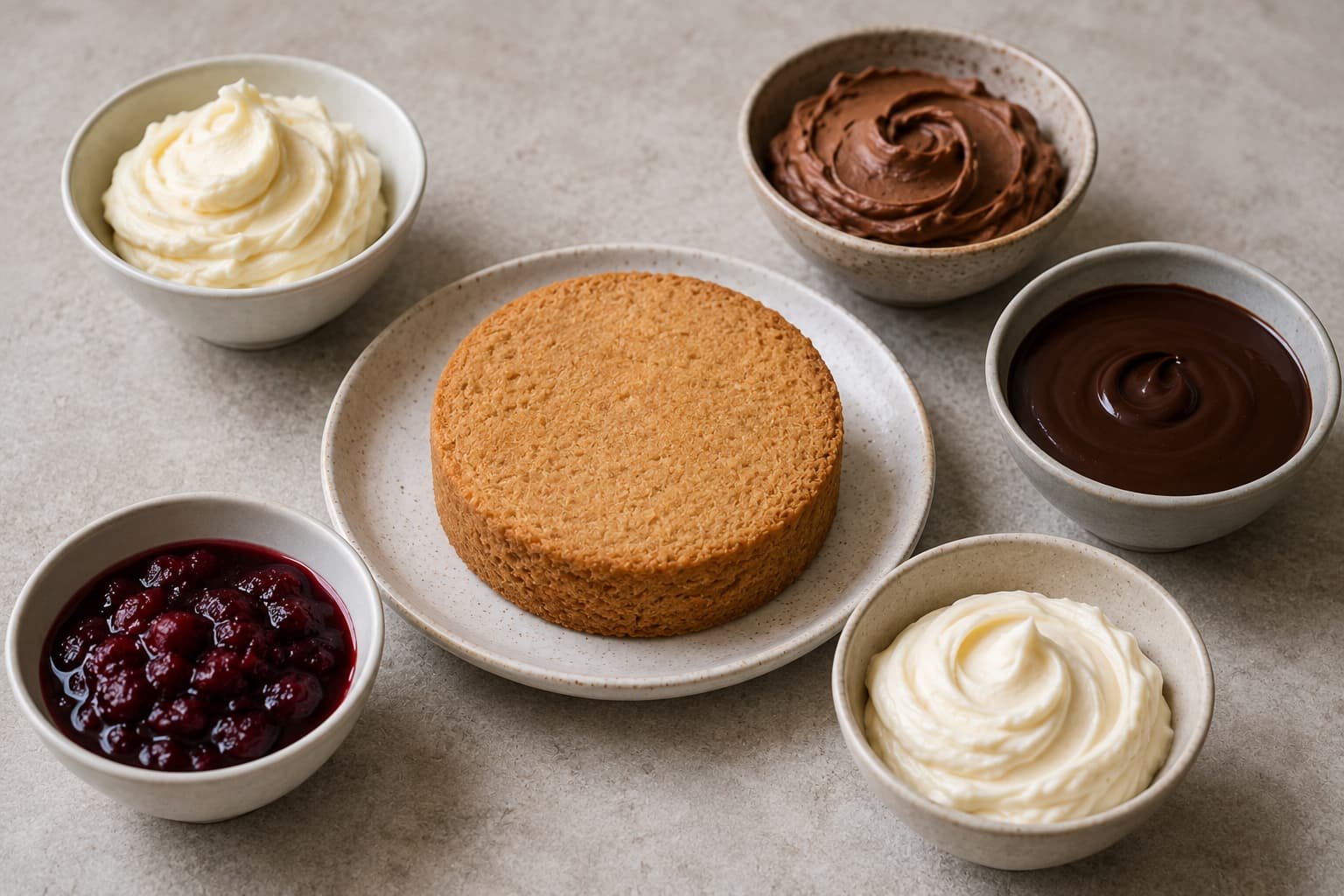
Frosting and filling can change the flavor, sweetness, height, appearance, and structure of a layer cake.
Their consistency can also affect how easily the cake stacks.
Common Frosting Options
Possible choices include:
- vanilla buttercream
- chocolate buttercream
- cream cheese frosting
- chocolate ganache
- whipped-cream-based frosting
Buttercream can be used between layers, around the exterior, or for piping.
Ganache can be used as a filling or exterior finish depending on its consistency and the recipe being followed.
Storage needs vary by frosting formula. Cakes containing perishable dairy ingredients should follow appropriate refrigeration guidance rather than being treated the same as every other frosted cake.
Common Filling Options
Possible fillings include:
- buttercream
- fruit preserves
- berry fillings
- chocolate ganache
- cream cheese frosting
Consistency matters.
A loose filling may move more easily between stacked layers. One possible technique is to pipe a firmer frosting around the edge of the cake layer to help contain a softer filling.
The amount and type of filling should suit the cake structure rather than being added as thickly as possible.
How Can a 6 Inch Cake Be Decorated for a Birthday?
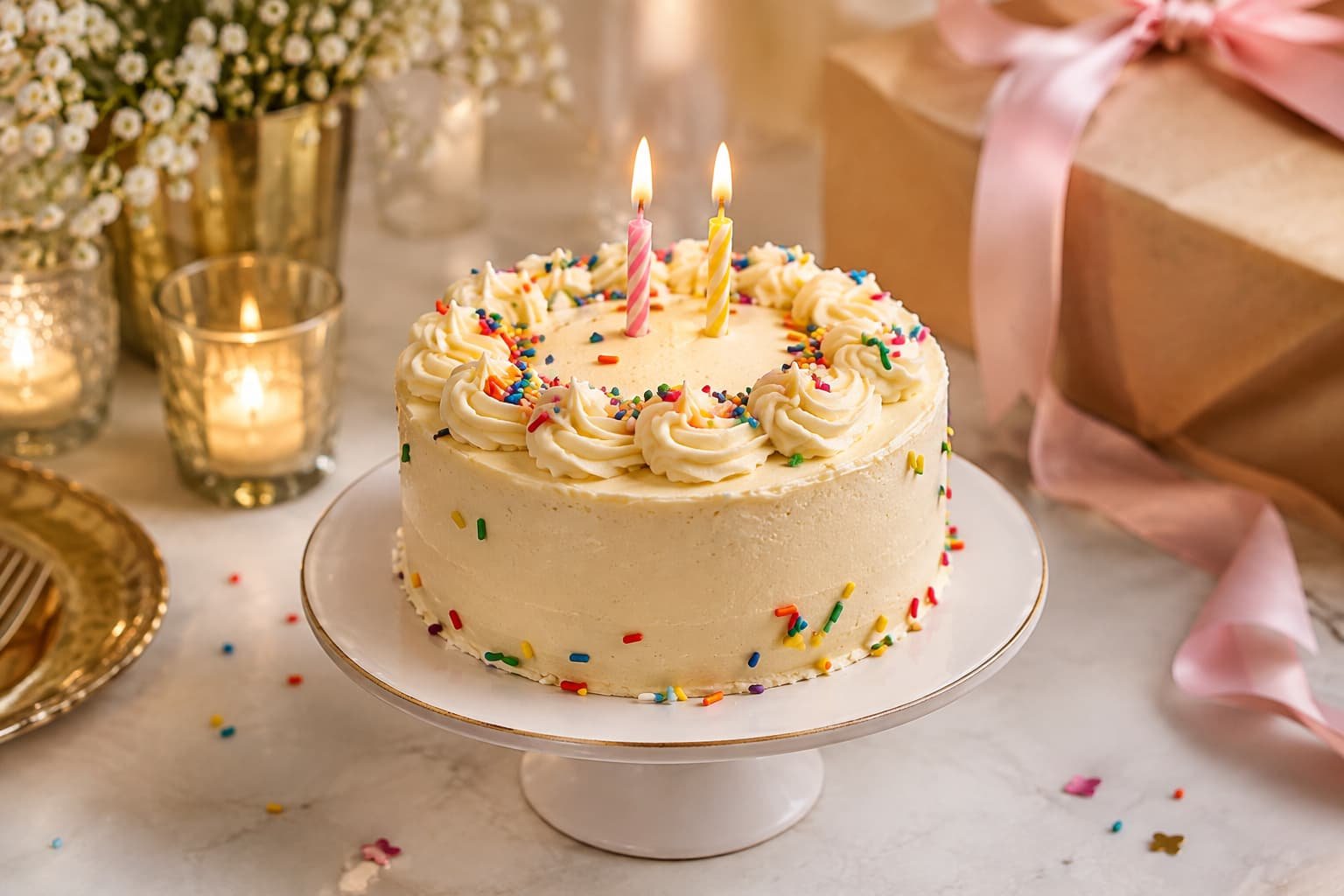
A smaller birthday cake usually benefits from a focused design.
Because a 6-inch cake has less decorating space than a wider cake, using one main feature can keep the presentation clear.
Possible ideas include:
- sprinkles and candles
- a piped frosting border
- a chocolate drip
- fresh berries
- a small cake topper
- a limited color palette
For example, smooth frosting with candles creates a different look from ganache with berries.
A smaller topper also leaves more visible space for frosting, piping, fruit, or candles.
How Can a 6 Inch Cake Be Styled for a Date Night or Anniversary?
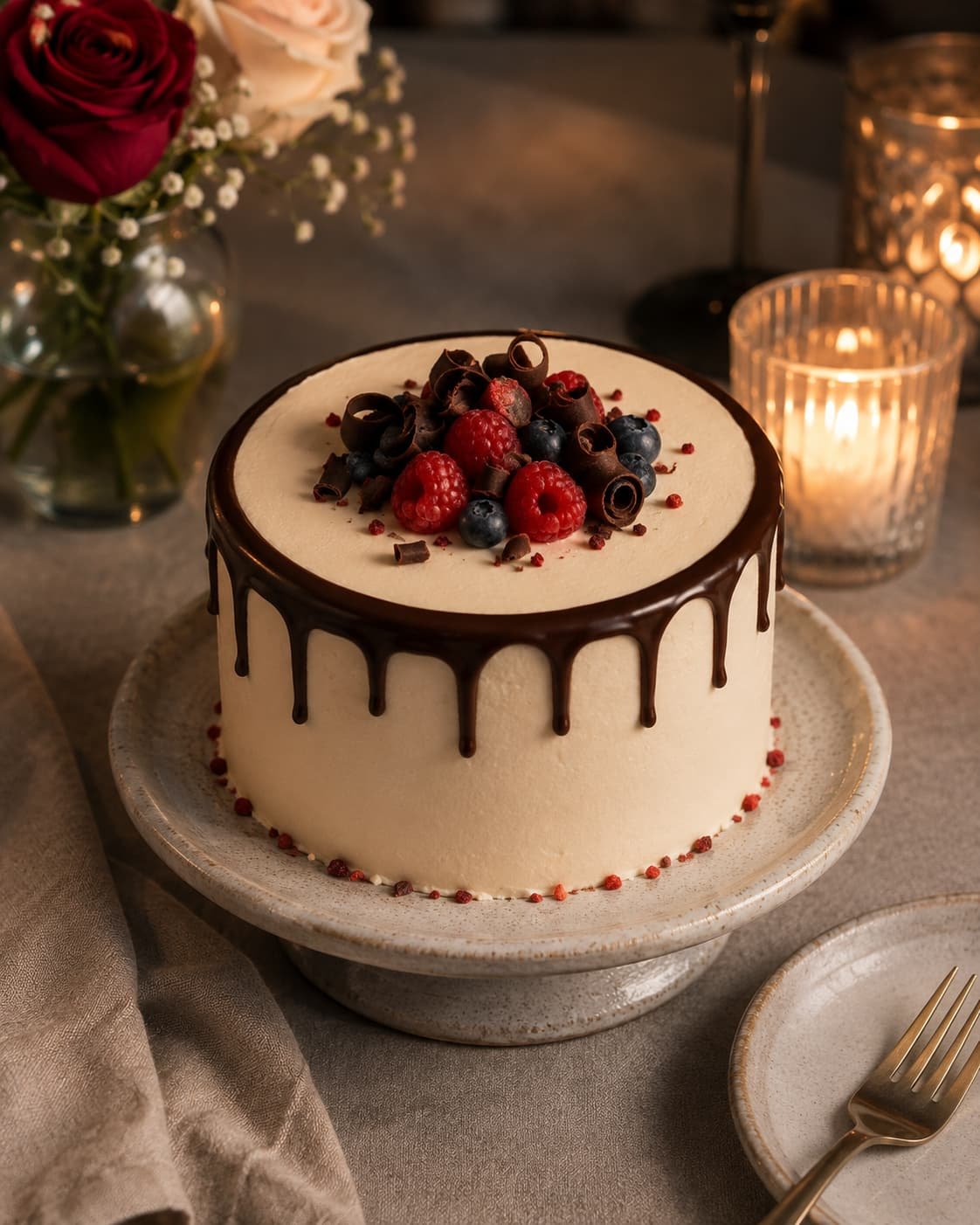
A date-night or anniversary cake can use the same basic cake formats as a birthday cake, but the decoration can be adjusted to suit the occasion.
Possible presentation ideas include:
- chocolate with berries
- ganache with simple piping
- smooth buttercream
- fresh fruit
- chocolate curls or shavings
- a small anniversary topper
A limited color palette can also create a simpler presentation.
These are styling options, not requirements. A cake does not need a specific flavor, frosting, or decoration to work for a date night or anniversary.
How Is a 6 Inch Cake Different From an 8 Inch Cake?
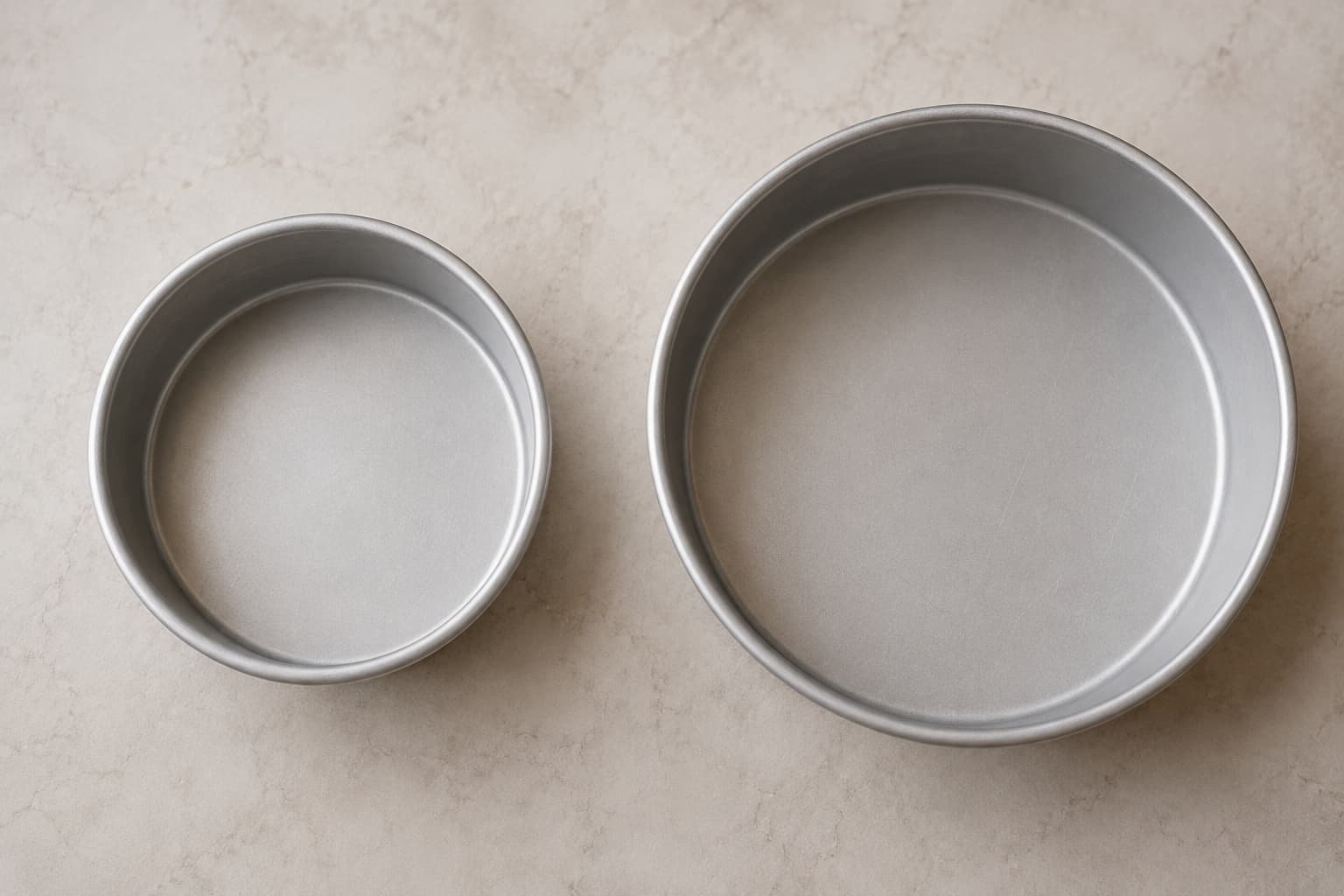
An 8-inch round cake has significantly more surface area than a 6-inch round cake.
When the pans have the same depth, a 6-inch round has about 56% of the surface area of an 8-inch round.
That difference affects:
- batter quantity
- layer thickness
- serving potential
- recipe scaling
An 8-inch pan also has more capacity than a 6-inch pan of the same depth.
This is why an 8-inch recipe should not simply be transferred into one 6-inch pan without considering how much batter the smaller pan can hold.
What Should You Know About Cooling, Filling, and Decorating?
Cake layers should generally be cool before they are filled and frosted.
Working with warm layers can soften some frostings and make assembly more difficult.
A typical layer-cake sequence is:
- Cool the cake layers.
- Add the filling.
- Stack the layers.
- Apply frosting.
- Add the final decoration.
Some cakes also use a crumb coat, which is a thin first layer of frosting applied before the final exterior coat. It helps hold loose crumbs in place.
A crumb coat is optional rather than required for every cake.
There is no universal cooling or chilling time, so follow the instructions for the specific recipe being used.
How Should a 6 Inch Cake Be Stored?
Storage depends on the cake, filling, frosting, and toppings rather than the cake’s diameter.
A plain cake may have different storage requirements from one containing cream cheese frosting, whipped cream, custard, or other perishable ingredients.
Fresh-cut fruit can also affect storage needs.
For practical planning:
- follow the storage instructions for the specific cake and frosting formula
- consider fillings and toppings as well as the cake layers
- refrigerate perishable ingredients when reliable food-safety guidance requires it
- do not assume every buttercream, ganache, fruit filling, or dairy-based frosting has identical storage requirements
There is no single room-temperature, refrigerator, or freezer duration that applies to every 6-inch cake.
Frequently Asked Questions About 6 Inch Cakes
Is a 6 Inch Cake Big Enough for a Birthday?
It can be suitable for a small birthday, but diameter alone cannot determine whether there will be enough cake.
Consider the cake’s height, number of guests, slice size, and whether other desserts will be served.
Use the serving guidance for the specific recipe when planning.
Is a 6 Inch Cake Suitable for Two People?
Yes. A 6-inch cake can be used for a date night, anniversary, or another celebration for two.
That does not mean the whole cake equals two servings. Depending on its height and how it is cut, there may be leftovers.
Is a 6 Inch Cake Considered a Mini Cake?
It is often described informally as a mini or small cake.
However, mini cake is not one standardized cake size. The term may also be used for cakes that are much smaller than 6 inches.
When size matters, stating the actual diameter is clearer.
Can a 6 Inch Cake Be Chocolate Instead of Vanilla?
Yes. Six inches describes the cake’s diameter, not its flavor.
Chocolate, vanilla, lemon, strawberry, red velvet, and other cake styles can all be made in smaller formats when an appropriate formula is used.
For chocolate cake, use a formula developed for chocolate rather than guessing how much cocoa to add to a vanilla recipe.
Final Thoughts
Choosing a 6 inch cake recipe involves more than looking at the diameter of the pan.
Pan depth, number of layers, batter quantity, and serving needs all affect the finished cake. Flavor, filling, frosting, and decoration can then be chosen to match the occasion.
A birthday cake may use candles, sprinkles, piping, or a small topper. A date-night or anniversary cake may use berries, ganache, chocolate decorations, or a simpler frosting style.
Recipe scaling also needs care. An 8-inch formula should not be transferred directly into a smaller pan without considering pan capacity and batter depth.
When practical, starting with a formula designed for the intended 6-inch pan setup is the simplest approach.