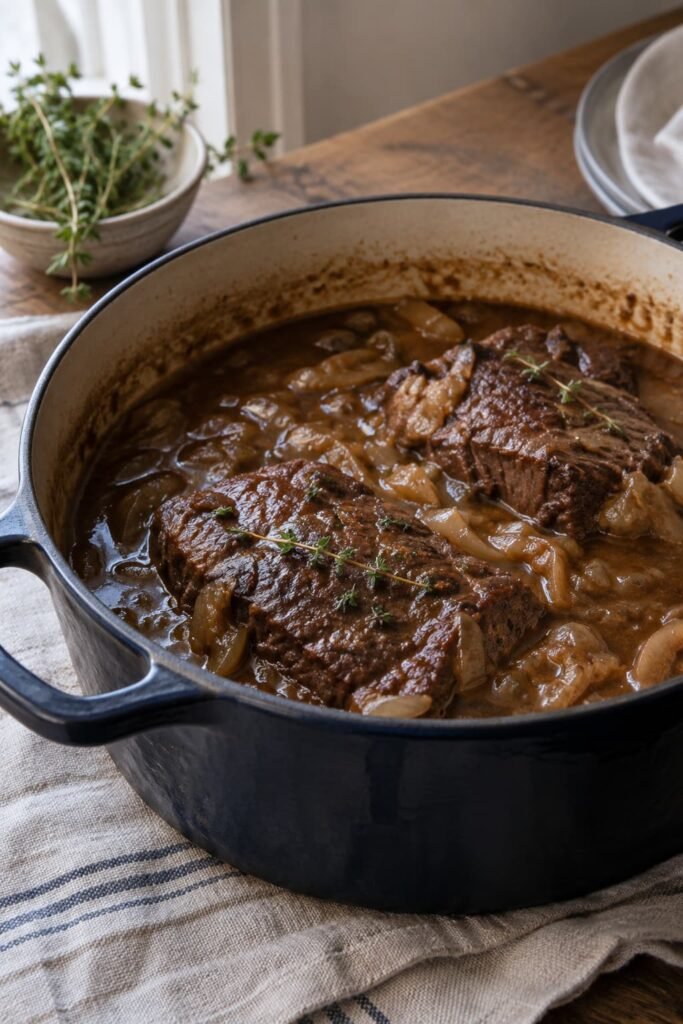
Braised chuck steak is beef chuck cooked slowly with moisture, usually in a covered vessel. The method is commonly used for chuck because this part of the animal includes cuts with substantial connective tissue that can benefit from slow, moist cooking.
Chuck comes from the shoulder area. The chuck primal contains both cuts suited to slow cooking and some more tender cuts that can be cooked with dry heat, so not every steak carrying a chuck-related name behaves exactly the same way. Braising is specifically listed as a suitable cooking method for chuck steak.
Onions are often included in braised beef dishes, and the cooking liquid may be developed into an onion gravy. The final texture and sauce consistency can vary with the specific cut, steak thickness, heat, cooking time, liquid level, and other ingredients.
What Is Braised Chuck Steak?
Braised chuck steak is chuck steak cooked slowly with a relatively small amount of liquid, generally in a covered pan or pot.
Braising is a moist-heat cooking method. It traditionally uses less liquid than methods in which food is fully surrounded by liquid, so the steak does not normally need to be completely submerged. Extension guidance defines braising as slow cooking in a small amount of liquid in a covered pan.
Browning may be used before the moist-cooking stage, but browning and braising perform different functions. Browning mainly develops color and flavor, while the longer moist-cooking stage affects the tougher structures within the meat.
Why Is Chuck Steak Commonly Braised?
Chuck steak is commonly braised because some cuts from the chuck contain enough connective tissue to benefit from prolonged moist cooking.
Collagen is one of the proteins found in connective tissue. During long, gentle cooking, collagen can break down and form gelatin, changing the texture of the meat and contributing to the character of the surrounding cooking liquid.
USDA guidance broadly describes chuck and round as less-tender beef areas that commonly benefit from moist-heat methods such as braising.
This is different from quickly cooking a naturally tender steak. A chuck steak intended for braising can reach a safe internal temperature before it has developed the softer texture expected from a braised dish. Food safety and braised tenderness therefore need to be considered separately.
How Does Braising Chuck Steak Work?
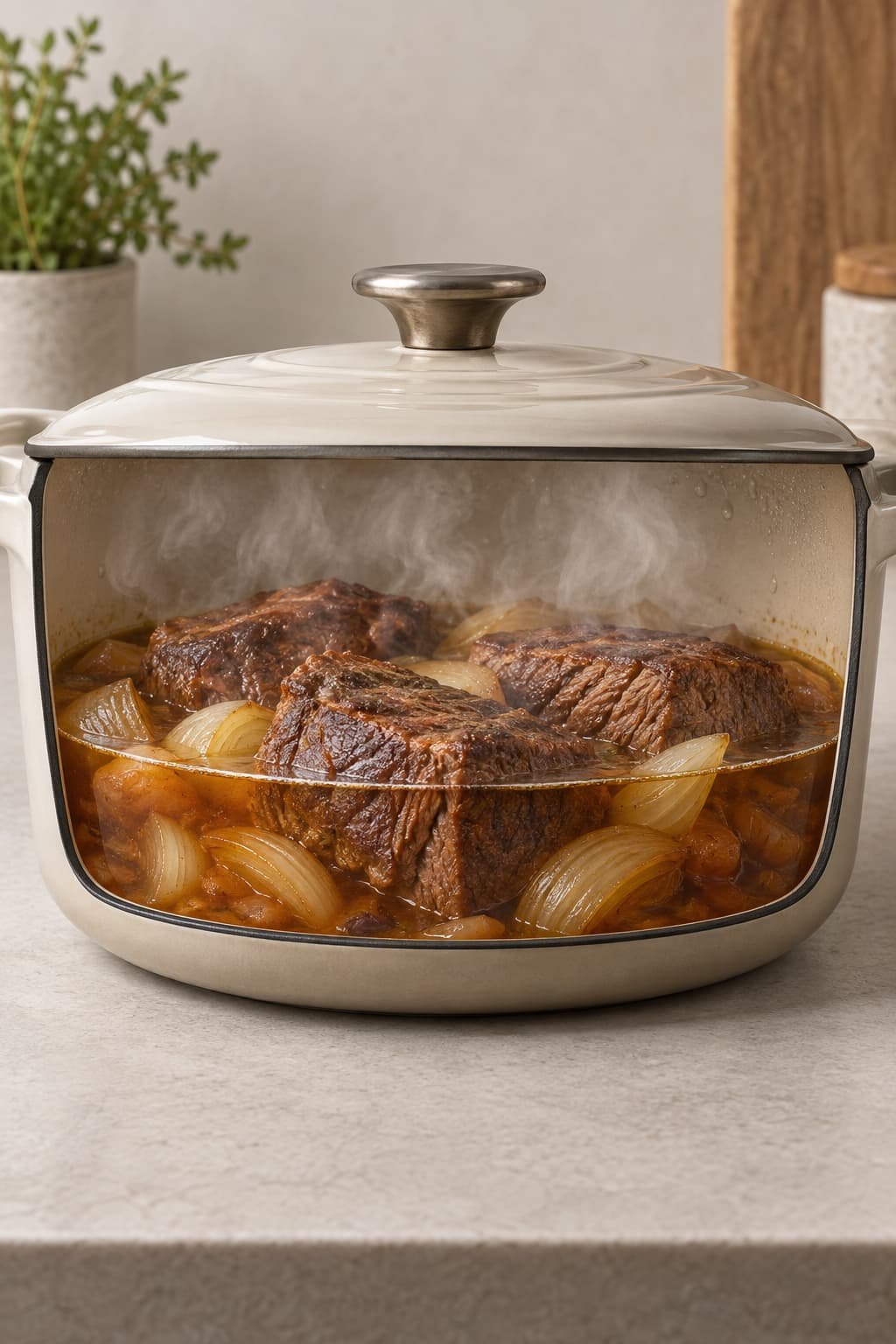
Braising combines moisture, controlled heat, and time. Browning is often included before the slow-cooking stage, but it is not what makes connective tissue soften.
What Does Browning Do?
Browning the surface of chuck steak can develop additional color and flavor.
It can also leave browned material in the cooking vessel. When liquid is added, some of this material can be loosened through deglazing and incorporated into the braising liquid.
Searing should therefore be understood mainly as a flavor-building step. A steak does not have to be aggressively seared for the later moist-cooking process to qualify as braising.
Does Chuck Steak Need to Be Covered With Liquid?
No. Chuck steak does not normally need to be completely submerged for braising.
Braising traditionally uses a relatively small amount of liquid in a covered vessel. The exact liquid level can vary depending on the size and shape of the pan, the amount and thickness of the meat, cooking conditions, and whether the liquid will later be served as a sauce or gravy.
This is why an exact liquid level should not be treated as a universal rule for every chuck steak preparation.
Why Does Gentle Cooking Matter?
Gentle cooking gives connective tissue time to change while maintaining a moist cooking environment.
Simply increasing the heat is not necessarily a shortcut to tenderness. Muscle tissue and connective tissue undergo different changes as meat cooks, and excessive heat can also increase moisture loss.
For an informational guide, it is more accurate to focus on the relationship between time, moisture, heat, and the specific cut than to claim that every chuck steak becomes tender after one fixed cooking period.
What Is the Difference Between Chuck Steak and Chuck Roast?
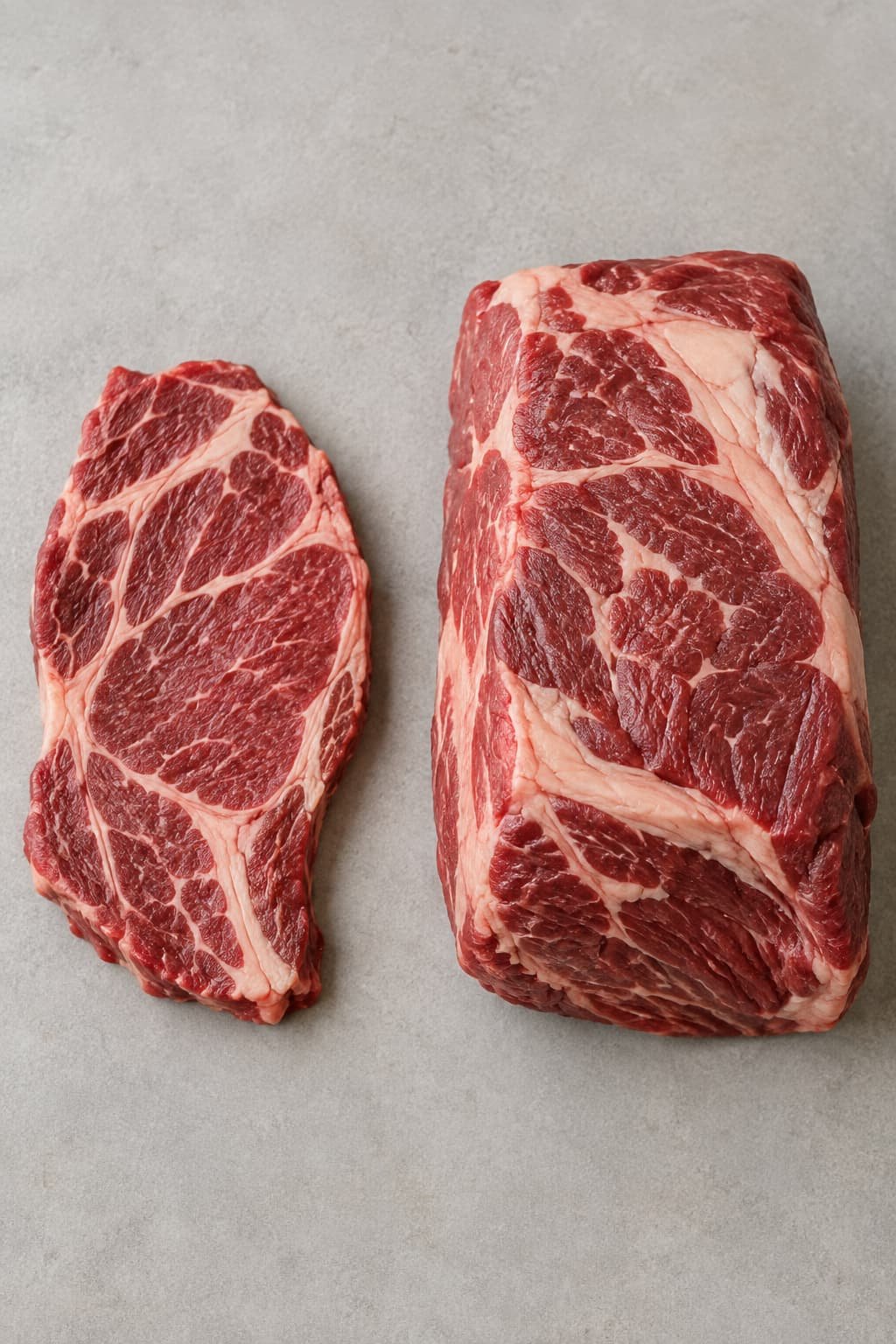
Chuck steak and chuck roast come from the same broad beef region, but their size and thickness are different.
Chuck steak is sold in steak-sized portions, while a chuck roast is generally a larger and thicker piece. That difference can affect how quickly the center heats, how the meat fits in the cooking vessel, how much liquid is practical, and how long the meat takes to reach a particular texture.
A cooking time written for a large chuck roast therefore should not automatically be applied to chuck steak.
The reverse is also true. Even when the cuts come from the same general area, size, thickness, and the particular muscle can change cooking behavior.
What Affects the Tenderness of Braised Chuck Steak?
The specific cut, thickness, cooking conditions, moisture, and time can all affect tenderness.
The Specific Chuck Cut
The chuck primal contains several muscles rather than one uniform piece of meat.
Some chuck cuts are suited to slow cooking, while others are tender enough for grilling or broiling. Beef-industry cut guidance reflects this variation within the chuck primal.
The label on the package therefore matters. Two steaks associated with the chuck region should not automatically be expected to soften at exactly the same rate.
Steak Thickness
Thickness affects how quickly heat moves through the meat.
A thick chuck steak can respond differently from a thin steak even when both are cooked in the same vessel. This is one reason fixed cooking times should be tied to a defined recipe and cut rather than presented as universal guidance.
Cooking Time and Heat
Time matters, but time alone does not determine tenderness.
A steak with more connective tissue may require different handling from a thinner or naturally more tender chuck cut. Heat intensity, evaporation, the cooking vessel, and the amount of moisture remaining during cooking can also affect the result.
Instead of relying on a single clock time, tenderness should be evaluated together with the characteristics of the meat and the cooking conditions.
How Can You Tell When Braised Chuck Steak Is Tender?
Braised chuck steak is generally considered tender when it gives relatively little resistance when checked with a fork, knife, or similar utensil.
That is a texture assessment, not a food-safety measurement.
USDA states that whole beef steaks, chops, and roasts should reach a minimum internal temperature of 145°F (62.8°C) as measured with a food thermometer, followed by at least a 3-minute rest.
Reaching 145°F does not automatically mean a chuck steak has developed the texture associated with prolonged braising.
The two checks answer different questions:
- Food thermometer: Has the steak reached the USDA safe minimum internal temperature?
- Texture check: Has the particular chuck steak softened to the desired braised texture?
Keeping those questions separate avoids treating food safety and tenderness as if they were the same measurement.
Why Can Braised Chuck Steak Stay Tough or Become Dry?
Braised chuck steak can remain tough if its connective tissue has not softened enough for the desired texture. It can also become dry when moisture loss becomes excessive.
Several factors may contribute:
- the particular chuck cut
- steak thickness
- cooking time
- heat intensity
- evaporation of the braising liquid
- how effectively the vessel retains moisture
These factors can interact.
For example, increasing the heat in an attempt to speed up the process may increase moisture loss without producing the same result as longer, controlled moist cooking.
There is therefore no reliable universal instruction such as adding an exact number of extra minutes whenever chuck steak remains chewy. The cut, thickness, heat, moisture, and current texture all need to be considered.
How Does Onion Gravy Develop in a Chuck Steak Braise?
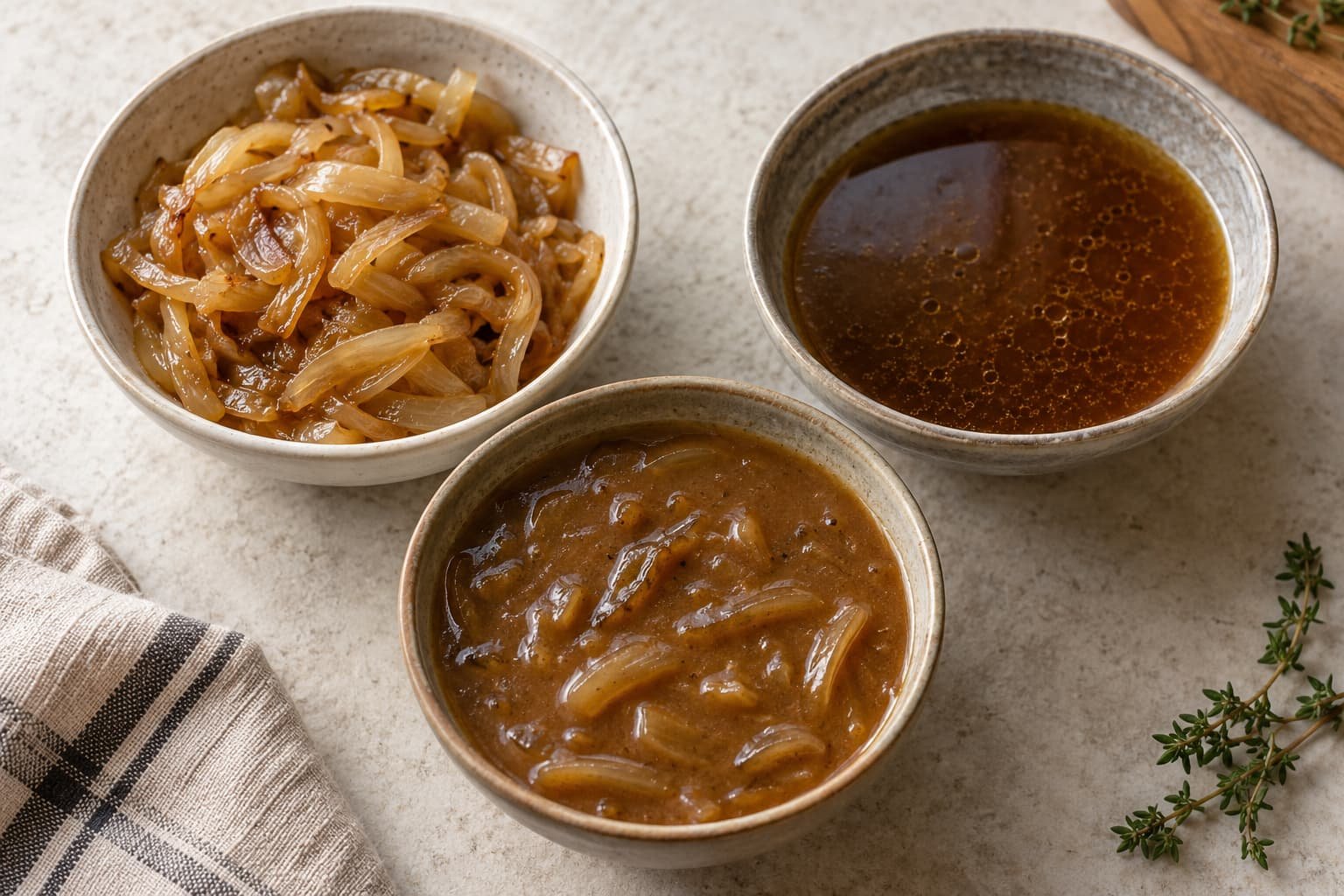
Onion gravy can be made from the liquid surrounding the steak after onions and other ingredients have cooked with the beef.
As onions cook, they soften and contribute flavor to the liquid. Browning and deglazing can add additional flavor, while gelatin produced as connective tissue changes during prolonged cooking may contribute some body.
The liquid may then be handled in several ways. It can be reduced through evaporation, thickened with a starch, combined more fully with the softened onions, or finished using a combination of approaches.
These methods are not automatically equivalent.
A gravy thickened with flour or cornstarch behaves differently from a sauce concentrated mainly through reduction. The amount of liquid, fat, gelatin, onions, and added starch can all influence consistency.
Because this article is not presenting a tested formula, there is no universal flour-to-liquid or cornstarch-to-liquid ratio given here.
Can Chuck Steak Be Braised on the Stovetop?
Yes. Braising can be done on the stovetop as well as in an oven.
Extension guidance describes braising meat in a small amount of liquid in a tightly covered pan and notes that the method can be carried out on the stovetop or in the oven.
The practical difference is heat distribution. Stovetop heat is concentrated beneath the vessel, so the intensity of the simmer and the amount of remaining liquid may require closer attention.
A controlled simmer is different from aggressively boiling the meat.
Is Braising the Same as Stewing?
No. Braising and stewing are related moist-heat methods, but they are usually distinguished by the size of the food pieces and the amount of liquid.
Braising commonly uses larger pieces of meat with a relatively small amount of liquid. Stewing typically uses smaller pieces surrounded more completely by liquid.
The distinction helps explain why cutting chuck steak into small pieces and fully surrounding them with liquid moves the preparation closer to a stew rather than a steak braise.
What Should You Consider Before Adapting Braised Chuck Steak?
Changing one element of a braise can affect several others, so substitutions should not automatically be treated as equivalent.
Different beef cuts can cook differently. Even cuts from the chuck can contain different muscles and amounts of connective tissue.
Thicker steaks may need different handling. Thickness changes how the meat heats and can affect the time needed to reach the desired texture.
Vegetables can affect the liquid balance. Onions, mushrooms, carrots, and similar ingredients contain moisture and can change the amount and concentration of the final sauce.
Broths and prepared sauces vary in saltiness. Replacing one product with another can alter seasoning even when the same volume is used.
Removing sauce ingredients changes more than flavor. Depending on the preparation, ingredients such as wine, Worcestershire sauce, or tomato paste may contribute acidity, sweetness, saltiness, color, or body.
Different thickeners produce different gravy textures. Flour, cornstarch, and reduction do not behave identically.
Garlic can scorch under strong heat. Increasing finely chopped garlic can require more attention during a high-heat browning stage.
Changing liquid quantity changes concentration. Extra liquid can produce a thinner sauce, while excessive evaporation can leave less moisture available for braising.
The main point is that substitutions may alter tenderness, seasoning, moisture, cooking time, and gravy consistency at the same time.
How Should Leftover Braised Chuck Steak Be Stored?
Cooked beef leftovers should be refrigerated promptly.
USDA advises discarding perishable food left at room temperature for more than 2 hours, or more than 1 hour when the temperature is above 90°F (32°C). Leftovers should be placed in shallow containers and refrigerated or frozen promptly.
Most cooked leftovers can be refrigerated for 3 to 4 days. USDA recommends reheating leftovers to 165°F (73.9°C).
For longer storage, USDA states that leftovers can be frozen for 3 to 4 months for quality. When kept continuously frozen, leftovers remain safe longer, although moisture and flavor can decline over time.
Final Takeaway
Braised chuck steak is a moist-cooking preparation that uses time and controlled heat to soften beef that may contain substantial connective tissue.
There is no single cooking time, liquid level, or gravy formula that applies to every chuck steak. The particular cut, steak thickness, cooking conditions, moisture level, and desired texture all affect the result.
Browning can contribute flavor, prolonged moist cooking can soften connective tissue, and the braising liquid can be developed into onion gravy in several ways. Food-safety temperature should be checked separately from tenderness, and substitutions should not be assumed to produce equivalent cooking times, textures, or gravy consistency.