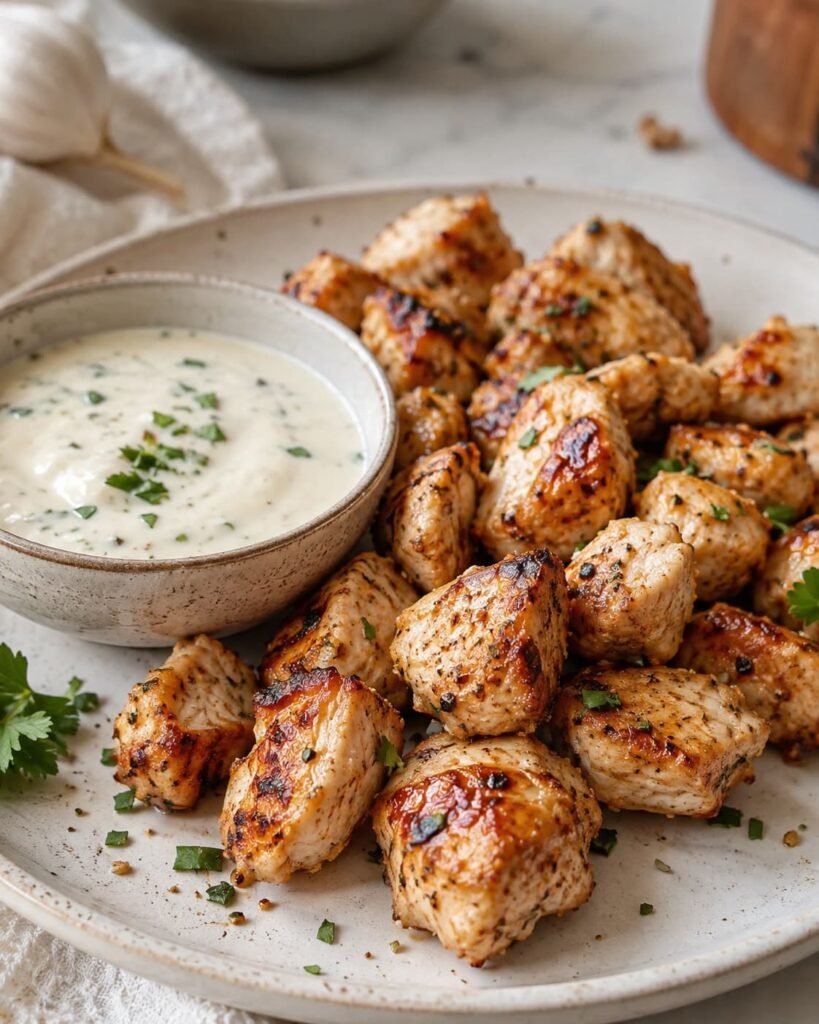
Grilled chicken bites with creamy garlic sauce generally refer to small pieces of seasoned chicken cooked on a grill or similar high-heat cooking surface and served with a creamy, garlic-flavored sauce.
The sauce may be served on the side for dipping, spooned over the cooked chicken, or used as a light coating. The final texture and flavor can vary depending on the chicken cut, seasonings, cooking method, and ingredients used in the sauce.
There is no single standard formula for this dish. Some versions use chicken breast, while others use boneless chicken thighs. Creamy garlic sauces can also vary, with yogurt-based and cream-based preparations representing two possible approaches.
Which Chicken Cuts Can Be Used for Grilled Chicken Bites?
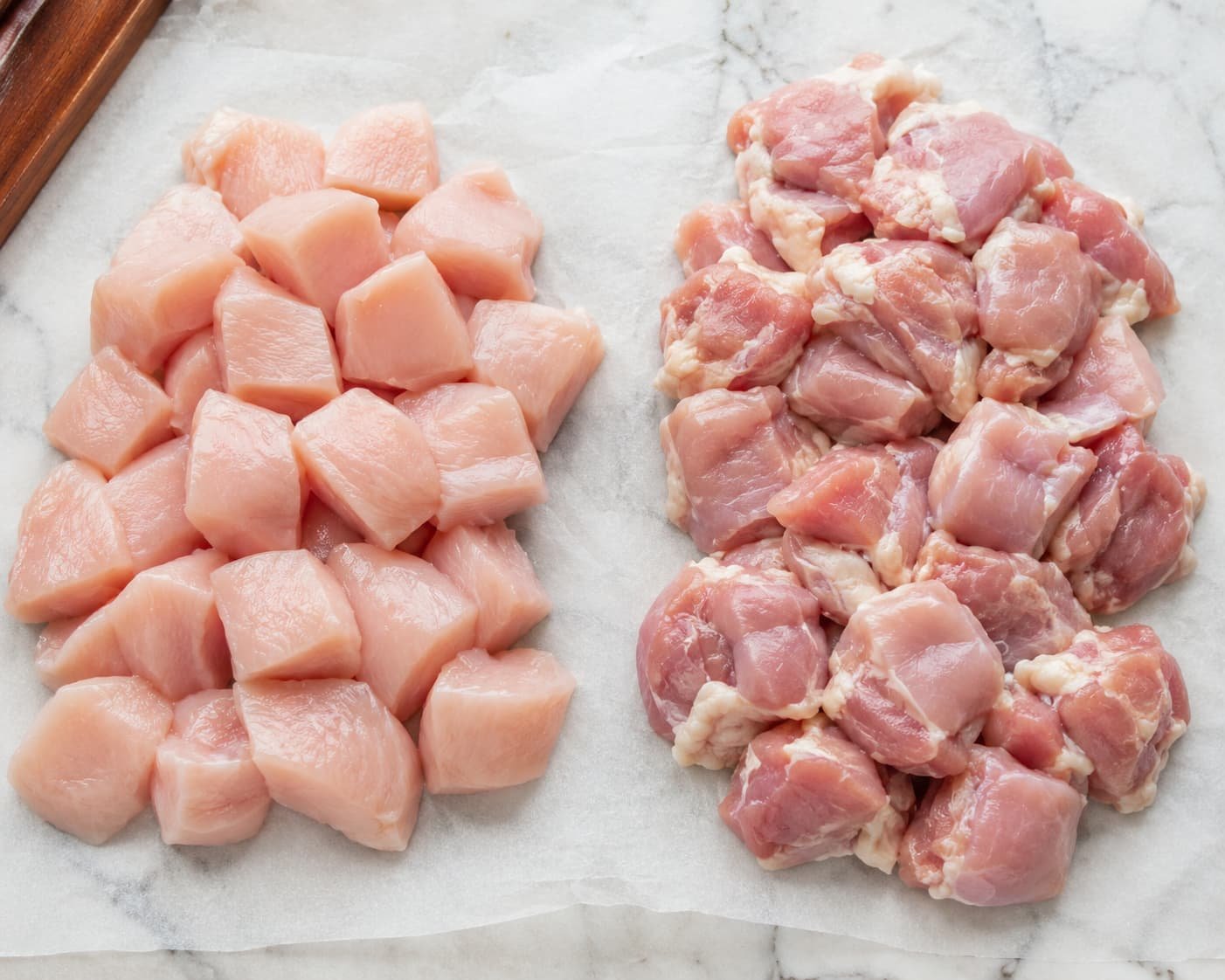
Boneless chicken breast and boneless chicken thighs can both be cut into smaller pieces for grilling. They differ in fat content, texture, shape, and flavor characteristics, so the choice can affect the finished dish.
Chicken Breast
Chicken breast is generally leaner than chicken thigh meat and has a relatively neutral flavor profile. This allows seasonings such as garlic, paprika, black pepper, herbs, or lemon to contribute much of the flavor of the finished chicken.
Because the chicken is being cut into smaller pieces, size consistency is useful during preparation. Pieces that differ substantially in thickness can reach the required safe internal temperature at different times.
Cooking beyond the temperature needed for safe doneness can also affect moisture and texture. For that reason, doneness is better assessed with an appropriate food thermometer than by relying only on exterior color or grill marks.
Boneless Chicken Thighs
Boneless chicken thighs generally contain more fat than chicken breast and have a different texture and flavor profile. They can be used with many of the same seasonings and sauce styles as breast meat.
Thigh meat is often less uniform in shape than chicken breast. Trimming and cutting it into reasonably similar pieces can make the portions easier to arrange and monitor during cooking.
Neither cut needs to be presented as the better option. Chicken breast and boneless thighs simply provide different characteristics, and the choice can depend on the texture, flavor, and type of preparation the reader prefers.
How Are Chicken Bites Prepared for Grilling?
Chicken bites are generally prepared by cutting boneless chicken into smaller pieces and adding seasonings or a marinade before cooking. The seasonings can vary depending on the flavor intended for the finished dish.
Garlic, black pepper, paprika, herbs, and lemon are among the ingredients that may be used with grilled chicken, but they are possibilities rather than a required formula.
Why Similar-Sized Pieces Matter
Keeping the chicken pieces reasonably similar in size can make them easier to cook evenly.
Pieces that differ substantially in thickness may reach a safe internal temperature at different times. Very small pieces may finish cooking before thicker ones, so reducing large differences in size can make the batch easier to monitor.
The pieces do not need to be identical. The practical aim is simply to avoid a mixture of very small and much thicker pieces when possible.
Seasoning vs. Marinating
Chicken bites can be seasoned directly or prepared with a marinade. Either approach can be used, depending on the flavor and preparation style.
A dry or lightly oiled seasoning mixture may include ingredients such as garlic powder, paprika, black pepper, or dried herbs. These examples are not a fixed seasoning formula.
Marinades may contain ingredients such as oil, herbs, spices, or acidic ingredients. Their effect on flavor and texture can vary according to the ingredients and preparation method.
Because no specific marinade has been tested for this article, exact quantities, ingredient ratios, and marinating times are not provided.
How Are Grilled Chicken Bites Cooked?
Chicken bites can be cooked on a heated grill until they reach the safe minimum internal temperature for poultry.
There is no single cooking time that applies to every batch. Piece thickness, grill temperature, equipment, and other cooking conditions can affect how quickly the chicken cooks. A food thermometer is therefore more reliable for determining safe doneness than a fixed number of minutes.
Outdoor Grill
On an outdoor grill, the chicken pieces can be positioned so they are manageable during cooking and can be turned as needed.
Because smaller pieces may be awkward to place directly across widely spaced grill grates, skewers or a grill basket can be practical options. They can help keep the pieces together and make them easier to handle.
Whatever arrangement is used, visible browning or grill marks should not be treated as proof that the chicken has reached a safe internal temperature.
Grill Pan as an Indoor Alternative
A grill pan can be used when an outdoor grill is not available.
The chicken can be placed on the heated surface and turned during cooking. A grill pan does not create exactly the same cooking environment as an outdoor grill, so cooking times should not be assumed to be interchangeable.
How to Check That Chicken Is Safely Cooked
Use a food thermometer to determine whether chicken has reached a safe temperature.
USDA food-safety guidance states that poultry should reach a safe minimum internal temperature of 165°F (73.9°C), measured with a food thermometer.
For a batch of chicken bites, temperature should be checked in the thicker pieces rather than assuming all pieces have cooked at the same rate.
Color, texture, and grill marks are not reliable substitutes for a temperature check. They can indicate changes taking place during cooking, but they do not confirm food safety.
What Is Creamy Garlic Sauce?
Creamy garlic sauce is a general term for a garlic-flavored sauce made with an ingredient that provides a creamy consistency. It does not refer to one standardized recipe.
Different preparations may use yogurt, cream, or another suitable creamy base. Garlic may be added in different forms, and other ingredients such as lemon, herbs, black pepper, mustard, or Parmesan may be included depending on the intended flavor.
These ingredients should be understood as examples rather than a required combination.
The consistency can also vary according to how the sauce will be served. A thicker preparation may be suitable for dipping, while a thinner sauce may be easier to spoon or drizzle over the chicken.
Cold yogurt-based sauces and warm cream-based sauces are therefore two possible approaches rather than interchangeable versions of one fixed formula.
What Types of Creamy Garlic Sauce Can Be Used?
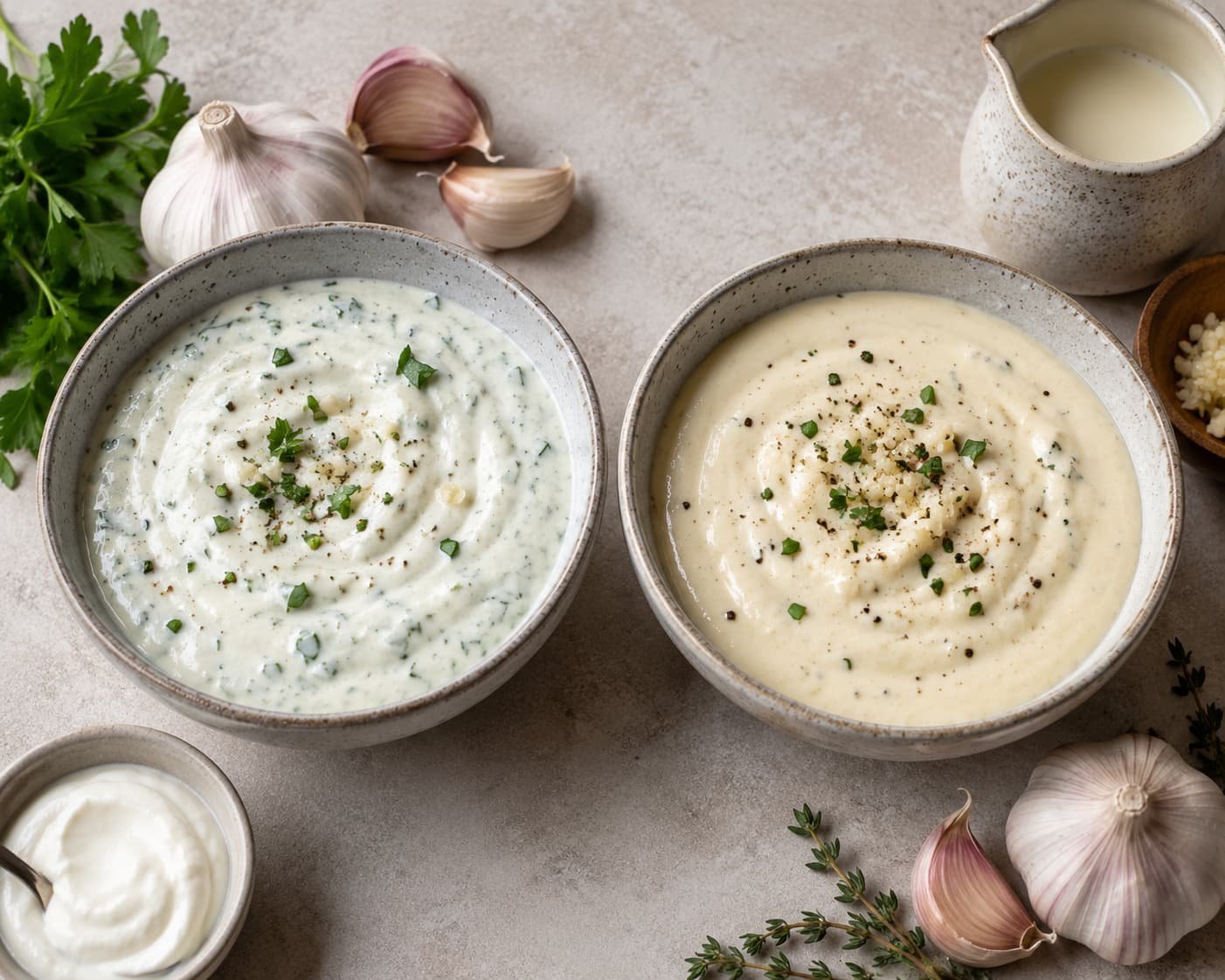
Creamy garlic sauce does not have to follow one formula. For grilled chicken bites, a cold yogurt-based sauce and a warm cream-based sauce are two possible approaches.
The choice affects the flavor, texture, and serving temperature, but neither style is required for the dish.
Yogurt-Based Garlic Sauce
Plain yogurt or Greek-style yogurt can provide the base for a cold or cool garlic sauce. Yogurt naturally has a tart flavor, which can give the sauce a different character from a cream-based version.
Garlic may be combined with ingredients such as lemon juice, herbs, black pepper, or oil. These are examples of commonly used additions rather than a fixed ingredient list.
The consistency can vary depending on the type of yogurt and any other ingredients added. A thicker yogurt can produce a thicker sauce, while additional liquid ingredients can make it looser.
Because no specific yogurt sauce has been tested for this article, exact quantities and ingredient ratios are not provided.
Warm Cream-Based Garlic Sauce
Cream can also be used as the base of a warm garlic sauce.
One possible approach is to gently cook garlic in butter or oil before adding the creamy component. Ingredients such as herbs, black pepper, Parmesan, mustard, or lemon may also be used depending on the intended flavor.
A warm cream-based sauce is different from a cold yogurt sauce in both preparation and flavor. The final consistency can also vary according to the ingredients and cooking method.
There is no single cooking time, ingredient ratio, or preparation method that applies to every cream-based garlic sauce, so this article does not provide a fixed formula.
How Does Garlic Preparation Affect the Sauce?
Raw and cooked garlic can contribute noticeably different flavors. How the garlic is cut and whether it is exposed to heat can influence how strong or mild it tastes in the finished sauce.
Raw Garlic
Raw garlic has a strong, pungent flavor. Mincing, crushing, or grating it exposes more of the garlic and can make its flavor more noticeable in a sauce.
For that reason, raw garlic can be used when a more pronounced garlic character is wanted, particularly in cold sauces.
The final intensity will depend on factors such as the amount used, how the garlic is prepared, and the other ingredients in the sauce.
Gently Cooked Garlic
Cooking garlic generally mellows some of its strong raw flavor. This makes gently cooked garlic one possible choice for warm cream-based sauces.
The garlic may be heated in butter or oil before the remaining sauce ingredients are added. The exact method depends on the type of sauce being prepared.
Because this article does not use a tested sauce formula, it does not specify an exact cooking temperature or number of minutes for the garlic.
Should the Sauce Be Served on the Side or Added to the Chicken?
The sauce can be served separately or added to the cooked chicken. The choice mainly changes how much sauce reaches each piece and how much of the grilled surface remains uncovered.
For dipping, the sauce stays in a separate container and can be added to individual bites as they are eaten.
For drizzling, some sauce is spooned over the chicken while portions of the grilled surface remain exposed.
For lightly coating, the cooked chicken can be combined with a small amount of sauce so that more of each piece is covered.
None of these serving styles is inherently better. The choice can depend on the desired presentation, sauce consistency, and how much sauce is wanted with the chicken.
What Can You Serve with Grilled Chicken Bites?
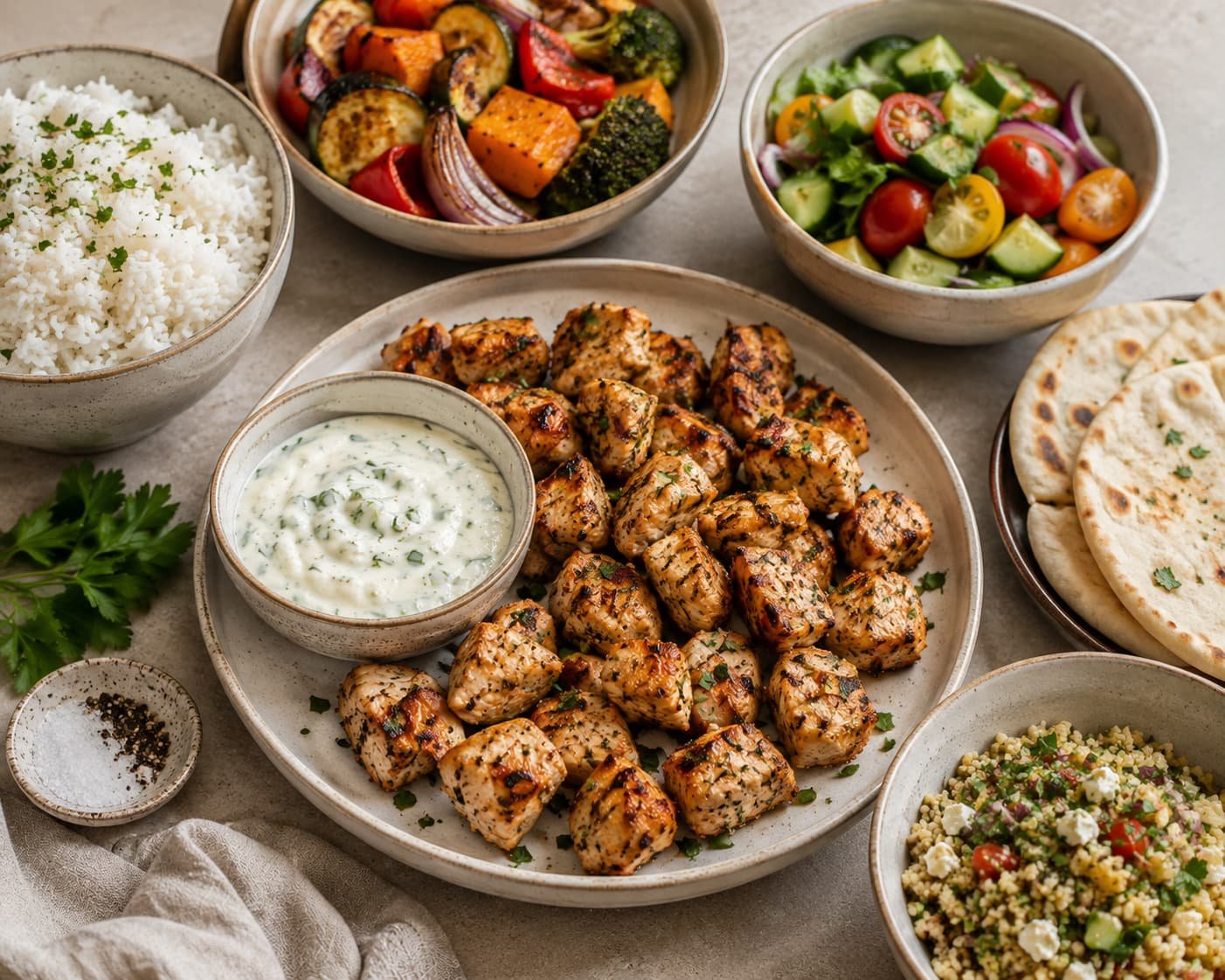
Grilled chicken bites can be served with a range of simple sides. The choice can depend on the type of sauce, the rest of the meal, and personal preference.
Rice can be served alongside the chicken or used as the base of a bowl. Garlic butter rice is one possible option when a more seasoned rice side is wanted.
Roasted or grilled vegetables can add a contrasting texture. Options may include zucchini, bell peppers, broccoli, mushrooms, or green beans, depending on what is available.
A fresh salad provides another type of side. Cabbage crunch salad is one possible pairing when a crisp vegetable-based accompaniment is preferred.
The chicken can also be added to wraps or flatbreads with vegetables and sauce. For a bowl-style meal, it may be combined with rice or another grain and vegetables.
Simple pasta is another possible accompaniment. There is no single side that is required for this dish.
How Should Grilled Chicken and Garlic Sauce Be Stored?
Cooked chicken and garlic sauce may be stored in separate covered containers. Keeping them separate is a practical option rather than a food-safety requirement, and it can make reheating and serving the components individually easier.
USDA guidance states that cooked chicken leftovers can generally be refrigerated for 3 to 4 days when handled and refrigerated properly. USDA also advises reheating leftovers to an internal temperature of 165°F (73.9°C).
There is no single storage duration that can be assigned to every homemade creamy garlic sauce. Storage depends on the ingredients, preparation method, and how the sauce has been handled.
Because no specific sauce formula has been tested or verified for this article, an exact refrigeration or freezing period is not provided for the sauce. Perishable homemade sauces should be refrigerated promptly, and any reliable storage instructions that apply to the specific preparation should be followed.
Smell, taste, and appearance should not be used as proof that refrigerated food is safe. Harmful bacteria may be present without causing an obvious change in those characteristics.
Frequently Asked Questions
Do Chicken Bites Have to Be Marinated Before Grilling?
No. Marinating is optional.
Chicken bites can also be seasoned before cooking without a separate marinating step. The choice depends on the flavor and preparation style.
Because this article does not use a tested marinade formula, it does not provide exact ingredient ratios or marinating times.
Can Grilled Chicken Bites Be Made Without an Outdoor Grill?
Yes. A grill pan is one possible indoor cooking method.
An indoor grill pan and an outdoor grill do not create identical cooking conditions, so cooking times should not automatically be transferred from one method to the other.
Regardless of the cooking surface, poultry should reach a safe minimum internal temperature of 165°F (73.9°C) as measured with a food thermometer.
Can Creamy Garlic Sauce Be Made Without Heavy Cream?
Yes. Heavy cream is not necessary for every type of creamy garlic sauce.
Yogurt can provide a creamy base for a different style of garlic sauce. The flavor, consistency, and serving temperature can differ from a warm cream-based preparation.
This should not be treated as a direct substitution ratio. The amount needed depends on the specific sauce formula.
Can the Chicken and Sauce Be Prepared Separately?
Yes. The chicken and sauce can be prepared as separate components and combined when serving.
Keeping them separate can also make it easier to choose how the sauce is used. It may be served as a dip, drizzled over the chicken, or added as a light coating.
Final Thoughts
Grilled chicken bites with creamy garlic sauce do not have to follow one fixed formula.
Chicken breast and boneless thighs are both possible choices, and cutting the meat into reasonably similar pieces can make the batch easier to monitor during cooking. Safe doneness should be checked with a food thermometer rather than judged from color or grill marks alone.
The sauce can also take different forms. A cool yogurt-based sauce and a warm cream-based sauce offer different approaches, while raw and cooked garlic can contribute different flavor characteristics.
Rice, vegetables, salads, wraps, grain bowls, and pasta are all possible serving directions, allowing the meal to be adapted without changing the basic combination of grilled chicken and garlic sauce.