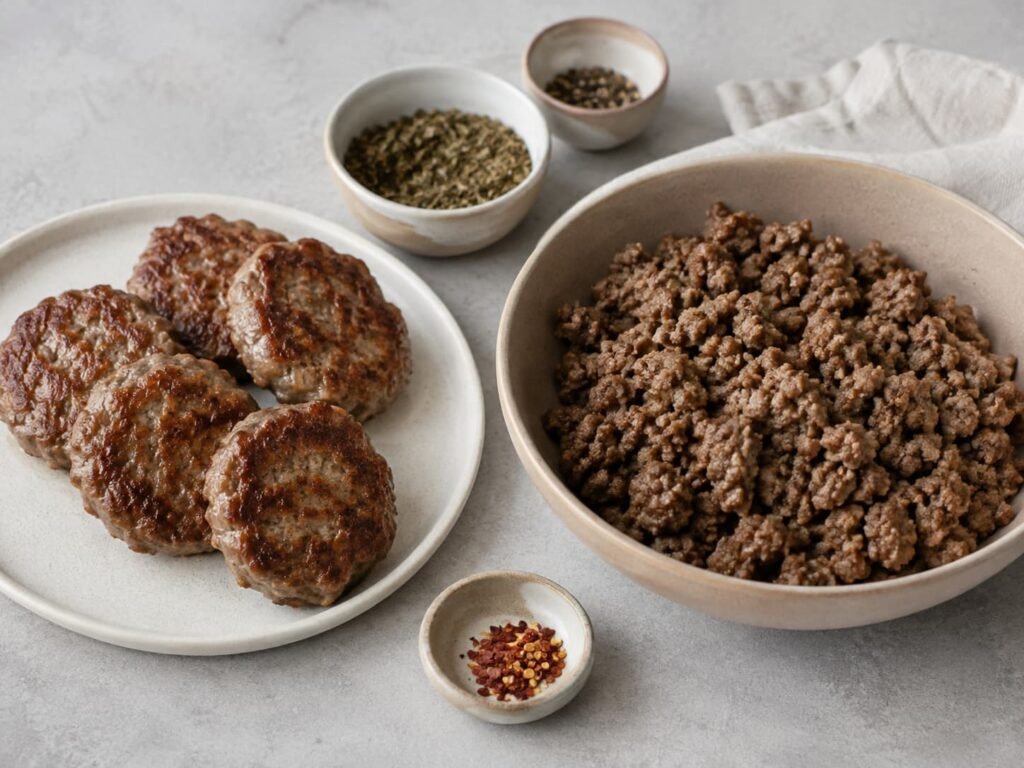
Beef breakfast sausage is ground beef seasoned with herbs and spices commonly associated with breakfast sausage. It can be formed into patties or cooked loose as crumbles, depending on how it will be used.
This is an informational guide, not a personally tested Daily Bite Recipes formula. It explains common seasoning choices, ground-beef options, preparation methods, safe cooking, storage, and meal-prep considerations without presenting an unverified recipe or promising a particular result.
What Is Beef Breakfast Sausage?
Beef breakfast sausage is seasoned ground beef prepared for breakfast-style meals. Fresh sausage does not have to be stuffed into a casing. It can be prepared as bulk sausage, patties, or links.
For a homemade beef version, the seasoning creates much of the breakfast-sausage character. Sage, black pepper, garlic, onion, and other herbs or spices may be used, but there is no single required blend.
How Is Beef Breakfast Sausage Different From Plain Ground Beef?
The main differences are seasoning and intended use.
Plain ground beef is a general ingredient used in burgers, meatballs, tacos, casseroles, sauces, and many other dishes. Breakfast-style beef sausage uses seasonings chosen to create a savory sausage profile.
It may also be shaped differently. Patties can be useful for breakfast sandwiches or plated meals, while crumbled sausage can be mixed into eggs, bowls, wraps, or other dishes.
Does Breakfast Sausage Have to Be Made With Pork?
No. Fresh sausage can be made from different meats, including beef and poultry.
Ground beef therefore provides a pork-free option for people who prefer beef or do not eat pork. It should not be expected to taste identical to pork sausage because the base meats are different.
Chicken is another option. Readers interested in a poultry version can see the Daily Bite Recipes guide to Ground Chicken Breakfast Sausage.
Using beef instead of pork or chicken does not automatically make a sausage healthier, leaner, or nutritionally better. Those comparisons depend on the specific meat, fat content, formulation, and serving size.
What Seasonings Are Commonly Used in Beef Breakfast Sausage?
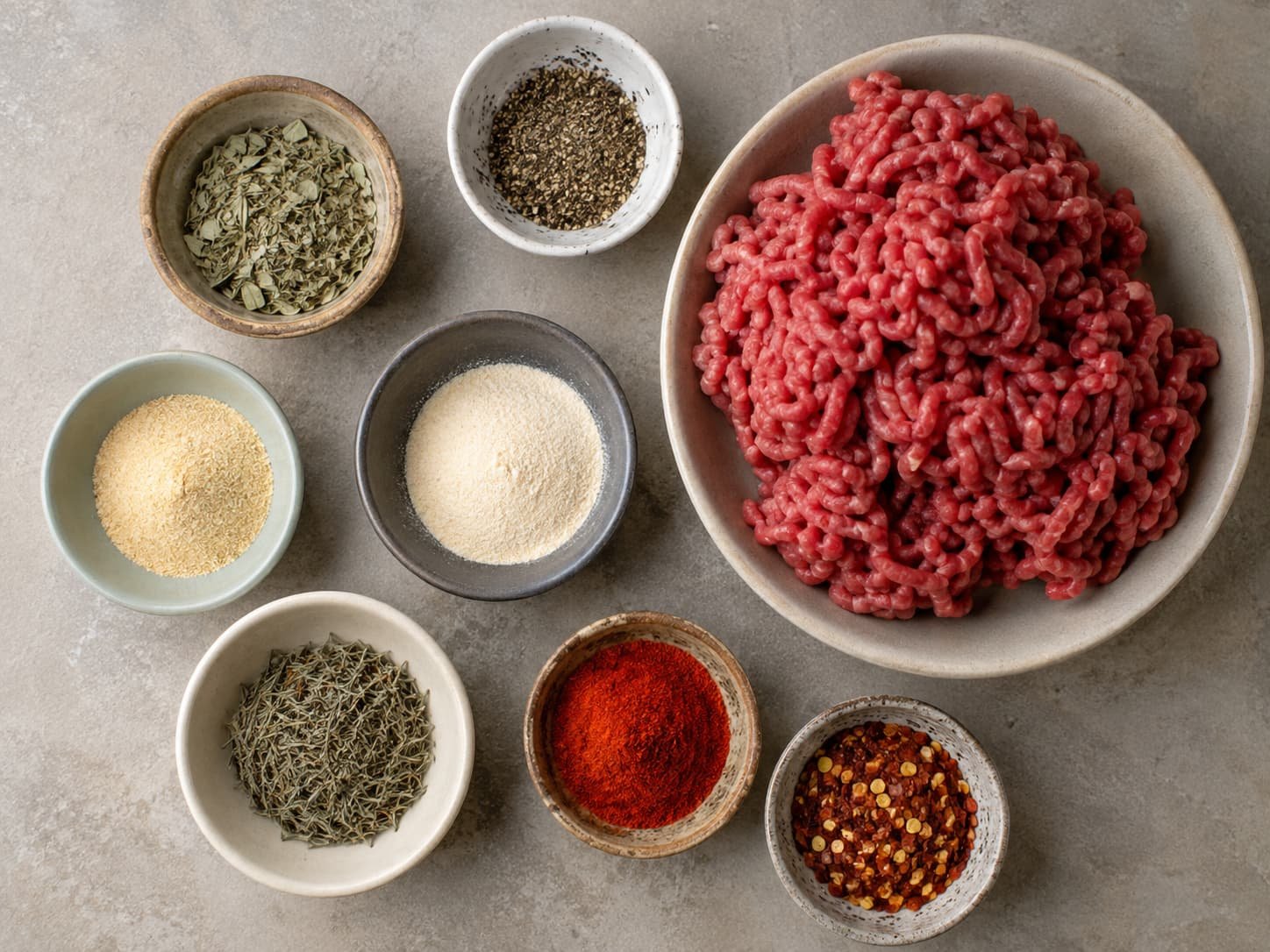
Breakfast-sausage seasoning varies, so there is no single spice combination that every homemade version must follow.
Common options include:
- Sage for an earthy herbal note
- Black pepper for mild warmth
- Garlic powder for savory flavor
- Onion powder for a mild onion note
- Salt for seasoning
- Thyme as an additional herb
- Red pepper flakes or another chile seasoning when some heat is wanted
Paprika and other herbs or spices may also be included depending on the desired flavor. Sweet ingredients are sometimes used in sweet-savory sausage styles.
These are seasoning options, not a fixed Daily Bite Recipes formula. Changing the combination or amount can change the final flavor.
Why Is Sage Commonly Associated With Breakfast Sausage?
Sage appears in many American-style breakfast sausage seasoning profiles. Its earthy, aromatic character can add a familiar herbal note to seasoned ground meat.
It is normally only one part of the overall flavor. Black pepper, garlic, onion, thyme, salt, and other seasonings can contribute as well.
A stronger sage presence may make its herbal character more noticeable, while a smaller amount may blend more subtly with the other ingredients.
Can Beef Breakfast Sausage Be Made Without Sage?
Yes. Sage is common, but it is not required.
A sage-free version can use other herbs and spices, although the resulting flavor will differ. Another herb should not automatically be treated as an exact replacement for sage, and there is no reason to assume a fixed substitution ratio without a verified formulation.
How Can the Ground Beef You Choose Affect Breakfast Sausage?
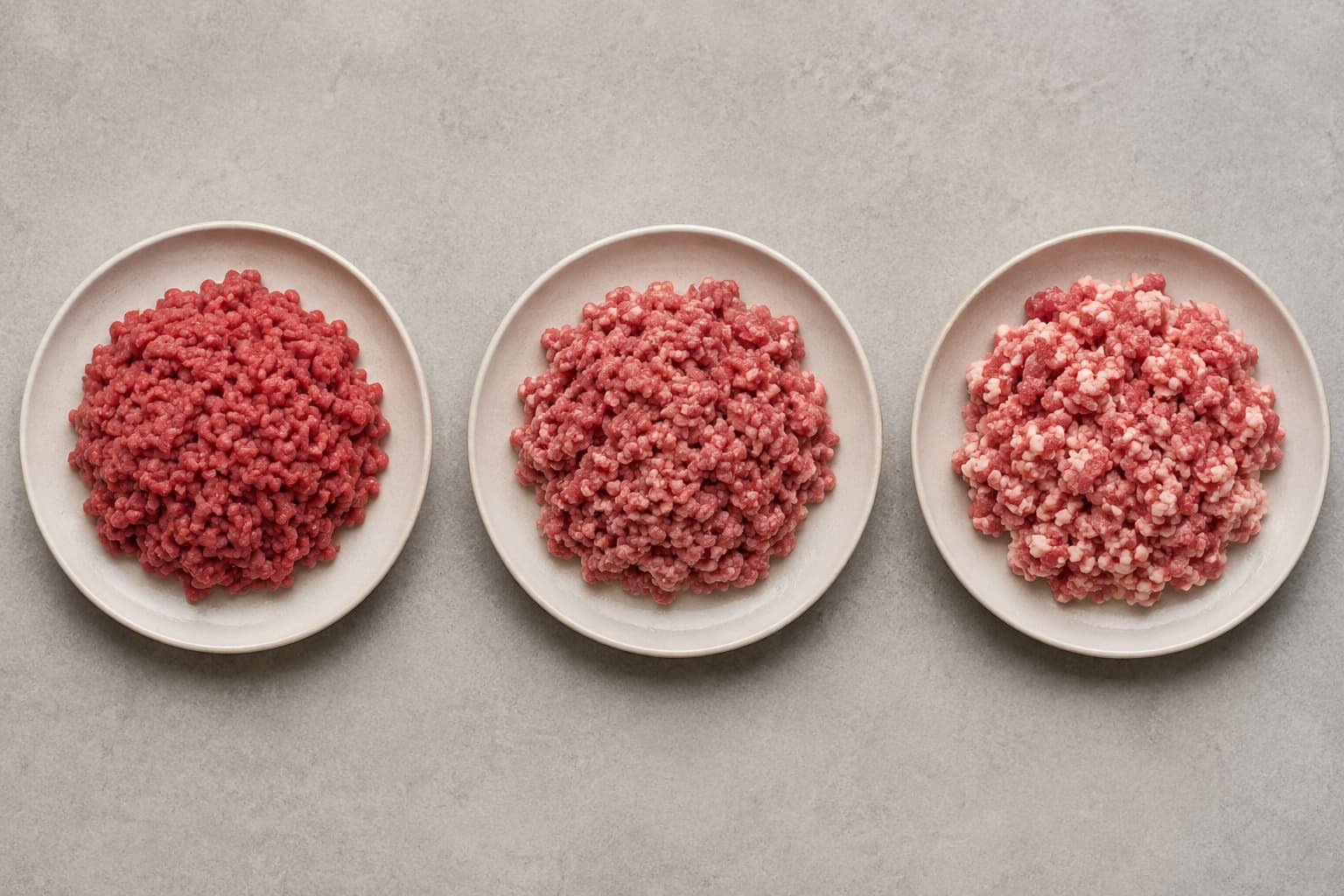
The ground beef you choose can influence how much fat is present and how the meat behaves during cooking. There is no single lean-to-fat ratio required for breakfast sausage.
Different published formulations use everything from relatively lean beef to mixtures containing more fat. The useful question is therefore not which ratio is universally “best,” but what the percentages mean.
What Does the Lean-to-Fat Ratio Mean?
Ground beef may be labeled 80/20, 85/15, 90/10, 93/7, or with another lean-to-fat ratio.
For example:
- 80/20 means 80% lean and 20% fat.
- 85/15 means 85% lean and 15% fat.
- 90/10 means 90% lean and 10% fat.
- 93/7 means 93% lean and 7% fat.
These numbers describe the composition of the ground beef. They do not tell you whether one package will automatically produce better sausage.
How May Leaner or Fattier Ground Beef Affect the Result?
Ground beef with a higher fat percentage contains more fat that may render during cooking. Leaner beef starts with less fat.
Fat content can influence the characteristics of cooked ground beef, but it does not determine the result by itself. Lean beef does not automatically produce dry sausage, and fattier beef does not guarantee a softer or more tender patty.
Cooking conditions, portion size, formulation, and final doneness can also influence texture.
For that reason, claims such as “80/20 is the best ground beef for breakfast sausage” are too broad.
Should You Make Patties or Crumbled Sausage?
Both forms are useful. The better choice depends mainly on how the seasoned beef will be served.
When Are Sausage Patties Useful?
Patties work well when individual portions are convenient. They can be used in breakfast sandwiches, served beside other breakfast foods, or divided among prepared meals.
Keeping patties reasonably similar in size and thickness can also make their cooking behavior more consistent. There is no need to prescribe one exact thickness.
When Are Crumbles More Practical?
Crumbled sausage is often easier to incorporate into another dish.
Possible uses include:
- egg dishes
- breakfast bowls
- wraps or burritos
- potato dishes
- casseroles
- other make-ahead breakfasts
Cooking the seasoned beef loose also removes the separate step of shaping individual patties.
What Matters When Preparing Beef Breakfast Sausage?
There is no single required preparation method.
One possible approach is to combine dry seasonings before adding them to the ground beef. This may make small amounts of stronger herbs and spices easier to distribute through the mixture.
The seasoning can then be mixed through the beef until reasonably distributed. If patties are being prepared, making portions of a similar size can help them cook more consistently. For crumbled sausage, the meat can instead be broken into smaller pieces during cooking.
Exact results can vary with the ground beef, portion size, equipment, heat level, and other ingredients.
Can Mixing and Patty Thickness Affect Texture?
Yes, although the exact effect can vary.
Mixing ground meat changes its structure as proteins are extracted and the mixture becomes more cohesive. With fresh sausage, extensive mixing may contribute to a firmer or more rubbery texture. There is generally little reason to work the meat more than needed to distribute the seasoning.
Patty thickness also influences how quickly heat reaches the center. Under similar cooking conditions, a thicker portion generally needs more time for its center to heat than a thinner one.
That is one reason cooking time alone should not be used to determine safe doneness.
How Should Beef Breakfast Sausage Be Cooked Safely?
Ground beef sausage should reach an internal temperature of 160°F (71°C) as measured with a food thermometer.
Color and cooking time alone are not dependable safety checks. Ground beef can brown before it reaches a safe temperature, and safely cooked ground beef can sometimes remain pink.
Can You Use a Skillet, Oven, or Air Fryer?
Yes. Patties can be prepared in a skillet, oven, air fryer, or another suitable cooking appliance. Loose sausage can also be cooked and broken into crumbles.
There is no universal cooking time for every method. Cooking speed can vary with:
- patty thickness
- portion size
- starting temperature
- cooking temperature
- appliance performance
- meat composition
- batch size
A cooking-time estimate may help with planning, but the internal temperature should determine safe doneness.
How Do You Check a Sausage Patty With a Food Thermometer?
Check the center of the thickest part of the patty.
For a thin patty, inserting the thermometer from the side can help place the sensing area closer to the center.
The target for ground beef is 160°F (71°C).
What Can Cause an Unexpected Texture?
Texture problems can have several possible causes. The lean-to-fat ratio, mixing, patty size, additional ingredients, and cooking conditions may all play a role.
Without knowing the exact formulation and cooking method, it is better to consider these as possible influences rather than diagnose one definite cause.
What May Contribute to a Drier Texture?
Ground-beef composition may affect the result, but lean meat should not automatically be blamed for dryness.
Cooking conditions can influence moisture loss and texture, while patty size and thickness affect how heat moves through the meat.
Because these factors interact, a statement such as “the sausage is dry because it was overcooked” may be too certain without knowing how it was prepared.
Why Might Patties Become Dense or Difficult to Handle?
Mixing ground meat with salt can make the mixture more cohesive as meat proteins are extracted. Extensive mixing may contribute to a firmer texture in fresh sausage patties.
Additional ingredients can also change how the mixture handles and cooks, depending on what is added and how much is used.
There is therefore no single explanation for every patty that feels dense, sticky, loose, or difficult to shape.
How Can Beef Breakfast Sausage Fit Into Meal Prep?
Cooked patties or crumbles can be prepared ahead and divided into portions for later breakfasts.
Patties may be convenient for sandwiches or plated meals, while crumbles can be added to eggs, bowls, wraps, potatoes, or other dishes.
If portions will not be eaten within the recommended refrigerator-storage period, freezing them can be more appropriate than keeping the entire batch refrigerated for the week.
For broader breakfast planning, see Best Meal Prep Breakfasts for the Whole Week.
How Should Cooked Sausage Be Stored, Frozen, and Reheated?
Cooked fresh sausage can generally be refrigerated for 3 to 4 days at 40°F (4.4°C) or below.
Food that will not be eaten within that period can be frozen rather than kept refrigerated longer.
How Long Can Cooked Sausage Stay in the Refrigerator?
USDA guidance gives 3 to 4 days for cooked fresh sausage stored at 40°F (4.4°C) or below.
Perishable leftovers should generally be refrigerated within 2 hours. If the surrounding temperature is above 90°F (32.2°C), that period is reduced to 1 hour.
These are food-safety guidelines, not guarantees about how long the meat will maintain a particular flavor or texture.
Can Raw and Cooked Sausage Patties Be Frozen?
Yes.
USDA lists approximately 1 to 2 months for uncooked fresh sausage and 2 to 3 months for fresh sausage after cooking as freezer guidelines for best quality.
These are quality recommendations rather than safety expiration dates. Food kept continuously frozen at 0°F (-17.8°C) or below can remain safe longer, although quality may decline with extended storage.
Raw patties can be portioned and frozen before cooking. Cooked patties or crumbles can also be divided into portions before freezing.
Freezing and reheating may change texture or moisture, so frozen sausage should not be expected to have exactly the same characteristics as freshly cooked meat.
How Should Cooked Sausage Be Reheated?
USDA recommends reheating leftovers to an internal temperature of 165°F (73.9°C).
A microwave, stovetop, oven, or another suitable method can be used. The required time will vary with the appliance, portion size, amount of food, and whether the sausage starts refrigerated or frozen.
When using a microwave, uneven heating can occur. Repositioning or rotating food as appropriate and checking the temperature in more than one place can help identify cooler areas.
How Does Beef Sausage Compare With Pork and Chicken Breakfast Sausage?
Different meats provide different base flavors and can behave differently during cooking. They should not be assumed to produce identical results even when similar seasonings are used.
Beef vs Pork Breakfast Sausage
Beef and pork provide different base flavors, while fat content varies with the specific ground-meat product.
Both can use seasonings associated with breakfast sausage, including sage, black pepper, garlic, onion, and other herbs or spices.
Neither should automatically be described as healthier or better. Nutrition depends on the specific meat, formulation, fat content, ingredients, and serving size.
Beef vs Ground Chicken Breakfast Sausage
Ground chicken can also be prepared with breakfast-sausage seasonings, but its composition and flavor differ from beef.
Those differences can affect cooking behavior and texture, so chicken should not be treated as a guaranteed one-for-one substitute for beef.
For more information about the poultry version, see Ground Chicken Breakfast Sausage.
Is Beef Breakfast Sausage Automatically High in Protein?
No. Beef provides protein, but that does not mean every homemade sausage should automatically be labeled high protein.
The protein content depends on the specific formulation and serving size. Without a defined recipe, serving amount, and reliable nutrition calculation, assigning a protein value would be speculative.
For an informational guide like this one, it is more accurate to say that beef provides protein rather than give an unverified number or make a specific high-protein claim.